Rubber Gym Flooring Tiles for Coaching and PT Studios

A coaching studio lives or dies on its floor. It is the one surface every client touches, the one component that absorbs dropped dumbbells, jump landings and hundreds of weekly sessions, and the one thing a landlord or a downstairs neighbour will complain about first. Shock-absorbing rubber tiles solve the three problems at once: they protect joints, they protect the substrate, and they keep structure-borne noise inside your own four walls.
Why shock-absorbing rubber tiles belong in a coaching studio
A loaded barbell returned to the ground releases its energy somewhere. Without a resilient layer, that energy goes straight into the screed, into the building structure and into the rooms below. A rubber tile spreads the impact over its whole surface and converts most of it into heat inside the granulate, which is why a well-specified floor turns a heavy deadlift session into a dull thud rather than a shock wave through the ceiling.
The second reason is durability. Rubber granulate bonded under pressure keeps its shape under repeated point loads, resists abrasion from sled work and shoe grit, and does not powder under UV exposure the way cheaper foam products do. For a studio owner this is a fixed-cost decision taken once, not a consumable replaced every season.
The third reason is commercial. Clients notice a floor. A continuous, flat, quiet surface reads as a professional facility; a patchwork of mats reads as a garage. In a market where personal training studios compete on perceived quality, the floor is one of the cheapest credibility upgrades available.
Protecting joints, equipment and the substrate
Repeated landings on concrete load the ankle, knee and lumbar spine far more aggressively than the same landings on a resilient surface. A rubber floor lengthens the deceleration phase by a few milliseconds, and that is enough to flatten the peak force curve considerably. For group formats built on jumps, box work and plyometrics, that is the difference between a sustainable weekly volume and a steady trickle of overuse complaints.
The same layer protects your assets in the other direction. Machine feet stop denting the substrate, dropped plates stop chipping the finish, and racks stop scoring lines into the screed each time they are repositioned. If your studio sits inside a leased unit with a timber or resin floor, this is usually the clause that decides whether you get your deposit back.
Traction matters as much as cushioning. A surface that is too soft costs stability under heavy squats and pressing; a surface that is too hard gives nothing back on landings. Matching thickness to the actual activity, zone by zone, is the whole craft of specifying a studio floor.
One product family, indoors and outdoors
Rubber tiles are not confined to the training room. The same granulate technology is used on terraces, poolside walkways, rooftop training areas and outdoor functional zones, because it is unaffected by rain, frost cycles and sunlight. A studio that runs summer sessions on a terrace or in a courtyard can carry the same surface outside and keep one consistent look across the whole facility.
Where an artificial turf strip is preferred for sled pushes and prowler work, the two systems sit side by side at similar heights, so the transition between a rubber zone and a turf lane stays flush and safe. Plan the zoning on paper before ordering: it is far cheaper to move a boundary in a drawing than to recut tiles on site.
Installation and maintenance
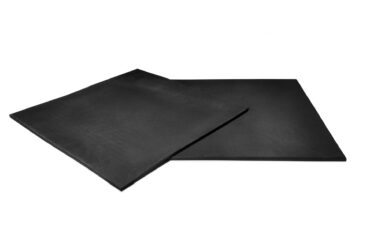
Interlocking puzzle tiles are the reason this category has become the default for small and mid-sized studios. They are laid loose, edge to edge, without adhesive, without fixings and without specialist tools. A single room can typically be turned around outside opening hours, which for a working studio is the difference between a floor upgrade and a week of lost revenue.
The substrate does the hard work: it must be clean, dry and flat, because a resilient tile follows every hollow underneath it rather than bridging it. Cutting is done with a sharp blade against a straight edge, and edge ramps finish the perimeter where the floor meets a doorway or a lower surface.
Maintenance is deliberately unglamorous. Sweep or vacuum daily to remove grit, which is the only real enemy of the surface, and damp mop with a neutral detergent. Avoid solvents and strongly alkaline cleaners, which attack the binder over time. A tile that is damaged in one spot is lifted and swapped individually, which is a structural advantage of a modular floor over a bonded roll.
Choosing thickness, surface and finish
Thickness follows the load, not the budget. Thin puzzle tiles are made for cardio zones, functional areas and studio spaces where nothing heavy is dropped. Mid-range thicknesses cover free weight zones and general strength floors. Thick tatami-type tiles belong under martial arts, floor work and grappling, where the fall height rather than the barbell drives the specification.
| Tile | Thickness | Typical zone |
|---|---|---|
| Interlocking puzzle tile, 100 x 100 cm | 7 mm | Cardio, functional and studio areas, light equipment |
| Wood-effect tile, 100 x 100 cm | 20 mm | Free weight zones, PT floors, showroom-grade finish |
| Puzzle tatami tile | 50 mm | Martial arts, grappling, floor and fall work |
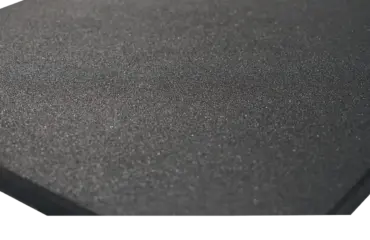
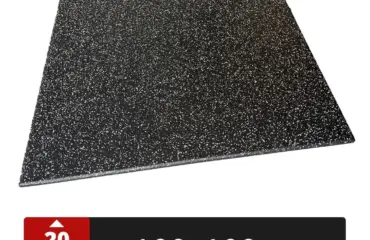
On finishes, the practical choice is between a plain speckled surface, a wood-effect surface for studios that want a warmer, less industrial room, and an artificial turf lane for sled and sprint work. Fire behaviour is a specification item, not a detail: several tiles in this range carry a Cfl-s2 classification with an A+ VOC rating, which is the combination public-access venues are usually asked to document. Always take the classification from the technical data sheet of the exact reference you order, including the smoke index, and keep it in your compliance file.
A good starting point is the full rubber gym flooring tile range, with the wood-effect tiles for client-facing studio rooms and the light oak 20 mm tile as the reference model in that family. Where a building requires impact sound to be handled under the finished surface, an acoustic underlay is added below the tiles rather than compensated for with extra thickness on top.
Frequently asked questions
Can rubber tiles be laid over an existing floor?
Yes, provided the existing floor is sound, flat, dry and free of loose material. Interlocking tiles are laid loose over screed, tiles, resin or timber. What they cannot do is correct an uneven substrate: every hollow underneath will eventually show through as a soft spot or a lifting joint.
How much noise reduction should I expect?
That depends on the tile, the substrate and the building, so no single figure applies to every project. What is predictable is the mechanism: a resilient layer plus, where needed, an acoustic underlay under it. If your lease or your local authority sets a numerical requirement, send it to us with the building details and we will specify against it.
Do the tiles need to be glued down?
Interlocking tiles usually do not. Adhesive is used mainly in high-traffic entrances, on ramps, or where wheeled equipment is dragged across the surface daily. Bonding is a decision to take before ordering, because it changes both the substrate preparation and the removal cost at the end of the lease.
Are they suitable for outdoor training areas?
Yes. Rubber granulate tiles are used on terraces, poolside areas and outdoor functional zones. Outdoors, drainage under the surface and a stable, compacted base matter more than they do indoors, and the tile reference should be selected for external use rather than simply carried over from the indoor room.
Specifying your studio floor
A studio floor is specified zone by zone: activity, load, drop height, room use and building constraints. Send us the floor plan with the surface areas and the intended use of each zone, and you will get back a tile-by-tile specification with quantities, thicknesses and the technical documents that go with them. Start with a quotation request and we will work from your actual dimensions rather than from a catalogue average.
Réalisations documentées
- Dalles et sols sportifs : livraisons documentées – plusieurs chantiers
- Sol sportif extérieur, square Georges-Vallerey – Taverny (95)
Sources et références
- Arrêté du 19 avril 2011 – étiquetage des produits de construction ou de revêtement de mur ou de sol sur leurs émissions de polluants volatils (Légifrance)
- Ministère de la Transition écologique – étiquetage des produits de construction : classes d’émission A+ à C