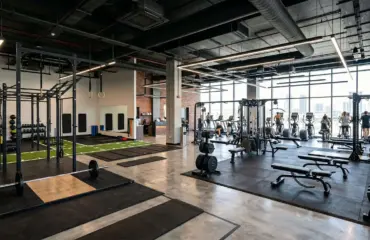
How to Choose Non-Slip Sports Flooring for a Gym

Choosing non-slip sports flooring for a strength room is a decisive step. It is what keeps users safe and what makes training comfortable and effective, and it is also the item operators most often decide last, after the equipment budget has been spent. Here are the points that actually matter when you specify the surface.
1. Type of surface
A strength room needs a hard-wearing surface capable of taking heavy traffic and frequent impact.
- Rubber and vinyl surfaces are the usual recommendation, for their durability and their resistance to cleaning chemicals.
- PVC tiles and vinyl rolls are also excellent choices, easy to maintain and highly resistant to wear.
Our rubber gym flooring tiles and rubber flooring rolls cover both approaches, tile by tile for zoning or in continuous rolls for large open areas.
2. Non-slip properties
The surface has to have a genuine non-slip finish so that users do not slide during exercise, and this matters most in rooms where humidity affects grip.
Look for:
- a resilient surface with a non-slip texture;
- well-finished joints, which minimise the risk of trips and falls.
3. Thickness and wear layer
The thickness of the surface is a key factor.
- A thicker wear layer gives better protection against abrasion and impact, which is critical in a strength room where weights are dropped.
- Natural and synthetic rubber surfaces generally offer high resistance and longer service life.
Zone the thickness rather than applying one specification everywhere: the lifting areas need more than the circulation routes. Our weightlifting rubber tiles are made for the drop zones.
4. Acoustic insulation and comfort
A good floor also has to provide acoustic insulation, to reduce impact noise and keep the atmosphere in the room bearable.
- Rubber surfaces and polyurethane mats give good acoustic performance while remaining easy to clean.
- Choose surfaces with anti-fatigue properties, particularly where members and staff spend long periods standing.
Where there are occupied rooms below, add an acoustic underlay under the finish rather than relying on the surface alone.
5. Ease of maintenance and cleaning
Ease of maintenance is not a detail.
- Vinyl and epoxy surfaces are usually simpler to clean and resist staining well, which is essential for keeping a strength area hygienic in daily use.
6. Appearance and colours
Function comes first, but appearance plays a part too.
- A range of finishes and colours is generally available, which makes it possible to create a motivating environment.
- Whether you use floor tiles, mats or wall protection, the decorative choice adds value to the space and helps members read the zoning.
7. Installation options
Finally, think about how the surface will be laid.
- Interlocking or bonded systems each have their advantages depending on the project.
- Check that the product is compatible with the screed or the underlay you intend to use.
Frequently asked questions
Tiles or rolls?
Tiles suit zoned rooms and make local replacement easy. Rolls give fewer joints over a large open area. Many facilities use both, tiles in the lifting zones and rolls elsewhere.
What thickness for a free-weight area?
More than for the machine line, because the surface has to absorb dropped plates. The exact figure depends on the loads and the substrate, so it is specified project by project rather than from a catalogue.
Does the floor need an underlay?
If there are occupied spaces below, yes. An acoustic underlay is what stops impact noise transferring through the structure; the finish alone will not do it.
How is the surface cleaned?
With a neutral cleaner suited to the material. Aggressive solvents shorten the life of a rubber surface, so the cleaning protocol should be agreed at specification stage.
Specifying your floor
With these points settled you can choose the right surface for your strength room. Whether you go for PVC tiles, rubber or vinyl, the specification has to match your own requirements for safety, durability and appearance. Send us the area, the substrate, the loads and what sits below the room, and we will specify the floor zone by zone. Request a quote for a costed proposal.
Réalisations documentées
- Dalles et sols sportifs : livraisons documentées – plusieurs chantiers
- Sol sportif extérieur, square Georges-Vallerey – Taverny (95)
À lire aussi sur le même thème
- How to Choose a Rubber Gym Flooring Supplier
- How Speckled Rubber Gym Flooring Tiles Transform Your Gym
- Rubber Flooring for Kennels, Veterinary Clinics and Stables
- How to Choose Rubber Flooring Density for Shock Absorption
- Rubber flooring for shops, hotels and restaurants: comfort, safety, design and compliance