Where to Buy a Professional CrossFit Rack
A professional CrossFit rack is bought from a specialist B2B supplier of training equipment, not from a general sports retailer. What separates the two is the steel section and gauge, the certification of the structure to EN ISO 20957-1 class S, the anchoring solution, the warranty and the ability to configure the rig around your floor plan. Price alone tells you very little.
A rack is the backbone of a training floor. Everything else arranges itself around it: barbell work, pull-ups, rig-mounted accessories, storage, traffic flow. Getting the purchase right therefore matters more than for almost any other item in the room. Here is how commercial buyers approach it.
Where professional racks actually come from
Specialist B2B equipment suppliers
This is the normal route for a gym, a box, a hotel, a club or a public facility. A specialist supplier carries several ranges, quotes a configuration rather than a catalogue item, and takes responsibility for delivery, anchoring and after-sales. You get a technical drawing before you commit and spare parts afterwards.
Manufacturers selling direct
Some manufacturers sell direct. That can work well for a single standard rack. It works less well for a full floor, where you need one point of contact covering rig, flooring, barbells, storage and installation rather than four separate orders.
General online marketplaces
Marketplaces list a great deal of equipment described as professional. Very little of it is certified for supervised commercial use, and the listing rarely states the steel section, the wall thickness or the standard the structure meets. For a facility open to the public, that missing information is the whole risk.
What to verify before you order
- Standard. Indoor equipment for professional use is certified to EN ISO 20957-1 class S. Ask for the document, not the claim.
- Steel section and wall thickness. These two figures decide the rigidity of the rig under kipping and dropped loads. They should be on the quotation.
- Anchoring. A freestanding rig and a floor-anchored rig are not the same product. Confirm which one you are buying and what the slab has to provide.
- Configuration. A rig should be drawn to your room, not the other way round. Ask for a layout before ordering.
- Warranty and spare parts. Light In Fitness warrants its steel structures for up to 20 years, and its stainless steel structures for life. Ask any supplier for the equivalent commitment in writing.
- Accessories and future extension. Check that uprights accept the attachments you will want in two years, and that the range can be extended rather than replaced.
Matching the rack to the use
| Use case | Suitable structure | What drives the choice |
|---|---|---|
| Barbell work, small footprint | Squat rack or power rack | Stability under maximal loads, safety catches, compact footprint |
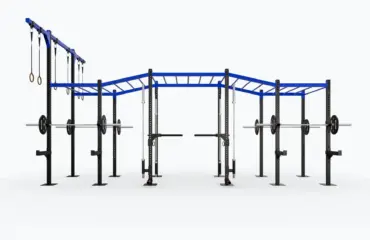
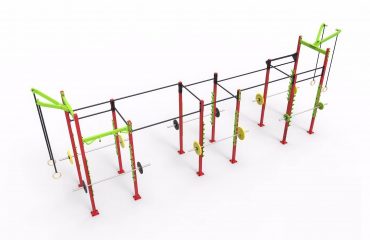
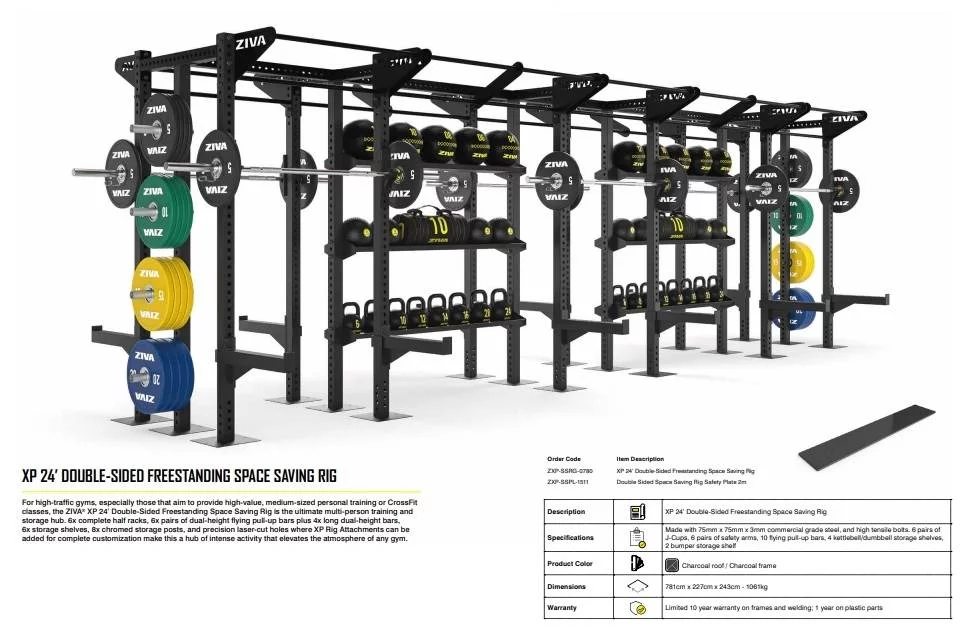
| Group training, box or functional area | Freestanding rig with multiple stations | Number of simultaneous users, pull-up bar spacing, accessory rails |
| Limited floor area | Wall-mounted rig | Wall load-bearing capacity, depth available, clearance in front |
| Competition or timed formats | Rig configured for the format | Station count, station spacing, flooring under drop zones |
Our CrossFit rigs and squat racks and power racks cover these cases, and the CrossFit and HYROX cages range covers competition formats.
Frequently asked questions
Can I buy a professional rack for home use?
Equipment certified class S is designed for supervised commercial use. It can be installed anywhere the floor and ceiling allow, but it is sized and priced for a facility, and the anchoring requirements are those of a commercial installation.
How much floor area does a rig need?
It depends entirely on the number of stations and on the clearance you leave for barbell work and pull-ups. That is precisely why a layout drawing comes before a price.
Is a freestanding or an anchored rig better?
Anchored is the reference solution when the slab allows it. Freestanding rigs exist for leased premises or slabs that cannot be drilled, and they are built heavier to compensate.
Getting a quotation
Send us the dimensions of the room, the number of simultaneous users you plan for and the disciplines trained. You get back a rig layout, a specification and a costed proposal. Request a quote to start.