Outdoor CrossFit Cage: Unlock the Potential of Your Open-Air Training Area
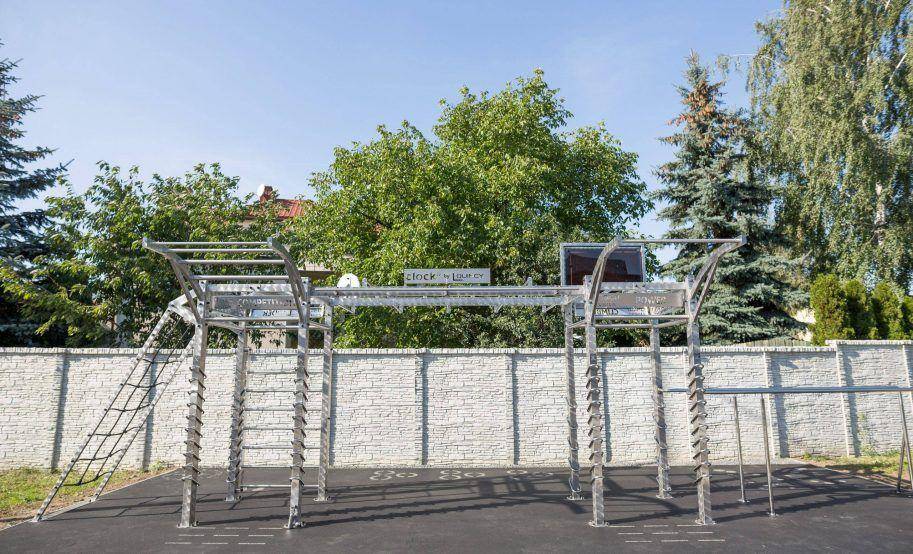
Open-air training has stopped being a seasonal extra. Clubs that opened a terrace kept it, hotels discovered that an outdoor training area photographs better than a windowless basement gym, and local authorities now treat free-access fitness structures as ordinary public amenities. At the centre of all these projects sits the same object: a steel frame, anchored to a slab, carrying pull-up bars, monkey bars, rope anchors, rings and dip stations, and engineered to stay outside permanently. That is an outdoor CrossFit cage.
This guide is written for the person who signs the purchase order rather than the person who trains on it: box owners, gym managers, hoteliers, campsite directors, sports facility officers, schools, rehabilitation centres and developers. It covers what the structure delivers, what it changes for your members, and the criteria that separate a rig that lasts fifteen winters from one that starts weeping rust in its second season.
What an outdoor CrossFit cage is, and what it is not
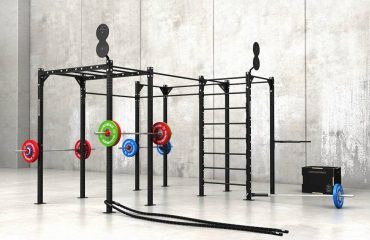
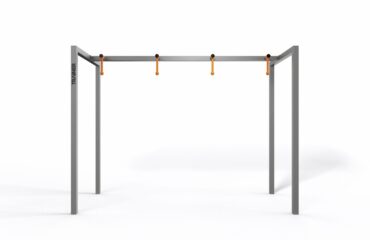
An outdoor CrossFit cage is a modular structure built around uprights and cross-beams. Bars, rigs, targets and anchor points are bolted onto that skeleton, which means the same footprint can be configured for pull-ups and muscle-ups, for rope climbing, for suspended training, for sled corridors or for a full obstacle circuit. It is a functional training platform, not a single-exercise machine, and that versatility is precisely why it works so well in shared or public spaces.
What it is not is an indoor rig moved outside. Outdoor adult fitness equipment falls under EN 16630, the European standard for permanently installed outdoor fitness equipment, which governs structural strength, entrapment, fall spaces and installation. Indoor equipment specified to EN ISO 20957-1 class S is designed for a controlled environment and will not satisfy an outdoor specification. If a supplier offers you the same product for both settings without changing anything, that is your first warning sign.
The physical case: one structure, a complete training session
The strongest operational argument for an outdoor cage is training density. A single structure supports full-body work using body weight and light accessories: pulling, pushing, carrying, jumping, climbing and core work all happen within a few square metres. Several users train simultaneously on different stations, which is a throughput figure no single machine can match.
Because the load is the user’s own body, progression is continuous rather than stepped. A beginner works assisted rows and hangs on the low bars; an advanced athlete works muscle-ups and rope climbs on the same frame an hour later. For an operator, that means one capital item serving the entire membership instead of a rack of machines each serving one population.
The conditioning effect is broad: strength and muscular endurance from the bar work, cardiovascular load from circuit formats, and mobility from the climbing and suspension stations. Training outdoors adds variable ground, wind and temperature, all of which raise the physiological demand of an otherwise identical session.
Wellbeing and retention: the argument that keeps members
Operators tend to buy outdoor structures for the training and keep them for the retention. Exercise outdoors is consistently associated with better mood and lower perceived stress than the same session performed indoors, and members say so in surveys long before they say it in cancellation forms.
There is also a visible progression effect. Completing a rope climb or a first strict pull-up in front of other people is a milestone that a treadmill cannot offer. That sense of achievement, repeated weekly, is one of the more reliable predictors of a member staying past their sixth month. For hotels, campsites and residences the same structure works as an amenity: it is used, it is photographed, and it costs nothing to run once installed.
For rehabilitation centres and accessible facilities, the outdoor setting removes the intimidation of a crowded weights room. Light and air do a surprising amount of work in getting hesitant users to start.
Availability: why an outdoor cage earns its footprint
Indoor floor area is the most expensive resource an operator owns. An outdoor cage sits on ground that generates no revenue at all: a courtyard, a strip of car park, a lawn beside the pool, a corner of a municipal park. It extends capacity without extending the building, and it does so without the ventilation, lighting and heating costs attached to every indoor square metre.
It also absorbs peak demand. Class formats can be pushed outside at busy hours, freeing the main floor. For campsites and hotels, the structure is available from first light to last, with no staffing requirement and no supervision cost beyond routine inspection.
The community effect
Functional training outdoors is inherently social. Sessions run in groups, stations rotate, and users watch each other work. That visibility does two things: it holds people accountable to a routine, and it makes the structure a recruiting tool. A busy outdoor rig on a visible frontage advertises the facility continuously to everyone who walks past it.
Municipalities exploit this deliberately. A street workout or outdoor CrossFit area placed on a walking route converts passers-by into users, reaches populations that never enter a paid facility, and does it without a subscription barrier. Clubs use the same logic on a smaller scale by running free open-air sessions as an acquisition channel.
Choosing the right outdoor CrossFit cage
Four criteria decide whether a purchase is a fifteen-year asset or a recurring maintenance line.
Corrosion protection before everything else. Outdoors, the finish matters more than the steel section. Hot-dip galvanising, or stainless steel in coastal and chlorinated environments, is what keeps a structure serviceable. Powder coating applied over untreated steel looks identical on delivery and fails at every bolt hole within a few seasons. Ask what is underneath the paint, and ask for the warranty in writing.
Structural specification and installation. The frame has to carry dynamic loads from users swinging, dropping and landing, and it has to do so anchored into a foundation designed for the job. Confirm that the equipment is supplied to EN 16630 and that the supplier provides anchoring drawings and foundation requirements rather than leaving them to your contractor.
Configurability. The advantage of a modular cage is that the station mix can be matched to the population using it. A cross-training box wants high bars, rope anchors and rig extensions; a campsite wants low bars, accessible stations and a gentler progression. Look at the full range of professional CrossFit and Hyrox cages before fixing a layout, and check that extensions can be added later on the same frame.
Capacity against footprint. Count simultaneous users, not stations. A two-level structure such as the Clock 24 two-storey outdoor functional rig puts a large number of training positions on a small ground area, which is decisive when the available surface is a courtyard rather than a field.
Surfacing and safety: the half of the project people forget
The structure is only part of the specification. Anything with a raised training position needs an impact-absorbing surface underneath it, sized to the fall space defined by the equipment. Bonded rubber, rubber tiles or artificial turf systems are the usual answers; compacted gravel and bare concrete are not. Budget the outdoor sports flooring at the same time as the cage, because retrofitting it later costs more and usually means lifting anchors.
Beyond surfacing, three things belong in the specification: non-slip bar finishes, no entrapment or shear points anywhere on the frame, and a documented inspection routine. Fixings work loose outdoors far faster than indoors, and a scheduled quarterly check is the cheapest risk control available to any operator.
One point worth stating plainly: children’s play equipment is governed by EN 1176-1, and its impact-absorbing surfacing by EN 1177. Those are different standards from EN 16630 and they are not interchangeable. If a project mixes an adult fitness area with a children’s play area, the two zones are specified separately.
Frequently asked questions
Can an outdoor CrossFit cage stay outside all year?
Yes, provided it was specified for it. Hot-dip galvanised or stainless steel frames are designed for permanent exposure. What shortens service life is not the weather but an inadequate finish and neglected fixings.
What surface do we need underneath?
An impact-absorbing surface covering the fall space defined by the equipment. Rubber tiles, bonded rubber or an artificial turf system are the standard solutions. The required thickness depends on the free height of fall of the stations you install, so it is determined once the layout is fixed.
How many people can train on one structure at once?
It depends entirely on the configuration, which is why capacity should be discussed before a model is chosen. A compact single-bay rig suits a small group; a multi-bay or two-level structure supports a full class rotating through stations.
Is it suitable for a public, unsupervised installation?
That is one of its main uses. Municipal and residential installations are unsupervised by design, which raises the requirement on standards compliance, anchoring, surfacing and inspection rather than removing it.
Can the configuration be extended later?
On a modular frame, yes. This is worth confirming in writing at the quotation stage, because it lets a project start at one budget and grow with usage instead of being replaced.
Turning ground into a training area
An outdoor CrossFit cage is one of the few purchases in this sector that improves three things at once: the training on offer, the capacity of the site, and the visibility of the facility. It converts ground that currently produces nothing into a space members use, and it does so with no running cost beyond inspection.
The projects that go well are the ones specified properly from the start: the right corrosion protection, an EN 16630 compliant structure, surfacing sized to the equipment, and a station mix matched to the people who will actually use it. Tell us the surface you have, the population you serve and the training you want to run, and we will put a configuration and a figure against it. Request a quote and we will work from your site plan.