Artificial Turf for CrossFit: Choosing the Right Gym Surface
Artificial turf has become one of the most requested surfaces in CrossFit and cross-training facilities. It grips, it absorbs the punishment of sled work and it still looks presentable after months of heavy daily traffic. For a commercial box, that combination is exactly what a training floor has to deliver.
Why artificial turf suits CrossFit training
CrossFit places a very particular demand on flooring. Athletes sprint, drag and push sleds, drop implements and change direction on the same few square metres, session after session. A synthetic turf lane answers all of it at once: the fibres give consistent traction for pushing and pulling, the backing keeps the lane flat under load, and the surface is soft enough to reduce abrasion and impact when an athlete goes down.
Grip is the decisive point. Sled and prowler work only makes sense on a surface that does not slip under the shoe and does not shift under the sled. Turf gives coaches a predictable lane they can programme around, which is far harder to achieve on a bare rubber floor.
Durability and running costs
Synthetic turf is a long-term investment rather than a consumable. It resists tearing, does not need watering, and is maintained with nothing more demanding than regular brushing and vacuuming. Over the life of a box, that low maintenance burden usually outweighs the initial price difference against cheaper coverings, and it frees your staff to coach rather than to repair the floor.
Because turf is laid as a defined lane, wear is concentrated where you decide it should be. When a lane finally reaches the end of its service life, it is replaced on its own without touching the rest of the training area.
Formats: from a single lane to a full functional zone
Light In Fitness supplies CrossFit turf both as ready-to-lay tracks and as turf sold by the square metre. Short-pile curled tracks are available in 10 m and 20 m lengths and in 1 m and 2 m widths, in green, black, blue and red, so a lane can be matched to the branding of the room. A narrower 15 m sled lane suits facilities that are short on floor space.
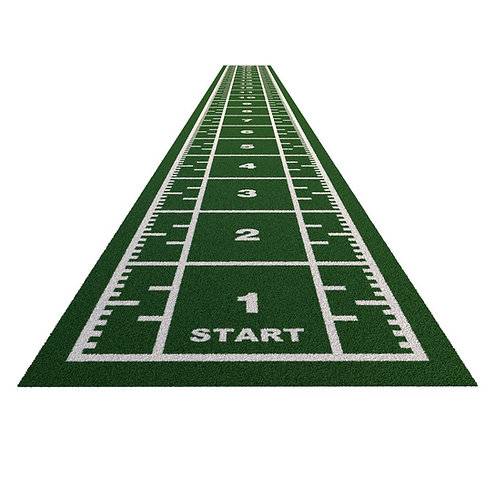
For competition-style programming, numbered sprint lanes carry metre-by-metre graduation along the track, in two, four or eight lane layouts, and can be produced with custom marking and your own logo. Hybrid rubber and turf tiles are also available where the same zone has to work indoors and outdoors. The full range is grouped under our artificial turf tracks category.
Integrating turf with the rest of the box
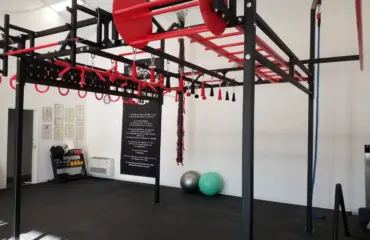
A turf lane is rarely specified on its own. It usually runs alongside a rig, a lifting platform and rubber flooring, and the three have to be planned together so that heights match and the lane does not sit proud of the surrounding floor. If you are laying out the room from scratch, look at the lane position and the CrossFit and Hyrox rigs at the same time rather than one after the other.
A common configuration places a 20 m track along the longest free wall, leaving clear run-off at both ends. The 20 m x 2 m black curled track is the version most often chosen for that layout because the darker fibre keeps its appearance under chalk and shoe marks.
Frequently asked questions
Can artificial turf be laid over an existing floor?
In most gyms it is laid on top of a flat, clean and dry existing surface. What matters is that the sub-floor is level: a lane laid over an uneven base will show every defect once athletes start sprinting on it.
How is CrossFit turf maintained?
Brushing to lift the fibres and vacuuming to remove dust and chalk covers normal use. No watering and no specialist machinery are required.
Is turf suitable for an outdoor training area?
Yes, provided the product is specified for it. Hybrid tiles combining a rubber base with a turf top layer are designed for indoor and outdoor use, which makes them the usual answer for terraces and outdoor functional zones.
Which width should I choose?
A 1 m lane is enough for single-athlete sled work. A 2 m lane allows two athletes side by side and is the standard choice for class formats and competition-style sessions.
Planning your CrossFit turf
The right lane depends on the length available, the number of athletes you run at once and the way the zone connects to your rig and platforms. Send us the dimensions of the room and we will come back with a specification and a costed proposal: request a quote.