Cross Training Rigs: A Buyer's Guide for Gyms and Boxes
Une cage de cross-training regroupe traction, dips, suspension et supports de barre sur une seule ossature. Sa capacité d'accueil dépend du linéaire installé, pas de la surface du local. L'ancrage au sol et le revêtement sous les zones de levée conditionnent la sécurité d'usage.
A cross training rig is the single piece of equipment that decides how a functional training room actually works. It gathers pull-up bars, dip stations, suspension anchors and barbell supports on one frame, so that a group of athletes can train side by side without moving equipment between exercises. For an operator opening a box, refitting a club or fitting out a hotel training area, the rig is usually the first line on the specification and the one that constrains everything else.
This guide sets out what the structure does, what it changes on the floor, and the three questions that decide whether the installation works: how much rig you need, how it is anchored, and what goes underneath it.
What a cross training rig is
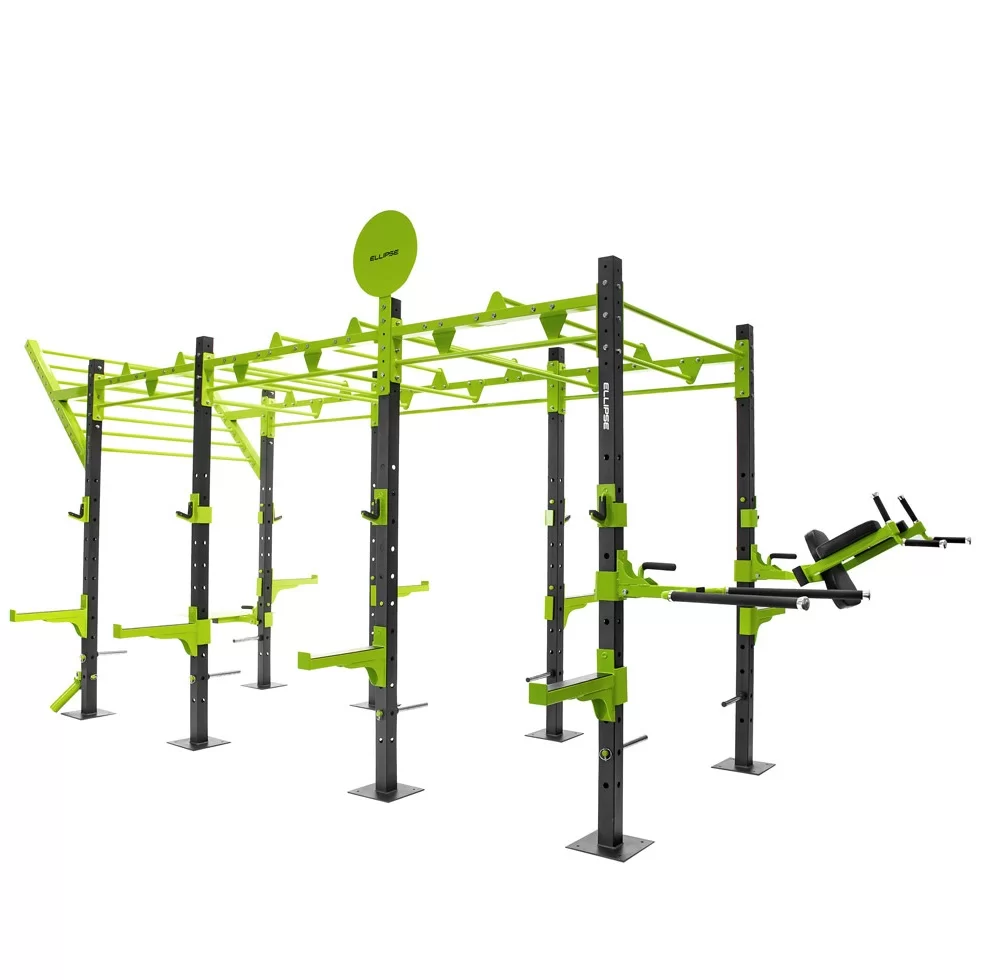
A rig is a modular steel structure built from uprights and crossbeams, drilled at regular intervals so that accessories can be fixed at different heights. The frame carries the anchor points; the accessories decide what the station does. That is the whole idea: one structure, a very large number of configurations.
Because the uprights are repeated along a run, the same structure serves several users at once. A rig can be wall-mounted, freestanding, arranged as a single line or built as a closed island in the middle of the room, and it can be extended later by adding bays rather than replacing what is already installed.
What this buys a facility is range. Strength work, conditioning, mobility and suspension training all happen on the same footprint, and the room can change what it programmes without buying new equipment.
What the structure delivers on a commercial floor
Variety of exercises. One rig supports a very wide catalogue of movements, which keeps class programming fresh and lets coaches target different muscle groups without redesigning the room. For members, a floor that offers strength, endurance and mobility work in the same place is a floor they keep coming back to.
Strength and coordination. The rigidity of the structure is what allows loaded work with confidence. Training on it builds functional strength and coordination, and functional patterns reinforce the muscles used in everyday activity, which helps prevent injury and improves athletic performance.
Full-body work. Movements performed on a rig recruit several muscle groups at once. That makes it efficient for conditioning, for cardiovascular work and for general physical preparation, all of which matter to the mixed membership a commercial club has to serve.
How much rig do you actually need?
This is where most specifications go wrong. The capacity of a rig is set by the linear length installed, not by the floor area of the room. A large room with a short rig will still have a queue at the pull-up bars during a class; a modest room with a well-planned run will not.
So the starting point is not the size of the building. It is the largest class you intend to run, the number of stations that class needs at the same time, and the accessories each station requires. From there the number of bays follows, and the layout of the room is built around it rather than the other way round.
Plan for growth as well. A modular structure can be extended, and it is far cheaper to leave room for two more bays at the design stage than to relocate a rig two years later. Our range of CrossFit rigs and of cross training cages covers wall-mounted, freestanding and island configurations.
Anchoring and flooring: the two safety questions
Two things determine whether a rig installation is safe in daily use, and neither of them appears in a product photograph.
The first is anchoring. A freestanding structure that carries pull-ups, kipping movements and loaded barbells has to be fixed to the slab, and the fixing method depends on what the slab is. This is a question to settle with the supplier before ordering, not on the day of installation.
The second is what goes under it, and specifically under the lifting zones. Barbells get dropped. The surface has to absorb that without damaging the slab, the bar or the plates, and it has to keep doing so for years. That is a different specification from general gym flooring, and it is worth treating separately: see our weightlifting rubber tiles.
Exercises the structure supports
The catalogue is long. A representative sample:
- Pull-ups. Using the integrated pull-up bars. Excellent for the back, arms and shoulders, and the movement that most often sets the number of stations a class needs.
- Squats. Using adjustable barbell supports. Primarily a leg movement, but it also recruits the back and trunk.
- Press-ups. Hands on the bars of the structure, which works the chest, shoulders and arms and allows the angle to be varied by height.
- Triceps extensions. Using suspension straps anchored to the frame, targeting the back of the arms.
Accessories are what open up the rest: rings, bands, climbing ropes, storage for plates and balls. The frame is the constant; the programme changes around it.
Getting the most out of the structure
Vary the configuration. A rig that is always used the same way is an expensive pull-up bar. Rotating accessories and station layouts keeps different muscle groups involved and keeps sessions interesting.
Work to a structured programme. Results come from planned, regular sessions rather than from occasional intensity. A written programme lets progress be measured, which is what keeps members enrolled.
Brief new users properly. Anyone new to training on a rig benefits from being shown the movements by a qualified coach, starting at a manageable intensity and building up as strength and endurance improve. Pain or unusual discomfort is a reason to stop and seek advice, not to push through.
What the equipment is built from
Three features separate a structure that lasts from one that does not.
Multiple anchor points. Regular drilling along the uprights and beams is what allows straps, bands and accessories to be fixed where they are needed, and what makes future reconfiguration possible.
Adjustability. Height and width settings let the same structure suit different users and different programmes.
Strength and durability. The steel section, the welds and the finish are what keep the structure stable through intensive sessions, year after year, in a room used by hundreds of people.
Frequently asked questions
Wall-mounted or freestanding?
Wall-mounted structures save floor area and suit narrow rooms; freestanding and island structures give access from both sides and therefore more stations per metre. The choice usually comes down to the shape of the room and to whether the walls can take the load.
Can a rig be extended later?
Yes, that is the point of a modular design. Bays can be added provided the original layout leaves room for them, which is why growth should be discussed at the planning stage.
Does the whole room need specialist flooring?
No. The lifting zones do. Elsewhere, a standard gym surface is normally enough. Treating the two zones separately usually costs less than covering everything to the heaviest specification.
Who is a rig suitable for?
Boxes and functional training clubs first, but also multi-purpose clubs adding a functional area, hotels, corporate facilities, schools, armed forces and rehabilitation centres. The structure is the same; the accessory selection and the length of the run change.
Specifying your structure
A cross training rig is a long-term fixture. It is bolted down, it defines the circulation of the room, and it will still be there when the programme has changed twice. That makes it worth specifying from the class you intend to run rather than from a catalogue photograph.
Send us your floor plan and tell us the size of your largest class, and we will come back with a configuration, an accessory list and a costed proposal. Request a quote to get started.