Hybrid Cross-Training: Programming Across Disciplines and Equipping For It
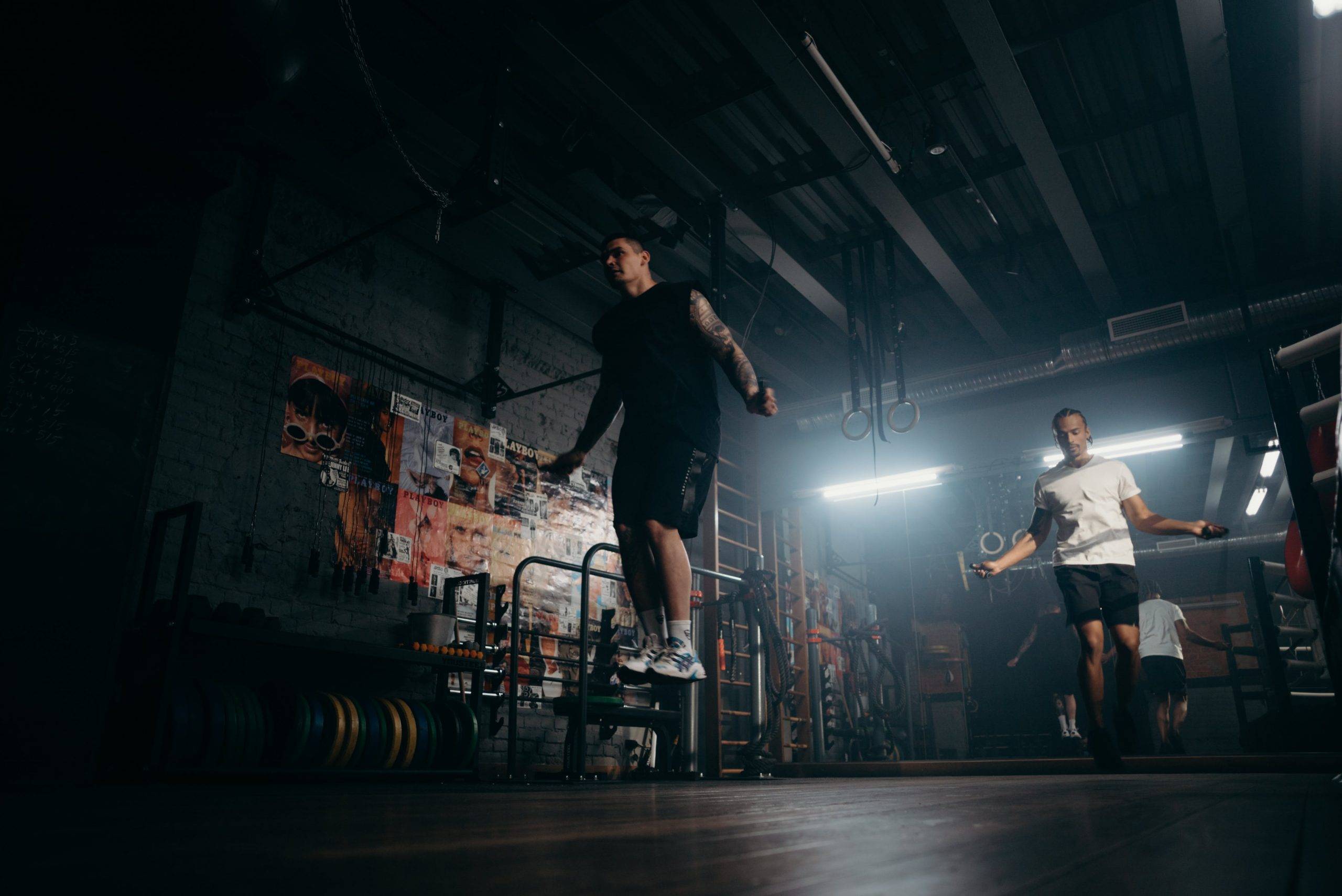
Cross-training built its following on constantly varied work: strength, conditioning and gymnastics rotated so that no quality is neglected. The next step a lot of boxes are taking is to borrow openly from other sports – the agility and jump patterns of court sports, the sprint and contact power of field sports, the balance and breathing work of yoga – and fold them into the weekly programme. Members call it hybrid or crossover training. For an operator it is a programming decision with real consequences for floor space, equipment and flooring, and those are the consequences worth thinking about before the first session is written.
What hybrid cross-training actually means
Hybrid programming keeps the cross-training framework – varied functional movement at relative intensity – and draws its movement vocabulary from a wider set of sports. In practice that means three additions to a conventional programme.
Court-sport patterns bring multidirectional agility: lateral shuffles, cutting, reactive change of direction, repeated jump and land cycles. Field-sport patterns bring linear acceleration, sled and push work, and upper-body pressing and pulling power. Movement and breath work in the yoga tradition brings single-leg balance, controlled range of motion and a genuine down-regulation phase at the end of a session.
The coaching argument for it is straightforward and not new: athletes who only ever move in the sagittal plane get good at moving in the sagittal plane. Adding lateral, rotational and reactive work broadens the base, tends to reduce the monotony that costs boxes their members in month four, and gives coaches a way to keep intermediate athletes progressing when the classic benchmarks stall.
What it demands from the facility
This is where the programme meets the building. A conventional cross-training class can be run on a rig, a platform strip and a small conditioning zone. A hybrid programme cannot.
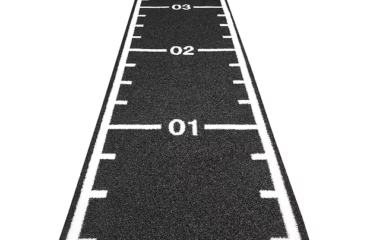
Open floor becomes the constraint. Multidirectional agility, shuttle work and reactive drills need a clear run, ideally with a marked lane. If your box is laid out entirely around rig stations and platforms, hybrid programming will be capped by the day you run out of floor, not by your imagination.
Landing surface matters more. Repeated jump-and-land work and change of direction load the surface differently from a barbell session. Flooring has to absorb impact, stay dimensionally stable and not become slippery under sweat. Our rubber gym flooring tiles range covers the different thicknesses these zones need, and the specification differs between a lifting area and an agility lane.
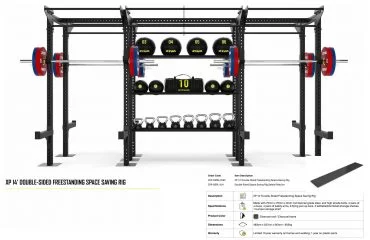
The rig has to carry more than pull-up work. Hybrid sessions use the structure for suspension work, banded resistance, plyometric step-ups and station-based circuits, often with several athletes rotating through. A rig sized for a class of eight will not carry a class of eighteen rotating between formats, whatever the pull-up bar count says. Our functional training rigs and CrossFit and Hyrox cages ranges are configured for exactly this kind of multi-station rotation.
Storage becomes a bottleneck. Every discipline you add brings accessories: balls, hurdles, ladders, bands, mats. Without a storage plan they end up on the floor, which removes the open space the programme needed in the first place.
Zoning a box for mixed disciplines
The layout that works is usually four zones rather than three. A lifting zone with platforms and dedicated flooring; a rig zone for gymnastics, suspension and station work; a conditioning zone for machines and sleds; and an open zone, deliberately kept empty, for agility, mobility and the cool-down phase. The open zone is the one operators cut first and regret first.
Sightlines matter in a mixed programme. A coach running three formats at once has to see all of them, which argues for zones arranged around a central coaching position rather than in a line. Noise separation matters too: a breathing and mobility phase does not coexist with a barbell drop three metres away, so plan the timetable or the acoustics accordingly.
The risks a coach has to manage
Three failure modes come up repeatedly when a box adds disciplines.
The first is volume creep. Adding a new movement family without removing anything else raises weekly load, and jump and sprint work in particular is far more demanding on connective tissue than its perceived effort suggests. The second is technical dilution: a coach who is expert in barbell work is not automatically competent to coach cutting mechanics or a breathing protocol, and honest gap-filling through education or a specialist coach is what separates a serious programme from a novelty. The third is recovery. Hybrid programmes stack neural fatigue quickly, and the deload has to be written into the cycle rather than improvised when people start getting hurt.
Frequently asked questions
Does hybrid programming need more space than standard cross-training?
Yes, and specifically more open floor. The equipment count may not change much, but the clear area needed for agility and mobility work does. Plan the open zone before the equipment order, not after.
What flooring should an agility zone have?
A surface that absorbs repeated landings, holds its dimensions and gives reliable grip. That is a different specification from a lifting platform area, and mapping the zones separately is cheaper than relaying a floor that was specified for a single use.
Will it work for a general fitness membership?
It works well, provided the movements are scaled. Court-sport and mobility patterns are often more accessible to a general population than heavy barbell work, and they give newer members something they can do well on day one.
How many athletes can one rig support in this format?
It depends on the rig configuration and how the class rotates, not on the number of bars. Send us your class sizes and your floor plan and we will size the structure against your actual rotation.
Equipping for the programme you actually run
Light In Fitness manufactures and supplies rigs, cages, flooring and functional equipment for cross-training boxes, clubs and performance centres. If you are moving towards a mixed programme, the useful conversation starts with your floor plan, your class sizes and the formats you intend to run. Request a quote and we will design the layout around the programme rather than around the catalogue.