CrossFit training: what it is and who it is for
Newcomers to training are looking for a format that will get them into the gym and keep them there. Members who already have a training history are looking for something that makes their sessions more engaging. Both groups end up considering the same options: full body workout formats, functional circuits, and CrossFit. This briefing looks at the last of these from an operator point of view. What is CrossFit, what does it actually develop, which member profiles is it suited to, and what does a facility need on the floor to deliver it safely.
What is CrossFit?
Greg Glassman is the creator of this training system. He built it around a single formula: constantly varied functional movements performed at high intensity. That sentence is as close to a definition as the method gets. The aim is to improve the movement patterns people use every day, and to prepare the body as a whole rather than one quality at a time: stronger, faster, more efficient. The method was originally developed as a conditioning system for special units and uniformed services. As it grew in popularity, dedicated facilities opened, and the intensity of a session is now scaled to the participant rather than to the origins of the programme.
For an operator this matters more than the branding. A CrossFit floor is a coached group training model with a high equipment density per square metre, a high turnover of members through a single space, and a heavy dependence on the quality of the structures and the floor underneath them. Our full range of structures is grouped under CrossFit and HYROX cages.
What CrossFit training develops
A CrossFit programme combines three families of work: weightlifting, gymnastics, and endurance and conditioning. That combination is what makes the method effective, and it is also what makes it hard to file under a single training category. The simplest way to describe it is that it takes what works from several disciplines and produces an all-round athlete.
Nobody should expect a member to break records in any one of those disciplines. They will not compete with gymnasts on equal terms, and they will not run a marathon on a record time. What they can expect is a body that is prepared for physical activity in general, and a level of general fitness that stands out above average across the board rather than peaking in one place.
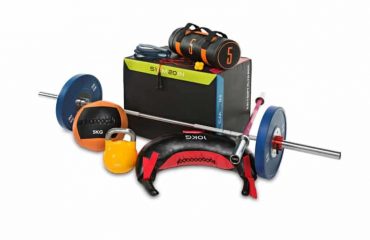
At first glance a session can look like a chaotic pile of exercises performed as fast as possible with little regard for technique. Nothing could be further from the truth. CrossFit is one of the more structured programmes in circulation. It rests on defined principles, and it can be run with bodyweight alone or with a range of equipment: kettlebells, resistance bands, boxes, dumbbells and barbells. A well built programme, whatever the accessories in use, develops the ten physical skills the method is built around: endurance, strength, flexibility, power, speed, coordination, agility, balance, accuracy and cardiorespiratory capacity.
Which member profiles is it for?
CrossFit works for every level of fitness, provided the coaching is there. A beginner can be brought into the method safely under a qualified coach. The doubts are predictable: watching competition athletes on a livestream, it is natural to think this is too heavy, or not for me. Every discipline has an elite level that takes years of work to approach. Nobody becomes a competitor immediately, but anyone can take small steps and work through their own weak points. A beginner programme is built around the member in front of the coach, not around the competition floor.
The concept that makes this possible is scaling: adjusting the difficulty of a session to the level of the participant. In practice it means that two members of very different ability can attend the same class and complete the same workout. One does back squats with a loaded barbell; the other does bodyweight squats or box squats. One does pull ups on the bar; the other does ring rows. Practically every foundational movement has an easier and a harder version. What stays the same is the satisfaction at the end of the session. Where members also pay attention to recovery and to a nutrition pattern that suits them, the gains in health and general wellbeing follow.
For the facility, scaling is an equipment question as much as a coaching one. A rig has to offer pull up bars and ring attachment points at several heights, the accessory wall has to carry a full weight range, and there has to be enough of each item for a class to run without queuing. Kettlebells in particular need to be stocked across the full range rather than in a few sizes, which is why our professional kettlebells are supplied as graduated sets.
Mixed ability groups and open access
Operators regularly ask whether the method suits members who are cautious about strength training, and in particular whether it produces a physique they did not ask for. It is worth being clear on this: the method is as appropriate for one group of members as another. A class is work on the whole body, on mobility, agility and conditioning, not a hypertrophy programme. The visible outcome of a class is general physical preparation, and the fear of an unwanted physique is not supported by what the programme actually does.
What does need managing is the mix inside a single class. A coach handling a wide ability spread needs equipment that scales without slowing the session down, and a floor plan that keeps a heavy lifting zone separate from a gymnastics zone. That separation is a layout decision taken at the equipment stage, not something that can be fixed later.
Where the training happens: the facility
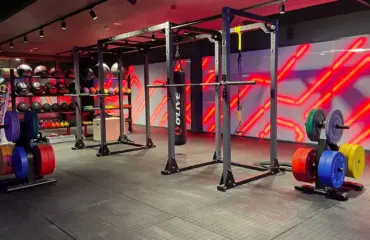
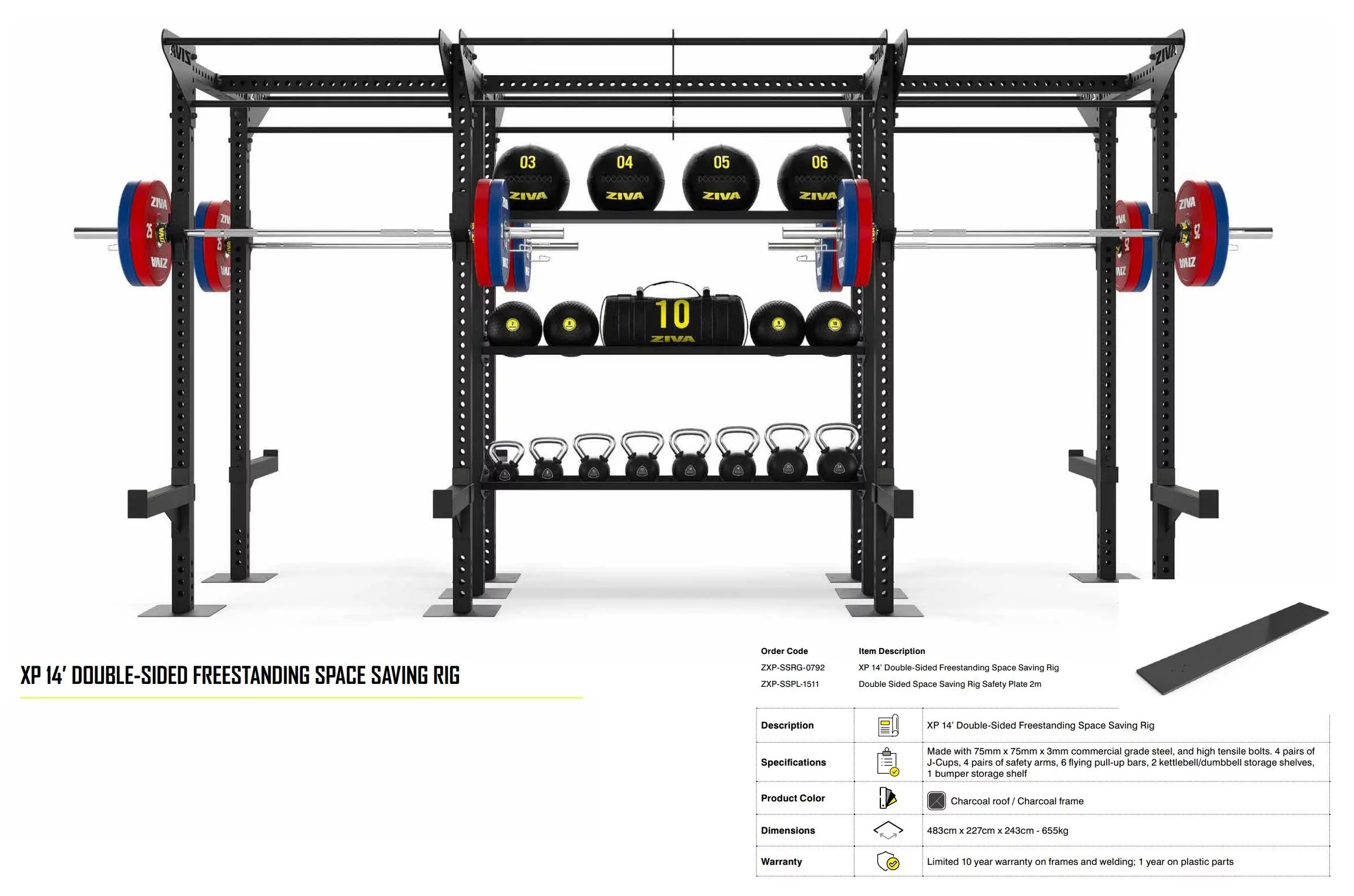
To get the full benefit of the method, members need to train in a facility built for it. That means a space where the structures are rated for the loads being lifted, where the floor absorbs dropped barbells, and where a coach can see the whole group. The structural core is the rig: a fixed or freestanding frame carrying pull up bars, rings, ropes, storage and often a monkey bar section. Our CrossFit rigs are configured to the room rather than sold as a fixed kit, which is what makes it possible to work with an awkward ceiling height or a narrow footprint.
The second structural item is the floor. Barbell work means repeated impact in defined zones, and a general purpose gym floor will not survive it. Dedicated weightlifting rubber tiles are laid in the drop zones, with a thinner covering across the rest of the training area. Indoor equipment for a commercial facility is built to EN ISO 20957-1 class S, the class intended for professional and supervised use.
Sessions with minimal equipment
Not every session needs the full floor. Where a class runs outdoors, in an overflow space or during a period when the main room is in use, the method adapts. Bodyweight conditioning is a legitimate part of the programme: a session built on push ups, squats and a skipping rope is a complete piece of work when it sits inside a coherent weekly plan. Adding a small number of kettlebells opens up a second repertoire immediately: swings, cleans, snatches, goblet squats, single arm presses and deadlifts. The possibilities are not the limiting factor.
This flexibility is useful for operators running satellite sessions, corporate contracts or seasonal outdoor programmes, because it means a second delivery point does not require a second full equipment package.
Frequently asked questions
Does a CrossFit floor need different equipment from a functional training area?
The overlap is large but not total. A functional area can work with a compact rig and light accessories. A CrossFit floor needs barbell capacity, drop zones, and enough duplicated equipment for a full class to work simultaneously.
How much space does a rig need?
It depends on the configuration, the class size and the ceiling height, which is why the rig is specified after a layout study rather than chosen from a catalogue page. Freestanding and wall mounted versions solve different constraints.
Can beginners and experienced members train in the same class?
Yes, and that is the point of scaling. It works when the equipment range is deep enough that the coach never has to give a member a load that is wrong for them.
What standard applies to indoor equipment in a commercial facility?
EN ISO 20957-1 class S covers indoor equipment intended for professional and supervised use, which is the applicable class for a commercial box or gym.
Specifying your floor
CrossFit is a coaching model before it is an equipment list, but the equipment decides whether the coaching model can be delivered. Rig configuration, drop zone layout and accessory depth are the three points that determine whether a class of fifteen runs smoothly or spends half its time waiting. If you are opening a box, converting a room or replacing an ageing rig, send us the plan and the class sizes you intend to run and we will come back with a configuration and a costed proposal: request a quote.