CrossFit: A Working Guide for Box Operators
CrossFit has gone from a niche practice to one of the strongest drivers of new gym openings in Europe. It was created in 2000 by Greg Glassman, and its origins lie in the garage gyms of the American West, where a small group trained hard with very little equipment. The method rests on one idea: broaden the basic qualities that make up general physical fitness rather than specialising in any one of them. Those qualities include cardiorespiratory endurance, strength, agility, balance, coordination, accuracy and precision of movement. This guide sets out what the discipline actually involves, what it demands of a facility, and what an operator should think about before building a box or adding a cross training zone.
What CrossFit is, in practice
CrossFit is a form of functional training characterised by high intensity and high variety. The variety applies to the movements themselves, to the number of repetitions and to the time those repetitions take. A single session may combine handstand work, a loaded lift and a sprint over several hundred metres. The scope is deliberately wide, and that is the point: the programme is designed so that no single quality is neglected.
Session duration
The conditioning piece itself lasts from a few minutes to several tens of minutes. Once you add the warm up, the skill practice done during the session and the stretching at the end, a class comfortably exceeds an hour. The duration of the working set depends on the athlete: it is the time taken to complete, for example, four rounds of a prescribed sequence, which is the rounds for time format. Alternatively the session can be capped in advance, with a sequence repeated continuously for ten minutes. Either way the clock is a structural part of the method, which is why visible timers and clear floor zoning matter so much in a box.
The movements involved
The programme includes weightlifting movements, but none of them require equipment beyond what a well specified gym already holds. Many movements need no equipment at all: burpees, lunges, squats, crunches and push ups. That accessibility is what allows a box to open with a compact inventory and grow it as membership builds, and it is also what allows a hotel or a corporate site to run scaled sessions in a small room.
Who is it for?
CrossFit is a universal training programme intended for any healthy person, whatever their fitness level and experience. Trained athletes and complete beginners follow the same session, because intensity is scaled individually to age, experience and current condition. That scaling is the mechanism that makes a mixed class work, and it is entirely dependent on coaching quality.
There are contraindications. The method is not advised for people with health problems such as hypertension, for anyone recovering from a serious injury, or for anyone with general physical weakness or a fever, because the intensity is high. Any member in one of those situations should be referred to their doctor before starting. Success otherwise comes down to two conditions: regularity, and a gradual increase in intensity as training progresses.
How to start, and what that means for your facility
Classes under this name are now common. Starting in a group class is the sensible route, and training alone from day one is usually a poor idea for a beginner. Introductory courses where a coach explains methodology, terminology and principles are worth offering as a separate product, because they convert curious visitors into members.
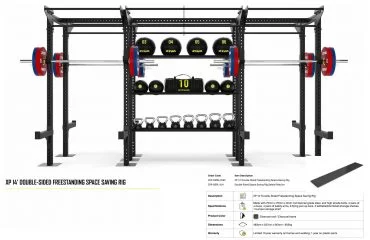
The best results come under professional supervision. That requires a large room filled with training equipment: boxes, wall bars, bars, dumbbells and kettlebells, along with the structure to mount pull up bars, rings and rope. The coach then sets an individual plan against the member goal, whether that is speed, strength, lower body development, weight management or muscle gain.
Training can also be done with body weight alone and little load, but injury risk rises sharply when nobody is present to correct technique. Most injuries in this discipline come down to inattention or an inadequate warm up. General overtraining also happens easily, because the programme targets every muscle group and micro damage accumulates across all of them at once. This is especially true for people who do not train regularly: their first session can be genuinely hard, which is exactly why the first weeks belong under supervision.
Advantages
- strengthens muscles and joints
- time efficient, since the working set is short
- varied, with a different session every time
- can be trained almost anywhere
- can be done with body weight alone
- improves general fitness and speed
- trains in a group, which builds a community around shared effort
- allows competition between members
Drawbacks
- injury risk rises with short, intense efforts, particularly when the warm up is not done properly
- beginners need supervision from a trained coach who selects both the exercises and the intensity to match their level
The four basic mistakes
- Competing with more experienced athletes. In this method the athlete competes against their own previous result, not against an opponent. Doing otherwise leads quickly to discouragement or injury. Competition against others comes once the skill and the strength are there.
- Neglecting recovery. Four to five sessions a week is a sensible ceiling, because the method loads the nervous system heavily. The body needs rest, and sleep and nutrition are the main levers.
- Lack of consistency. Systematic training is what delivers the objective. Long breaks produce disappointing results.
- Skipping the warm up and the stretching. Every session should open with a warm up that raises heart rate and prepares joints and muscles, and close with stretching, which reduces how much the micro damage is felt the following day.
Equipping a box
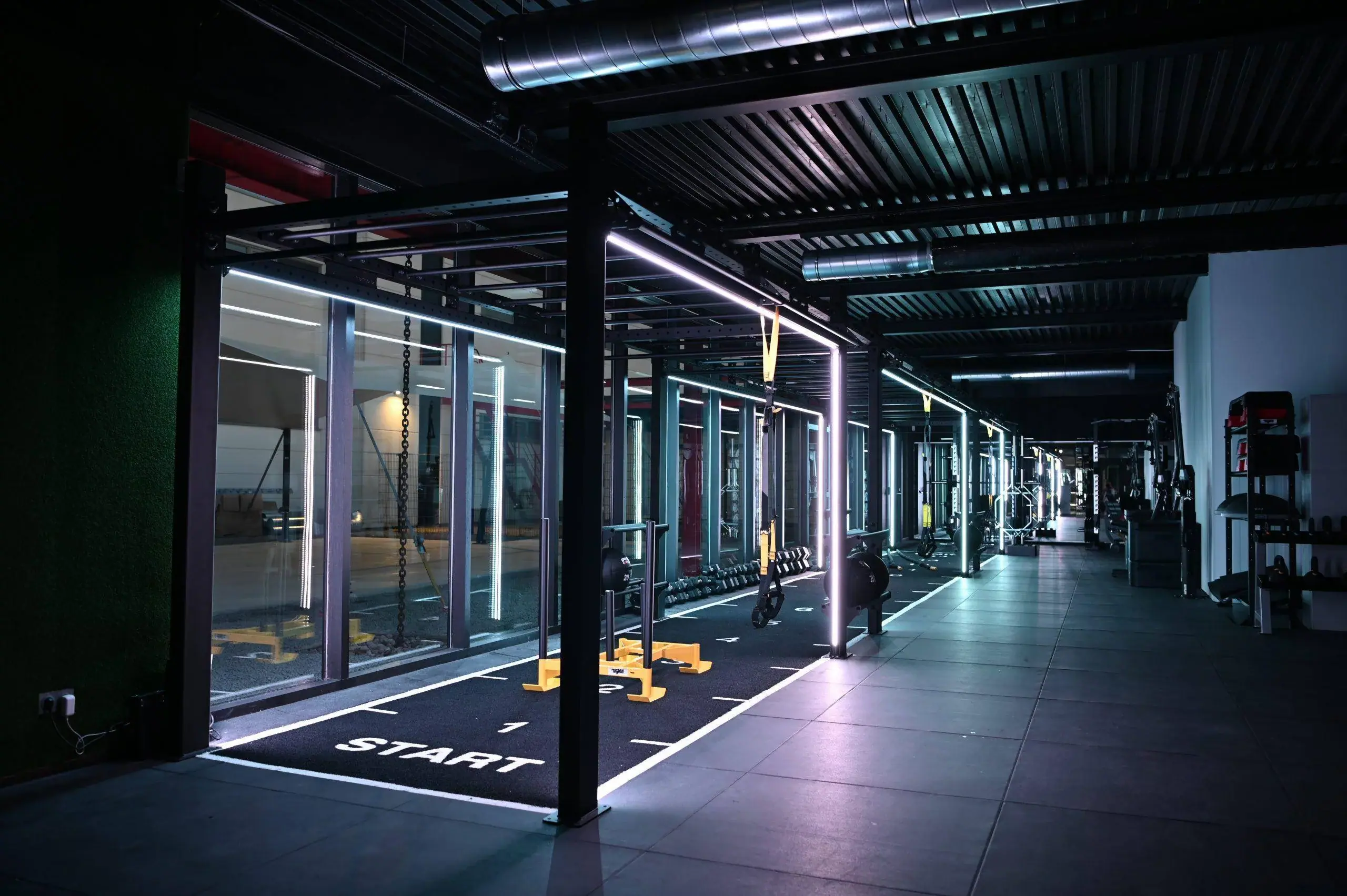
A CrossFit floor is defined by its structure and its flooring more than by any single machine. The rig determines how many athletes can work at once and which movements are available; the floor determines whether loaded barbells can be dropped safely and how much noise reaches the neighbours. For commercial installations, indoor training equipment should be specified to EN ISO 20957-1 class S, the class intended for supervised professional use.
Our structures are set out under CrossFit rigs and cross training cages, and the floor that goes underneath them under weightlifting rubber tiles.
Frequently asked questions
Does CrossFit suit complete beginners?
Yes, provided intensity is scaled to the individual and the first weeks are coached. The programme is designed to be adjusted to age, experience and current condition rather than reserved for trained athletes.
How many sessions per week?
Four to five at most. The method places a heavy load on the nervous system, and recovery, sleep and nutrition are as much a part of the programme as the sessions themselves.
Who should not train this way?
People with hypertension, anyone recovering from a serious injury, and anyone with general physical weakness or a fever. Refer those members to their doctor before they start.
What equipment does a box actually need?
A rig or cage sized to your class capacity, barbells and bumper plates, kettlebells and dumbbells, boxes, and a floor able to take dropped loads. Everything else is added as membership grows.
Planning your box
Light In Fitness equips cross training boxes, gyms, clubs, hotels and local authority facilities across Europe. Send us your floor area, your ceiling height and your target class size, and we will propose a rig configuration and a flooring build to match. Request a quote and our team will come back with a costed layout.