Artificial turf sled and sprint tracks: choosing the right length
Une piste de gazon synthétique destinée aux sled push se définit par trois dimensions : la longueur du couloir, sa largeur utile et la hauteur de fibre. La longueur commande le format d'entraînement possible, notamment le sled push de 15 m en HYROX. La hauteur de fibre conditionne la glisse du traîneau et l'usure du gazon.
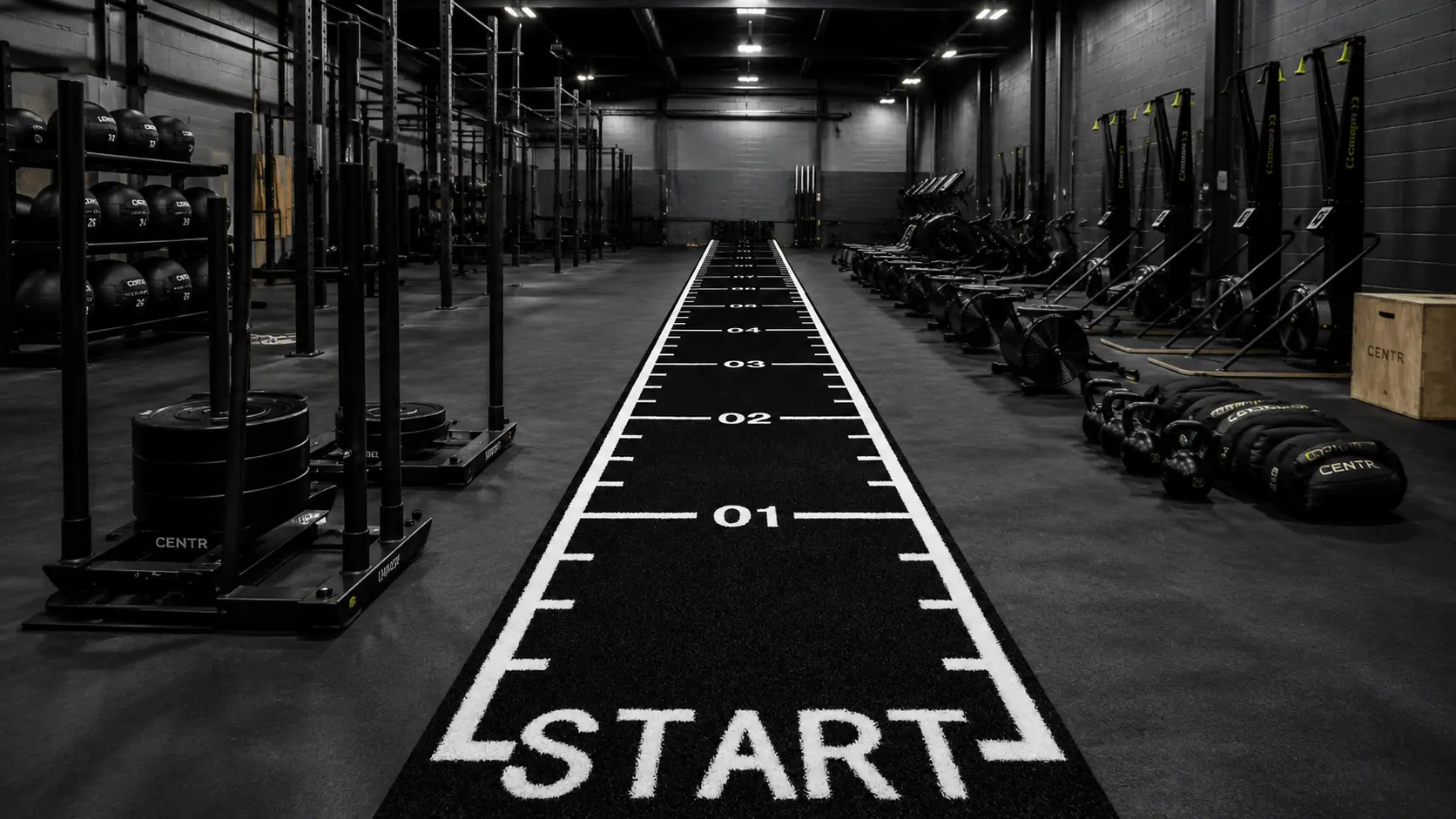
Three dimensions cover almost every professional sled and sprint track in artificial turf: 10 by 2 m, 15 by 2 m and 20 by 2 m. The 2 m width is the market standard because it matches the spacing between the outer runners of a competition sled. The length is what you actually choose, and it is decided by the programming, not by the available floor area. This guide sets out what each length allows, why 12 mm curled fibre dominates sled applications, and where custom lengths up to 50 m are justified.
Why turf rather than rubber in the sled lane
Sled push, sled pull, short sprints, broad jumps and agility drills need a surface that conventional rubber flooring does not provide well. Three structural reasons explain the shift. Standard SBR rubber rolls do not hold under repeated sled work: with a sled loaded beyond 100 kg, roll seams lift and joints fail, and the surface degrades quickly in intensive use. The glide coefficient of a short curled 12 mm fibre is calibrated to sit between useful resistance, which is the training effect, and smooth travel, which avoids joint blocking. And metre-by-metre marking printed onto the lane lets coaches calibrate distances in workouts and time performances precisely.
10 by 2 m: the compact professional format
Total surface 20 m2. This is the entry professional format for spaces where floor area is limited but functional conditioning remains central to the programming: compact functional facilities of 200 to 300 m2, premium private gyms, independent coach or professional athlete training spaces, and physical preparation centres with constrained space.
Its limits are worth stating clearly. Ten metres cannot reproduce the official competition sled push, which is run over 50 m for men and 25 m for women. At 10 m the lane is an interval training format rather than a simulation of the event. Long sprints beyond 40 m are impossible, which narrows the range of conditioning drills.
15 by 2 m: the reference specification
Total surface 30 m2. This is the versatility and budget compromise for the majority of B2B projects and the default specification for a mid-sized facility integrating conditioning and race preparation into its weekly programming: functional facilities of 300 to 500 m2, multi-discipline physical preparation rooms, mid-market clubs adding a race-ready offer, coaching centres running several conditioning slots a day, and military or institutional physical preparation rooms.
Fifteen metres matches the reference distance for interval sled series in conditioning programming, where five sets of 15 m sled push with 30 seconds recovery is a standard protocol. The length is also sufficient for full-speed short sprints, since 15 m is enough for an average athlete to reach maximum velocity, as well as for cumulative broad jumps and varied agility drills. If your facility is under about 350 m2, 15 m is generally sufficient and frees 10 m2 of valuable floor for racks or cardio.
20 by 2 m: the competition-oriented format
Total surface 40 m2. This is the premium format for high-end functional facilities of 400 m2 and above with daily conditioning, race-ready venues able to simulate the official stations, national performance centres, military operational training bases, premium 24/7 facilities using the conditioning floor as a differentiator, and sports medicine and athlete recovery centres.
The competition format combines 1 km of running with eight functional stations, including a sled push and a sled pull run over 50 m for men and 25 m for women. A 20 m lane simulates those in two or three lengths, against five on a 10 m lane, which changes both the quality of the preparation and how the effort feels to the athlete. Bonded installation is recommended for daily intensive use at this length.
Comparison of the three standard dimensions
| Criterion | 10 by 2 m | 15 by 2 m | 20 by 2 m |
|---|---|---|---|
| Total surface | 20 m2 | 30 m2 | 40 m2 |
| Indicative price excl. VAT | 1 375 euros | around 2 050 euros | 2 750 euros |
| Short interval sled push | Yes | Yes, reference | Yes |
| Full-speed sprint reached | Limited | Yes | Yes |
| 50 m sled simulation | No, 5 lengths | Difficult, 3 lengths | Yes, 2 to 3 lengths |
| Long agility drills | No | Limited | Yes |
| Recommended facility size | 200 to 300 m2 | 300 to 500 m2 | 400 m2 and above |
Fibre specification: what makes a turf sled-capable
Not every artificial turf handles intensive sled work. Three technical criteria separate a conditioning fibre from a decorative one.
| Parameter | Specification | Why |
|---|---|---|
| Fibre type | Curled, short looped pile | Firm, stable surface with maximum resistance to repeated abrasion from sled runners and no deformation under cyclic load |
| Alternatives to avoid | Monofilament, textured decorative | Monofilament suits pure sprinting but flattens under repeated sled work; textured decorative fibre shows visible wear in under six months |
| Pile height | 12 mm | 10 mm and below feels close to bare rubber; 15 mm makes the sled slightly harder to push and lays over more easily; 20 mm and above blocks the movement |
| Density | 35 000 tufts per m2 minimum | Resistance to repeated abrasion in intensive use |
| Backing | SBR latex or draining polyurethane | Chosen according to indoor or outdoor use |
| Marking | Numbering every metre | Distance calibration in workouts and timing of performances |
Why 2 m is the standard width
The 2 m width matches the standard spacing between the outer runners of a competition sled. That guarantees sled stability, with no risk of a runner riding off onto the surrounding rubber floor; push comfort, since the athlete keeps optimal foot placement without stepping on the turf to rubber transition; and shared safety, since two athletes can pass on the same lane during multi-station sessions. It is also the economical choice, because wider widths are rarely held in stock and carry a 30 to 50 per cent production surcharge. Widths of 2.5 to 3 m are available to order for facilities wanting two athletes running in parallel, but 2 m covers the large majority of B2B cases.
Custom lengths from 25 to 50 m
For performance centres, regional sports complexes, military gymnasiums and high-end race-ready venues, custom lengths are available in 5 m increments. A 25 by 2 m lane simulates the women’s 25 m sled in a single length. A 30 by 2 m lane suits long sprints and farmer’s carry at reference distance. A 40 by 2 m lane supports parallel multi-station conditioning. A 50 by 2 m lane reproduces the men’s sled push in a single length, at official championship format. Custom manufacturing lead time is 90 to 120 days, and these formats need a dedicated project study covering setting out, installation method, with bonded laying mandatory beyond 25 m, and special transport.
Standard lengths from 10 to 50 m in 5 m increments are offered in five catalogue colours: green, black, brick red, bright red and blue, with logo, design and custom colour available to order.
Frequently asked questions
What length is needed to prepare properly for a 50 m sled push?
Twenty metres allows the distance to be covered in two or three lengths, which is the realistic minimum for serious preparation. Fifty metres in a single length reproduces the competition format exactly, and is a custom order.
Is 15 m enough to reach full sprint speed?
Yes for an average athlete, which is one of the reasons 15 m is the reference specification. It also matches the standard interval sled protocol of five sets of 15 m with 30 seconds recovery.
Why not use a higher pile for comfort?
Because comfort underfoot and sled behaviour pull in opposite directions. At 15 mm the sled becomes harder to push and the fibre lays over; from 20 mm the sled cannot be used properly. 12 mm is the technical optimum.
Loose laid or bonded?
Loose or semi-permanent laying is workable at 10 and 15 m depending on traffic. Bonded laying is recommended for daily intensive use at 20 m and mandatory beyond 25 m.
Can the lane be marked with distances?
Yes. Numbering every metre is available and is included as standard on the 20 m format, with logos and custom design to order.
Specify your sled and sprint lane
Light In Fitness has supplied professional sports surfaces from Tours, France, since 2013, with standard track lengths held in stock and turnkey installation available. Send us the floor area, the programming and the target race format and we will return a length recommendation with a setting-out plan. Quotations are issued within 24 working hours. Browse sports flooring and CrossFit rigs, or request a quote.
Réalisations documentées
- Dalles et sols sportifs : livraisons documentées – plusieurs chantiers
- Sol sportif extérieur, square Georges-Vallerey – Taverny (95)
- Cage street workout ultime, Hub Armées – DICOM-GSB EFG / Division Métiers
- Cage street workout ultime, CFIM 6 de Fréjus – armée française