Where to Buy CrossFit Equipment for Your Box: A Professional Buying Guide
Fitting out a CrossFit box or a functional training area is not the same exercise as equipping yourself as an individual athlete. The equipment has to absorb group classes back to back, several hundred sessions a month, and it has to keep its geometry and its finish while doing it. The question every operator asks first is therefore a sourcing question: where do you actually buy CrossFit equipment when you are buying for a business?
Sports retail chains: convenient, rarely sized for a commercial floor
Large sports retailers are the most visible option and the easiest to visit. They carry barbells, jump ropes, resistance bands, suspension trainers and a selection of racks. For a coach who needs a spare accessory the same afternoon, they do the job.
The limits show up quickly on a commercial project. Ranges are built around individual buyers, so the load ratings, the frame sections and the warranty terms are calibrated for a few sessions a week rather than for continuous class use. Assortments are also fragmented: assembling a full rig, the flooring under it and the storage around it from a single shelf is rarely possible, and the technical advice available in store seldom extends to anchoring, floor loading or layout.
Specialist suppliers online: the realistic route for a full fit-out
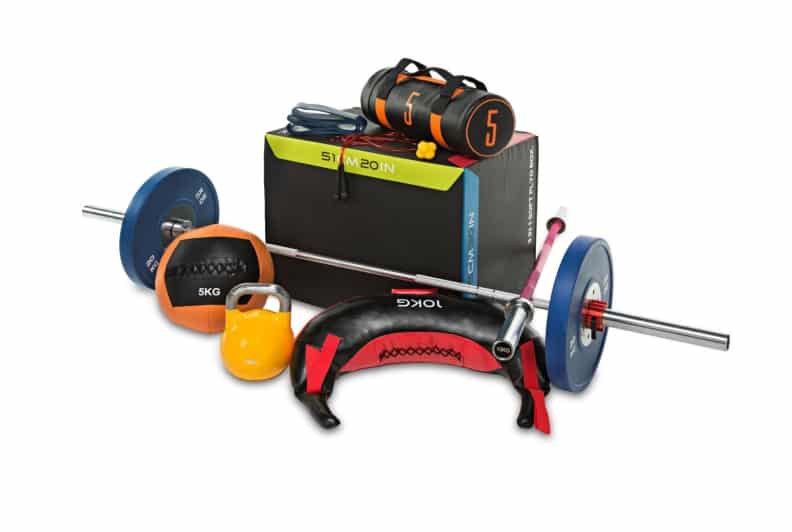
Suppliers that work specifically with training facilities carry the depth a project needs: freestanding and wall-mounted rigs, squat racks and power cages, Olympic barbells and bumper plates, kettlebells, sleds, rowers and air bikes, plus the shock-absorbing flooring that has to go underneath all of it. Buying from one supplier keeps the specification coherent — the rig, the storage and the floor are chosen as a system rather than assembled from three unrelated sources.
Ordering remotely also makes comparison straightforward, and a specialist supplier is normally the one that can answer the questions a retailer cannot: what the structure weighs, how it is fixed, what clearance the pull-up bars need, what happens to the warranty in a club context, and who comes out if a component fails.
Buying from the manufacturer: what changes
Going directly to the manufacturer changes the nature of the conversation. Dimensions stop being fixed catalogue entries and become project variables: a rig can follow the length of an available wall, a storage configuration can be adapted to the accessories actually used, a colour can follow the club identity. Lead times and installation are quoted against the real site rather than against a standard box.
For a new opening, a relocation or a second room, this is usually the deciding factor. The equipment budget is rarely the hard part; the hard part is the fit between the structure and the volume available.
What a professional specification should cover
Whichever route you take, the same points decide whether the purchase holds up over five years:
- the intended use — group classes, open gym, competition, or a mix, since that drives the load ratings
- the number of simultaneous training stations, which sets the rig length far more than the floor area does
- the floor build-up, because dropping loaded barbells onto an unsuitable surface damages both the slab and the plates
- the fixing method — freestanding, wall-mounted or anchored — and what the building will accept
- the warranty on the structure and the availability of spare parts several years after delivery
- storage, which is what keeps an equipped room usable rather than cluttered
Our CrossFit and Hyrox cages and the matching professional fitness accessories are designed around exactly these constraints, and a configuration such as the Crossfit Rig Area 1 freestanding cage can be adjusted to the room rather than the other way round.
Frequently asked questions
Can a box be equipped gradually?
Yes, and it is common. The usual approach is to install the structure and the flooring first, because both are difficult to retrofit, then extend the accessory inventory as membership grows. Choosing a modular rig from the start is what makes that possible without replacing the original purchase.
Is a coach a good purchasing channel?
A coach knows what the training actually demands and is a useful voice in the specification. For a commercial installation, however, the purchase itself is better handled with the supplier, because anchoring, warranty and after-sales responsibility need to sit with whoever manufactures and installs the equipment.
Should flooring be bought at the same time as the rig?
It should. The floor build-up determines the finished height under the structure and the way dropped loads are absorbed. Specifying both together avoids the classic problem of a rig installed on a surface that cannot take the impact it receives.
Equipping your facility
Buying CrossFit equipment for a professional facility is a specification exercise before it is a shopping exercise: define the use, the number of stations and the floor, and the shortlist narrows on its own. If you are planning an opening, an extension or a refit, send us the room dimensions and the intended programming and we will put a configuration and a costed proposal together — request a quote.