Who Are Gym, Fitness and CrossFit Training For?
In short: gym floor training, group fitness and CrossFit answer three different member expectations. Understanding who walks through the door for each of them is what tells an operator how much floor area, how many machines and which structures to budget for.
Three formats, three audiences, one building
Sedentary work has made structured exercise a mainstream need rather than a niche one, and most operators end up serving all three formats under the same roof. They are not interchangeable. The gym floor sells autonomy, group fitness sells guidance and progression, CrossFit sells intensity and a coached community. Each of them draws a distinct member profile, and each one consumes space and equipment very differently.
Getting the mix right before ordering equipment is what protects the investment. A facility that buys a full strength line and then discovers that two thirds of its members came for coached classes has bought the wrong room.
The gym floor: who actually uses it
The gym floor still carries the cliche of heavy strength training, and that audience is real, but it is no longer the majority. A large share of members arrive with body composition and general health goals rather than competition goals, and they come precisely because diet alone does not produce results without physical activity. Others are rehabilitating, preparing for a season, or simply looking for the one hour a week they control entirely.
What that mixed audience needs from the equipment is range and legibility. Selectorised machines with clear loading and adjustment let a beginner train safely without supervision, while plate loaded stations and free weights serve the experienced end of the room. A complete strength training machine line covering the main movement patterns is what allows one floor to serve both. Members also report the mental benefit as strongly as the physical one, which is a retention argument as much as a health one.
Group fitness: progression is the product
Group fitness suits every level, which is exactly why it fills a timetable. A newcomer starts with mobility, stretching and core work; the same person moves on to conditioning and step classes a few months later without changing facility. Programmes segmented by age or life stage, such as classes for older adults or for parents returning to activity, widen the addressable audience well beyond the classic 25 to 40 bracket.
The operational consequence is that a studio needs versatile, quickly reconfigurable equipment rather than a large machine count: mats, small free weights, functional accessories and enough clear floor for the largest class on the timetable. Results follow regularity, and regularity follows enjoyment, so the room has to be pleasant to be in.
CrossFit: ten physical domains in one programme
CrossFit is built on ten physical domains: endurance, strength, power, speed, agility, coordination, accuracy, cardiorespiratory fitness, flexibility and balance. They are trained through weightlifting, running, swimming, squatting, push-ups, skipping and sit-ups, combined in short, varied and intense sessions.
The audience it attracts is broader than its reputation suggests. Members come to improve general conditioning and work capacity, and the effect on the respiratory and circulatory systems is one of the reasons the format retains people who never intended to compete. Others come for stress management, because the endorphin response after a hard session is what they are actually buying, and they report better sleep as a result.
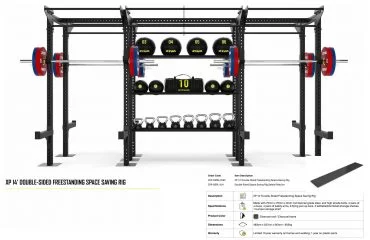
For the operator, this translates into a rig or cage, free weights and cardio equipment able to take continuous group use, plus flooring rated for dropped loads. Our CrossFit rigs are modular, so the station count can follow the class sizes you actually reach rather than the ones you hoped for.
What this means for an equipment plan
Start from the timetable, not from the catalogue. Count the peak occupancy of each format, allocate floor area accordingly, then specify equipment for each zone. Indoor equipment for a commercial facility must be built to EN ISO 20957-1 class S, the studio class for supervised professional use. Class I designates professional equipment with inclusive access, which is a different scope and not a higher tier above class S. If your audience includes rehabilitation or older members, that distinction matters when you write the specification.
Frequently asked questions
Is the gym floor only for people who want to build muscle?
No. A large part of the audience trains for body composition, general health or rehabilitation. The floor has to serve both ends of that range, which is why a mix of selectorised machines, plate loaded stations and free weights works better than a single category.
Who is group fitness suitable for?
Every level, provided the timetable offers a progression. Relaxation, mobility and core classes bring in beginners; conditioning and step classes retain them once they are fitter. Age-specific and life-stage groups widen the audience further.
Do I need a separate room for CrossFit?
A separate zone at minimum. The format needs a rig or cage, clearance for dropped loads and flooring specified for that purpose, and the noise it generates is difficult to reconcile with a quiet studio in the same space.
Planning the mix
Tell us the formats you want to run, the peak class sizes and the surface available, and we will propose a zoning plan and a costed equipment list for each area. Request a quote and we will start from your timetable.