CrossFit for gym operators: hype, method and equipment
Cross-training has moved from a garage experiment to a permanent line item in commercial fitness budgets. Gym owners, hotel groups, municipal sports departments and armed forces training centres all end up asking the same question: is CrossFit a passing trend, or a format worth dedicating a room to? This guide sets out what the method actually trains, where it came from, who it suits, and what a professional operator needs on the floor to deliver it safely.
What cross-training actually develops
CrossFit is a strength and conditioning format built around ten physical qualities that its originators considered the ones that matter most in everyday life:
- general athletic fitness
- stamina
- muscular strength and endurance
- flexibility
- cardiovascular and respiratory endurance
- speed
- power
- coordination
- balance
- accuracy
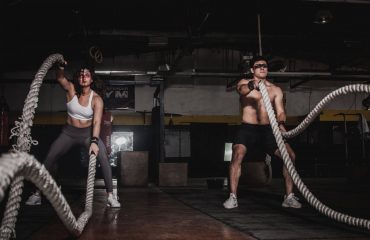
The movement pool is deliberately universal: jumping, pulling, lifting, running, rowing, sit-ups, tyres, ropes, boxes. Loads and ranges are scaled to the athlete rather than the other way round, which is why a single class can hold a first-timer and a competitor at the same time. Sessions are run at pace, with little room for long rests between movements. That is what makes the format demanding, and it is also what keeps members coming back: the harder the session, the greater the satisfaction at the end of it.
For an operator, the practical consequence is simple. A cross-training class is not a circuit bolted onto an existing gym floor. Ten or twelve people work simultaneously, on different stations, at high intensity, dropping loaded barbells and swinging on bars. The room has to be designed for that.
Where the method came from
The format was created by Greg Glassman, who combined several disciplines into one brutally efficient workout in his own garage. It worked: he was soon contracted in California to run cross-training sessions for police officers, and the programme was subsequently adopted by the marines, by fire services and by US soldiers. From there the know-how travelled worldwide, and Glassman and his wife built a business on it.
The route into Europe followed the familiar pattern of affiliate boxes: a handful of city-centre facilities first, then dedicated rooms across the wider market. Today many conventional gyms advertise cross-training classes without owning the right equipment for them, which is precisely why purpose-built training rooms are being commissioned instead.
Who can train in a box?
Prospective members frequently ask whether the format is really for them. The honest answer is that cross-training sessions are genuinely demanding, but the point of training is to become a better version of yourself, not to survive somebody else session. On that basis the format works perfectly well for beginners, provided one condition is met: before moving on to advanced movements, the body and the joints need to be conditioned, and the session has to be modified accordingly.
That is a staffing and layout question as much as a coaching one. Newcomers, even physically active ones, should start under the supervision of a qualified coach, which means the room needs sightlines, circulation space and enough stations for a coach to scale a class without splitting it in two.
Cross-training or a conventional gym floor?
The answer is that one does not exclude the other, and the two sell better together. Fast, intense cross-training work is a good complement to strictly hypertrophy-oriented training. The body adapts quickly, so exposing it to different training formats gives it new stimuli and supports its development. The caveat is recovery: cross-training is short but very intense, so a member who also trains on the strength floor needs a programme that leaves room for regeneration.
Commercially, this argues for a hybrid facility rather than a choice between two business models. A dedicated cross-training cage in its own zone, next to a conventional selectorised and free-weight floor, lets one site serve both memberships without either format degrading the other.
Specifying the room: what professional equipment means here
Three decisions carry most of the budget and most of the risk.
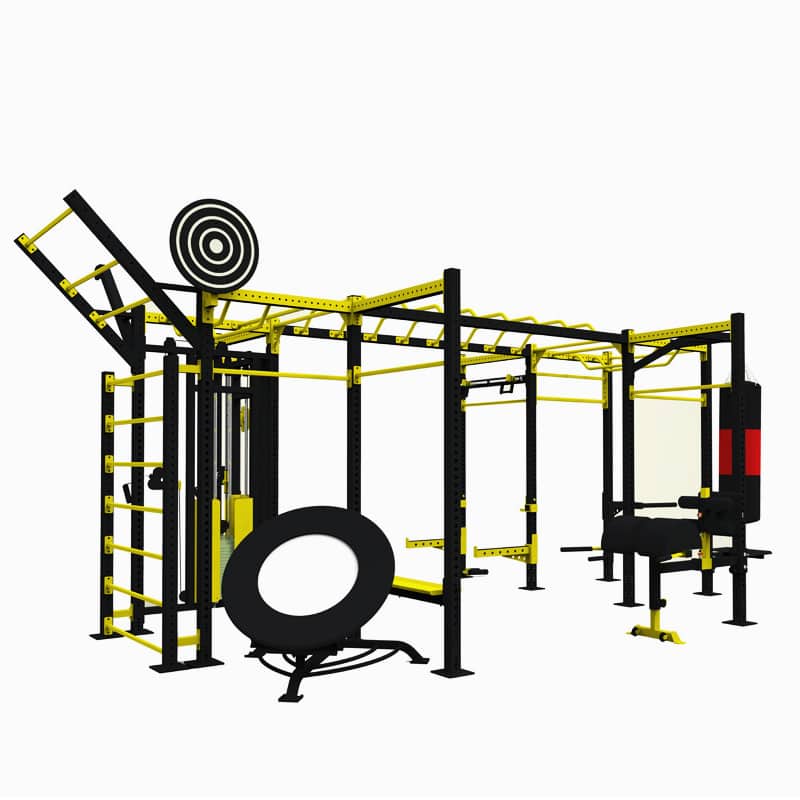
The rig or cage. This is the backbone of the room and it determines how many athletes can work at once. Wall-mounted structures save floor area in narrow rooms; freestanding rigs allow work on both faces and can be extended later. Our full range of CrossFit rigs and racks covers both configurations, including bespoke layouts built to a floor plan.
The standard. Indoor equipment for a commercial facility must be built to EN ISO 20957-1 class S. This is the professional class: it governs stability, structural strength and safety for equipment placed in supervised, publicly accessible facilities. It is the specification to insist on in a tender, and the one your insurer will look for after an incident.
The floor. Dropped barbells are part of the format, not an accident. Lifting zones need shock-absorbing rubber sized for the loads actually being dropped, and the rest of the room needs a surface that tolerates sled work, burpees and dynamic footwork without lifting at the seams.
Around that core sit the consumables that define the class: barbells and bumper plates, boxes, ropes, and a full rack of professional kettlebells in a spread of weights wide enough to scale a mixed-ability group.
Frequently asked questions
Is cross-training suitable for complete beginners?
Yes, provided the movements are scaled and the athlete is supervised by a qualified coach. Conditioning of the joints and connective tissue should precede advanced movements, and the training plan should be adjusted rather than simply lightened.
Can a conventional gym add cross-training without a separate room?
It can add elements, but a genuine class needs its own zone. Ten or more athletes training simultaneously at high intensity, with dropped loads and overhead work, is incompatible with a machine floor in both noise and safety terms. A separate room, or a clearly delimited zone with its own flooring, is the workable minimum.
What equipment standard should appear in a purchase specification?
For indoor equipment, EN ISO 20957-1 class S. Class S is the professional class for equipment in supervised facilities open to the public. Class I is a professional class covering inclusive access, not a higher intensity tier, so it does not replace class S in a general commercial specification.
Building your own cross-training floor
Whether you are converting an industrial unit, adding a zone to an existing club or fitting out a training facility for a public body, the specification work is the same: define the number of simultaneous athletes, fix the rig geometry to the building, then choose flooring and accessories around it. Send us your floor plan and intended capacity and we will come back with a costed layout. Start with a request for a quotation.