CrossFit training: the four standards and their measured effects
Le CrossFit associe haltérophilie, gymnastique et travail cardio dans des séances variées et chronométrées. Cette combinaison développe la capacité de travail générale plutôt qu'une qualité isolée. Elle exige un encadrement technique réel, la fatigue dégradant rapidement l'exécution des mouvements complexes.
CrossFit is not a collection of hard sessions: it is four written standards that define what fitness means and how a session must be built. Those standards are what separates a box that programmes coherently from one that simply exhausts its members. This article sets out the four standards formulated by Greg Glassman, the physiology they rest on, and what a controlled six week study measured on untrained participants.
The four standards Greg Glassman wrote
Describing the founding assumptions of CrossFit, its creator Greg Glassman systematised them as four standards that set the objectives and guide the training activity of anyone practising the discipline. They are cumulative: a programme that satisfies three of them and ignores the fourth is not CrossFit, it is circuit training with a barbell.
Standard one: general fitness across ten physical skills
The first standard concerns the development of physical fitness in the broad sense, defined by competence in ten domains.
| The ten skills |
|---|
| Cardiorespiratory fitness |
| Endurance |
| Strength |
| Flexibility |
| Power |
| Speed |
| Coordination |
| Agility |
| Balance |
| Accuracy |
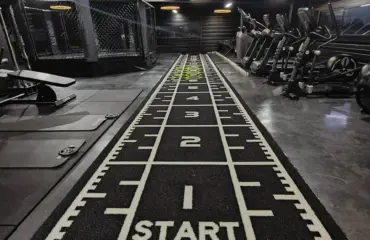
For an operator, this list is a purchasing specification in disguise. A floor that can only deliver strength and cardiorespiratory work covers two of the ten. Balance, accuracy and agility need open floor, throwing targets and structures to hang from.
Standard two: constant variety, no specialisation
The second standard refers to the variety of tasks a member has to face on the way to physical development. That variety is meant to build a versatile athlete, prepared for any situation and able to come out of it on top.
Glassman illustrates the standard with a container holding an unlimited number of tickets, each ticket a physical challenge calling on a wide range of skills. Every ticket drawn should be a task the athlete can handle. That is the picture of the target state: the overall level of competence and condition of somebody trained by the method.
The consequence is the mixing of weightlifting, gymnastics and endurance work inside the same programme. Against a high level specialist in one discipline, a runner who only ever refines running, the CrossFit athlete should come out ahead in any event that rewards versatility. In the founder’s own phrasing, the CrossFit athlete’s specialty is not specialising.
Standard three: train all three energy pathways
The third standard calls for effort that engages the three mechanisms by which the body obtains energy: the phosphagen pathway, glycolysis under anaerobic conditions, and the aerobic pathway.
The basic energy source for muscular work is ATP, adenosine triphosphate, an organic compound made of adenosine and three phosphoric acid molecules, present in every living cell. Chemical energy becomes mechanical energy through hydrolysis: under the action of ATPase a phosphate molecule detaches, leaving ADP, adenosine diphosphate, and inorganic phosphate.
Energy flow in the body is a feedback loop between the breakdown of ATP and its resynthesis. Resynthesis happens under anaerobic conditions from phosphocreatine and glycogen, muscular and hepatic, and under aerobic conditions from glucose, free fatty acids, keto acids and amino acids. Short efforts are dominated by anaerobic processes, long efforts by aerobic ones.
| Pathway | Substrate | Effort it sustains |
|---|---|---|
| Phosphagen, alactic | Stored ATP, then phosphocreatine | Highest force values, a few seconds only |
| Glycolytic, lactic | Glycogen, glucose broken to pyruvate | Extends effort to several tens of seconds |
| Aerobic | Blood glucose, free fatty acids | Becomes dominant after a few minutes |
Anaerobic capacity is the ability to produce very short efforts of very high, supramaximal intensity. Aerobic capacity is the ability to sustain long efforts and is measured by maximal oxygen uptake, VO2max. In the glycolytic pathway, pyruvic acid converts to lactic acid under anaerobic conditions, and that conversion is what limits the ability to hold high power. As working time rises, aerobic processes take a growing share, a large part of the pyruvic acid is oxidised, lactic acid production falls and the use of blood borne substrates increases.
CrossFit sessions cut across durations. Because high intensity is imposed from the first seconds, in practice the two anaerobic supply systems are almost always used first, as in the benchmark workout Fran completed in around two minutes, before the body switches to the aerobic system, as in the benchmark Chelsea which runs for thirty minutes as standard. Glassman encourages variation in duration while indicating that anaerobic efforts should predominate, on the researched principle that anaerobic work raises aerobic capacity.
Standard four: health markers
The fourth standard concerns measures of health, the criteria whose measurement shows how fit, or how physically developed, a person actually is. Blood pressure, body composition, and levels of good and bad cholesterol are the examples given. This is the standard that matters most to a corporate wellness client or a rehabilitation centre, because it is the only one expressed in figures a physician recognises.
What the research actually measured
The effectiveness of training by the CrossFit method has not been widely verified by professional researchers so far; scientific publications on the subject are scarce. A number of studies confirm the effectiveness of efforts similar in character to CrossFit, but the method exactly as set out by its creator in The CrossFit Training Guide, available on crossfit.com, has been tested only to a very limited extent.
A study conducted in 2014 at the University of Alabama under the direction of J. M. Goins, published as Physiological and performance effects of CrossFit, was built precisely on those founding assumptions. It set out to establish whether and how far CrossFit training changes aerobic and anaerobic capacity, power, the functioning of the three energy systems, resting heart rate, systolic and diastolic blood pressure, body weight and body composition in terms of body fat.
The participants were eight women and four men aged nineteen to twenty nine, not specialised in any sport, moderately active, and not taking part in any form of high intensity training. The protocol was a six week cycle following the pattern proposed by The CrossFit Training Guide: five training days followed by two days of rest, thirty training days in total. Each day carried one session programmed by the method, using varied techniques drawn from weightlifting, gymnastics and endurance sport, a varying number of techniques within one task, from monostructural work up to four elements, and varying priorities of task and time, so as to expose the body to the widest possible range of stimuli.
The first three and last three days of the cycle were filled with test sessions, differentiated by the energy pathway they load.
| Test session | Content | Pathway loaded |
|---|---|---|
| CrossFit Total | One repetition maximum in back squat, press and deadlift, all in one session with no time limit. Standard devised by Mark Rippetoe, co author of Starting Strength, published in the CrossFit Journal in December 2006. | Phosphagen |
| 500 metre row | Stationary rowing ergometer | Glycolysis |
| Fight Gone Bad | Maximum repetitions across three five minute blocks separated by one minute of rest, one technique per station, AMRAP scoring | Aerobic |
The five stations of Fight Gone Bad, with the loads used, were the wall ball, a squat and throw with a twenty pound medicine ball, around nine kilograms, to a target marked on the wall at ten feet, around three metres; the sumo deadlift high pull with a seventy five pound bar, around thirty four kilograms, pulled to the chin from a wide stance; the box jump onto a twenty inch box, around fifty centimetres; the push press, a seventy five pound bar driven overhead with the hips and legs; and rowing scored on calories burned as displayed by the ergometer computer.
Throughout the six weeks participants were instructed to train at maximum intensity relative to their own capacity and training level, and encouraged to complete each task as fast as possible, minimising pauses and stoppages.
| Parameter | Change over six weeks |
|---|---|
| Anaerobic capacity | 25 per cent |
| Diastolic blood pressure | 14 per cent |
| VO2max | 11 per cent |
| Body fat | 3 per cent decrease |
| Maximum heart rate | 2 per cent |
| Systolic blood pressure | 2 per cent |
| Resting heart rate | 1 per cent |
| CrossFit Total, load lifted across three lifts | 11 per cent increase |
| 500 metre row time | 4 per cent improvement |
| Fight Gone Bad score | Up to 31 per cent |
Conclusions showed a tendency to improvement across the parameters examined, with the exception of body weight. The large gain on Fight Gone Bad supports the transfer of anaerobic adaptation into aerobic performance. It is worth underlining that the longest session in the whole six week cycle, excluding warm up and post session recovery, lasted only twenty minutes, and aerobic capacity still rose significantly. Part of the improvement on the test sessions also reflects technical, not only motor, skill acquired over the cycle.
The results bind to the specific group tested, that is, people who had never trained CrossFit before. For an operator that is the commercially interesting population: the beginner walking through the door, not the competitor.
What the standards mean for the equipment on your floor
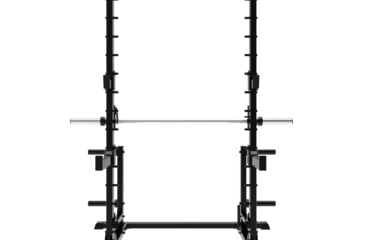
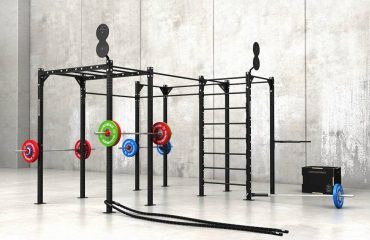
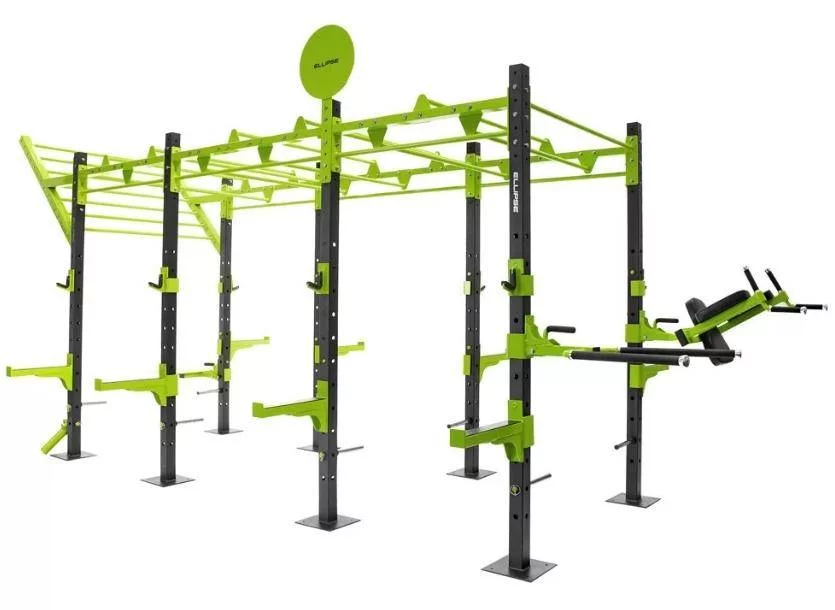
Read as a purchasing brief, the four standards say three things. Constant variety needs a structure with many independent working stations rather than a line of single function machines, which is the argument for a rig; our range of CrossFit and Hyrox cages is built around that. Loading all three energy pathways in one room means ergometers sitting next to barbells, which is why professional rowing machines appear in every benchmark cited above. And a floor that takes loaded barbells released from height needs a dedicated drop zone rather than a general purpose surface, which is the role of weightlifting rubber tiles.
Frequently asked questions
Is the method appropriate for members with no training background?
The participants in the study cited were not specialised in any sport and did no high intensity training before the cycle, and they progressed on almost every parameter measured. The condition attached in the source is that the practice be conducted thoughtfully and responsibly, which in a commercial setting means real coaching, because fatigue degrades the execution of complex movements quickly.
Do short sessions really build aerobic capacity?
In that study, yes. The longest session of the six week cycle lasted twenty minutes excluding warm up and recovery, and VO2max still rose by eleven per cent. The founder’s position is consistent with it: vary duration, but let anaerobic efforts predominate, because anaerobic work raises aerobic capacity.
Can the figures be applied to trained athletes?
No. The study results are binding only for the group covered by the test, previously untrained adults aged nineteen to twenty nine. Nothing in it supports a claim about experienced competitors.
How many stations does constant variety require?
There is no universal figure, because it depends on class size, session format and the floor area available. The design rule that follows from the second standard is that the number of distinct movement patterns available at once, not the number of machines, is what limits programming.
Equipping a facility around these standards
Changes in the qualities named in the first standard, and in basic motor and health parameters, are observable and confirmed both by practitioners and by research. The controversy starts where recreation ends and competition begins, and that is a separate subject.
Send us your floor plan, your class size and the movement patterns you intend to programme, and our technical team returns a station by station layout and a detailed quotation. Request a quotation and we come back to you with a costed proposal.