How to Set Up a CrossFit and Cross-Training Gym
Une salle de cross-training se dimensionne sur le linéaire de rig et le nombre de postes de levée simultanés, avant la surface totale. Le sol doit encaisser les barres lâchées sur les zones de levée, ce qui impose une épaisseur différenciée. Les charges libres et le cardio de conditionnement complètent l'équipement de base.
A cross-training gym is sized on the linear metres of rig and on the number of simultaneous lifting stations before it is sized on total floor area. The floor has to absorb barbells dropped on the lifting zones, which calls for a differentiated thickness rather than one tile laid everywhere. Free weights and conditioning cardio complete the core equipment. Almost everything else in the project, from the lease you sign to the class timetable you publish, follows from those three decisions.
Decide what you are actually selling
CrossFit and cross-training are close relatives, not the same product. CrossFit combines strength and conditioning through functional movements performed at high intensity, usually with a class of fixed size moving through the same workout at the same time. Cross-training is aimed at members who want to improve general fitness by combining strength work, endurance and cardio, and it spreads people across stations at their own pace. That difference decides how many people can train at once, and therefore how much rig, how many barbells and how much floor you need. Settle it before you look at premises.
Size the rig before you size the room
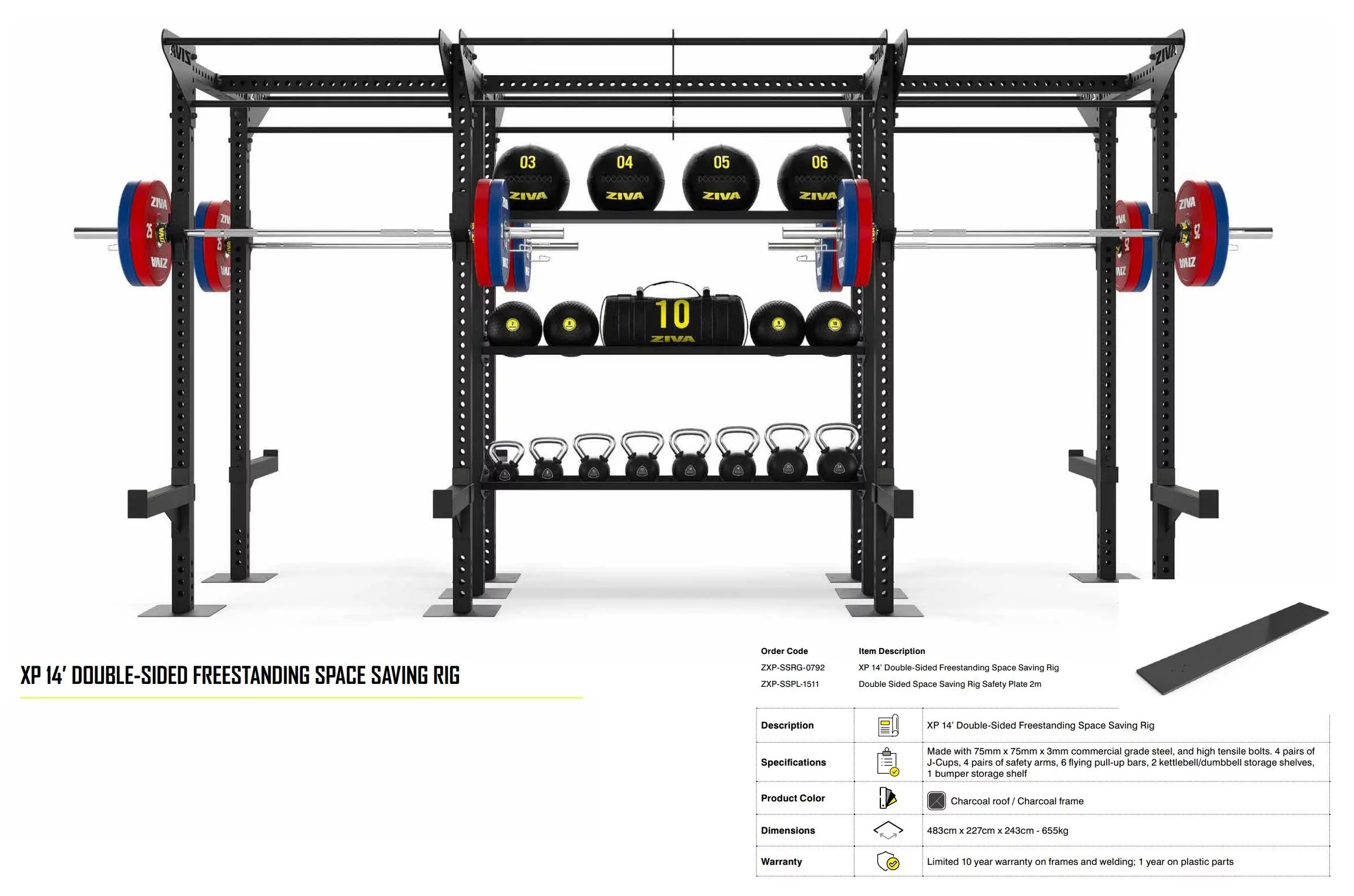
The instinctive approach is to find a unit, then fill it. The reliable approach is the reverse. Count the members you intend to have in the busiest class, give each one a working station on the rig, add the pull-up capacity, the storage runs and the circulation that lets a coach walk the class without stepping over a barbell, and you have a linear requirement in metres. Only then does a floor area become meaningful. A room that looks generous on a plan can turn out to hold six lifting stations instead of twelve because the rig had to be broken into two runs.
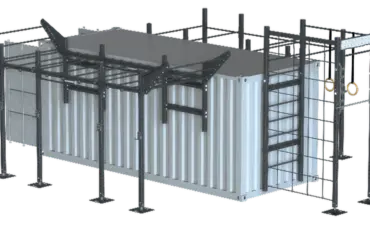
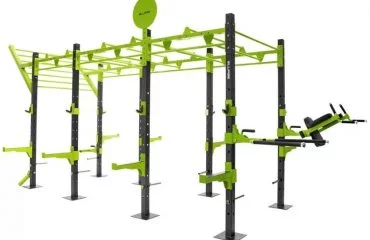
Ceiling height, column positions and the position of the fire exits usually constrain the rig more than the total surface area does. Send the plan before you sign, not after. The families of structures are compared on the CrossFit and HYROX cages page.
Flooring: one surface will not do
This is where new operators most often underspend. A dropped loaded barbell is a very different event from a treadmill running eight hours a day, and a single tile specification cannot serve both without being wrong somewhere. Lifting zones and platforms take a thick, dense rubber able to absorb repeated impact; the functional and cardio areas take a thinner surface chosen for wear, grip and cleaning. Where the gym sits above another occupied floor, an acoustic underlay is added under the whole build-up rather than only under the lifting area, because impact noise travels through the slab and not through the tile.
Turf tracks for sled pushes and carries are usually specified separately again. The impact grades are grouped on the weightlifting rubber tiles page.
The core equipment list
The base of any cross-training room is deliberately simple, and it does not change much from one country to another:
- Olympic barbells and bumper plates, in enough pairs to serve every lifting station at once
- Kettlebells, dumbbells and free weights across a usable range rather than a few heavy pieces
- Gymnastic rings, pull-up bars, suspension straps and battle ropes on the rig
- Medicine balls, plyometric boxes and resistance bands for conditioning work
- Conditioning cardio: rowers, air bikes, ski ergometers, treadmills and cross trainers
- Gym mats and storage furniture, so that the room can be reset between classes in minutes
Quantities, not brands, are what usually get a project wrong. A class of twelve that has to share four barbells is a class that will not renew.
Professional class, not semi-professional
Everything installed in a supervised commercial facility is specified to EN ISO 20957-1 class S, the professional class. Class I is also a professional class, designed for inclusive access, and not a step above class S. Equipment sold as semi-professional is built for a different duty cycle and has no place in a room that opens to the public and runs classes back to back. The saving disappears the first time a frame is replaced under warranty and the class has to be cancelled.
Six steps from plan to opening
- Build a solid business plan. Set out your objectives, your target market, your pricing model, your budget and your funding. This is also where you decide capacity, which is the number that drives the equipment list.
- Find the right premises. Look for a location your members can reach easily, with the clear span and the ceiling height the activity needs, and make sure the building complies with the safety and planning rules applicable in your country.
- Buy equipment that matches the duty cycle. Durable, professional grade, and specified in the quantities your busiest class actually needs.
- Hire qualified staff. Certified coaches, plus support staff, all trained in first aid so that the room is never without someone able to respond.
- Build a community. Social events, in-house competitions and open sessions turn a facility into a club, and a club retains members that a facility does not.
- Deliver outstanding service. Listen to what members say, adapt the timetable, and offer personalised programming for those who want it.
Do not forget recovery
Recovery space is the cheapest differentiator a cross-training gym has. A sauna, a steam room, a cold plunge or simply a quiet area where members can sit after a session extends the time they spend on site and gives them a reason to come on days they are not training hard. Plan the drainage and the ventilation for it at the shell stage; retrofitting a wet area into a finished gym is expensive.
Frequently asked questions
How much floor area does a cross-training gym need?
There is no single figure, because the answer comes from the capacity you have chosen and from the shape of the unit. The same surface area holds very different numbers of lifting stations depending on the clear span and the column grid. Send the plan and the target class size and we will return a layout with a station count.
Can the same room host CrossFit classes and open gym use?
Yes, and most successful rooms do, but the layout has to allow it. That normally means keeping the lifting platforms along the rig, placing the conditioning cardio where it does not cut the coaching sightlines, and reserving a free floor area that can be cleared for a class without moving equipment.
Should the equipment be bought all at once?
The rig, the flooring and the barbells should be, because they define the room and are disruptive to change later. Cardio and accessories can be phased as membership grows, provided the electrical supply and the floor build-up were specified for the final layout from the start.
Have your gym specified
Send us the plan of the unit, the class size you are aiming for and the mix of CrossFit, cross-training and open gym you intend to run, and we will come back with a rig layout, a flooring specification zone by zone and a full equipment list. See what a full fit-out includes on the CrossFit box equipment page, or start with the request a quote form.