Professional CrossFit Equipment: How to Choose a Supplier
Sourcing professional CrossFit equipment is a procurement decision, not a shopping trip. A box, a fitness club, a hotel gym or a municipal sports hall buys structures that will absorb thousands of repetitions every week, under public liability. The real question is not only where to buy, but from whom, against which standard, and with what after-sales cover. This guide sets out the sourcing routes open to commercial buyers and the checks worth running before an order is signed.
Commercial grade is a standard, not a marketing word
Indoor training equipment installed in a facility open to third parties must meet EN ISO 20957-1 class S. Class S covers equipment built for continuous use in supervised commercial environments, with the structural safety factors that go with it. Class I is a professional class for inclusive access, not an intensity tier above class S. Outdoor adult stations follow EN 16630, while children’s equipment follows EN 1176-1, with EN 1177 governing the impact-attenuating surface underneath. Ask any supplier for the declaration that names the standard and the class: a brand that answers with a brochure rather than a document has told you something useful.
Buying from a specialist B2B supplier
Most operators end up here, and for a structural reason. A specialist quotes a configuration rather than a list of items: rig, anchoring, flooring, storage and free weights are specified together because they interact. Bar spacing dictates how many athletes work per station, the rig footprint dictates the flooring plan, and the flooring build-up dictates the drop zones. A supplier who prices those elements in isolation leaves the integration risk with you.
Light In Fitness has worked this way since 2013 and has equipped more than 2,500 customers. Alongside its own range it distributes ZIVA, Ellipse and Xebex, which together cover rigs and racks, plate-loaded and selectorised strength machines, air-resistance cardio, benches, barbells, dumbbells, kettlebells and gym flooring. Buying a whole room from one source keeps a single warranty contact and one spare-parts channel.
The routes that rarely work for a commercial fit-out
Buying through the gym you train in is standard advice and it suits an individual. It does not suit an operator: the volumes are wrong, the invoicing is wrong, and there is no design support behind it. General marketplaces are worse. Listings there mix consumer and commercial ranges under the same photographs, the class declaration is usually absent, and lead times are quoted for a parcel rather than for a pallet with tail-lift delivery and an installation slot.
The second-hand market deserves a more nuanced answer. Ex-club rigs and plate-loaded machines can be perfectly sound, but you inherit an unknown fatigue history, missing hardware and, frequently, no traceable declaration of conformity. For a structure that will be bolted to a slab and used by paying members, that is a poor trade.
What to check before you sign
Footprint and ceiling height come first: a freestanding rig needs clearance for pull-ups and muscle-ups, and a wall-mounted rig needs a wall that can genuinely take the pull-out load. Ask what the anchoring specification assumes about the slab. Then look at the floor. Weightlifting zones need a thicker, denser tile than a general training area and the two are not interchangeable. Confirm the warranty in writing, and confirm that wear parts such as pads, bearings, cables and J-cups will still be orderable in five years.
Finally, treat budget as a total cost of ownership. A cheaper rig that needs its flooring replaced after two seasons, or that cannot be extended when the box grows, is not cheaper.
Frequently asked questions
Can I equip a commercial box with equipment sold for private use?
No. Equipment declared for private use falls outside EN ISO 20957-1 class S and is not intended for supervised commercial operation. Beyond the safety argument, installing it in a facility open to the public can weaken your insurance position; check the requirements applicable in your own country.
Freestanding rig or wall-mounted rig?
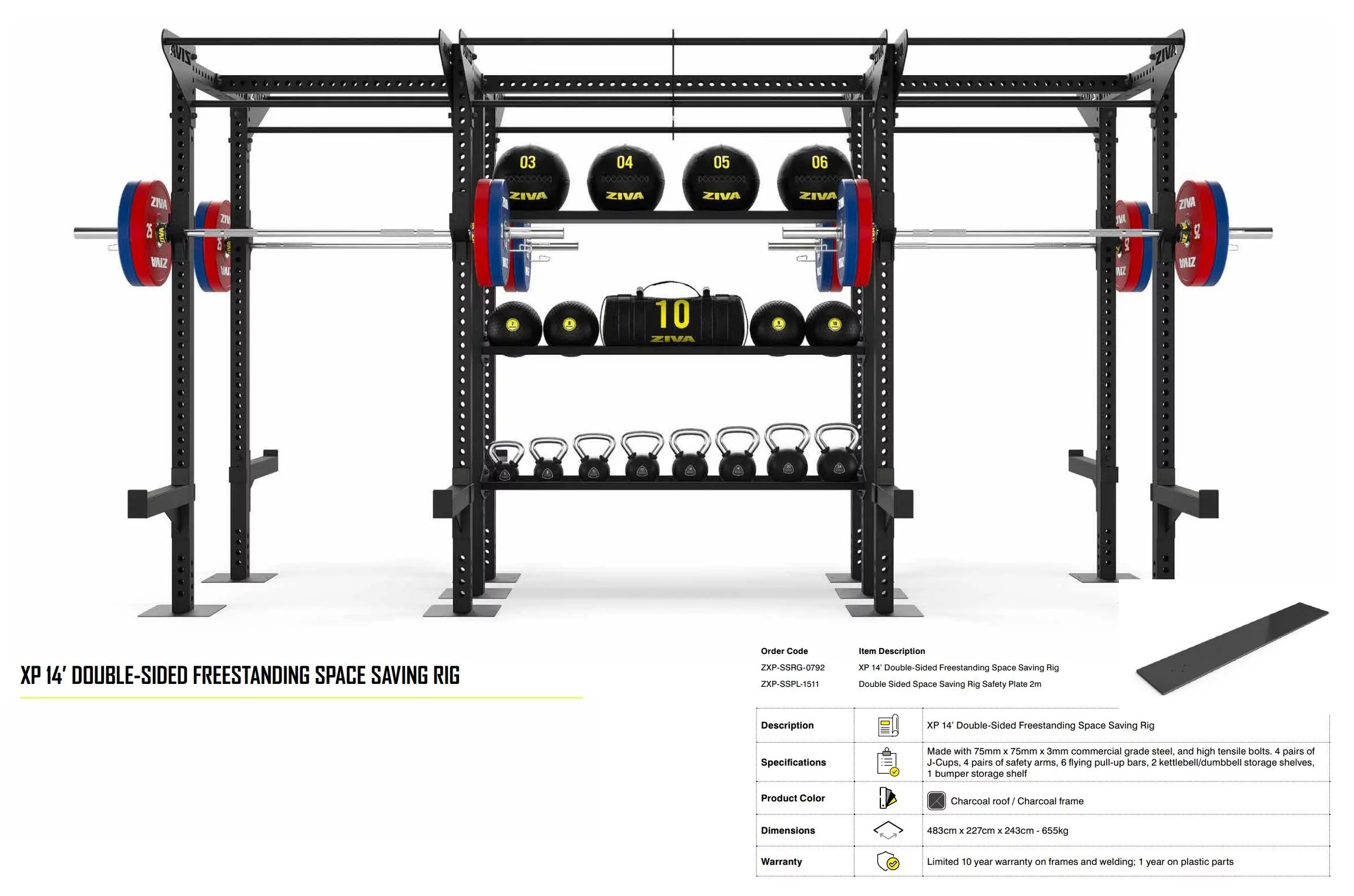
A freestanding rig can be repositioned and does not load the building envelope, which suits leased premises and large open floors. A wall-mounted rig saves floor area in a narrow room but commits you to that wall and to its structural capacity. Our freestanding CrossFit rigs page sets out the available configurations.
How many training stations do I need?
That follows from class size and programming, not from floor area alone. Count the maximum number of athletes training simultaneously, then specify stations so that no movement in a typical workout creates a queue. A supplier should model this with you at the drawing stage.
Specifying your project
Where to buy matters less than what you specify. Bring the room dimensions, the ceiling height, the slab type, the class sizes and the programming, and the equipment list follows from them. Review CrossFit and HYROX cages and rubber gym flooring tiles to frame the scope, then request a quote and have the whole configuration priced as one project.