10 CrossFit Movements and the Equipment Your Box Needs
Fitting out a cross-training box always starts with the same question: which movements will actually be programmed on the floor, week after week? Everything else follows from that answer. The rig you specify, the number of barbells you buy, the depth of your flooring and even the way you organise your training zones are all consequences of a programming decision. This guide walks through ten movements that appear in almost every high-intensity functional training session, and sets out what each one demands from a professional facility.
It is written for the people who sign the purchase order: affiliate box owners, independent functional training studios, hotel and resort fitness managers, municipal sports departments and club committees. The point is not to teach the movements, but to make the link between programming and capital expenditure explicit, so that the equipment you buy still fits the sessions you run three years from now.
Why the movement list decides the equipment list
High-intensity functional training combines cardiovascular work, weightlifting and gymnastics in constantly varied sessions. That variety is exactly what makes it demanding to equip. A studio built only around selectorised machines cannot deliver it; neither can a room with a rig but no conditioning space. The facilities that work are the ones where every programmed movement has a dedicated, safe and repeatable place to happen.
There is a second consequence, and it is financial. Equipment used in a supervised commercial environment is subjected to loads and hours no consumer product is designed for. Indoor equipment for this use should be specified to EN ISO 20957-1 class S, the class intended for professional and commercial operation. Specifying below that level is a false economy: replacement cycles shorten, downtime rises, and the equipment becomes a liability rather than an asset.
What functional training delivers for your members
Endurance and strength in the same session. Sessions typically pair cardiovascular work such as running, rowing or skipping with strength work such as squats, presses and pull-ups. Because these movements recruit several muscle groups at once, members develop transferable strength and general work capacity rather than isolated muscle size. For an operator, that combination is the retention argument: members feel measurable progress on tasks they recognise from daily life.
Mobility and coordination. Lunges, deadlifts and the clean and jerk all require coordination between multiple muscle groups, and most sessions build in mobility and stretching work. Better mobility means a fuller range of motion, and a fuller range of motion means fewer injuries and fewer interrupted memberships.
Metabolic conditioning. Intense sessions raise heart rate sharply and keep metabolic demand elevated after the session ends. Combined with sensible nutrition, this is what most members come for. It is also what defines your ventilation, your flooring and your cleaning routine, because the sessions are genuinely sweaty ones.
The ten movements and what each one needs on the floor
1. Burpees. A full-body movement: from standing, drop into a plank, perform a press-up, return to the plank and jump back to standing. It works the upper body, the core, the glutes and the legs while training cardiovascular endurance and coordination. Floor requirement: shock-absorbing surface with enough clear area per athlete, since burpees are usually programmed for the whole class at once.
2. Squats. The foundation movement. Standing with feet at shoulder width, the athlete lowers until the thighs are parallel to the floor. It builds leg, glute and lower-back strength and improves trunk stability. Floor requirement: squat stands or a rig with adjustable J-cups, olympic barbells and enough platform space for loaded work.
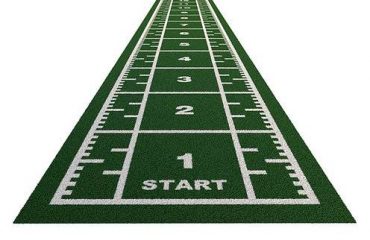
3. Lunges. A long step forward with one leg while the trailing knee descends towards the floor. Lunges strengthen the legs and glutes and improve balance and stability. Floor requirement: a clear lane, usually the same turf track used for sled work and carries.
4. Press-ups. From a plank position with the hands slightly wider than the shoulders, the athlete lowers the body by bending the elbows and pushes back to the start. Press-ups develop upper-body strength and endurance. Floor requirement: none beyond a clean, comfortable surface, which is precisely why they appear in almost every warm-up.
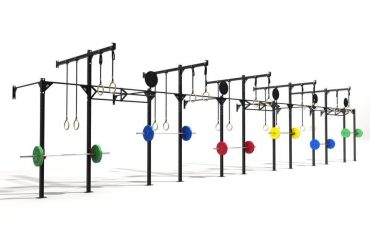
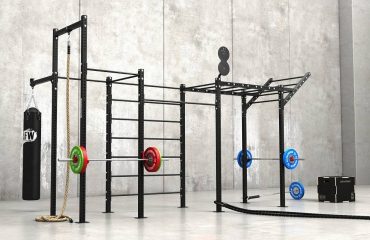
5. Pull-ups. An advanced movement: hanging from a fixed bar, the athlete pulls up until the chin passes the bar. It develops back, arm and shoulder strength and improves posture. Floor requirement: this is the movement that forces the rig decision. Bar height, bar diameter, the number of simultaneous stations and the anchoring method all have to be settled before the structure is ordered.
6. Deadlifts. A versatile movement that loads the back, legs and glutes. The athlete hinges at the hips and knees, keeps a flat back and stands up with the bar. It builds general strength and posture. Floor requirement: lifting platforms or dedicated weightlifting flooring, because repeated loaded contact is what destroys ordinary surfaces first.
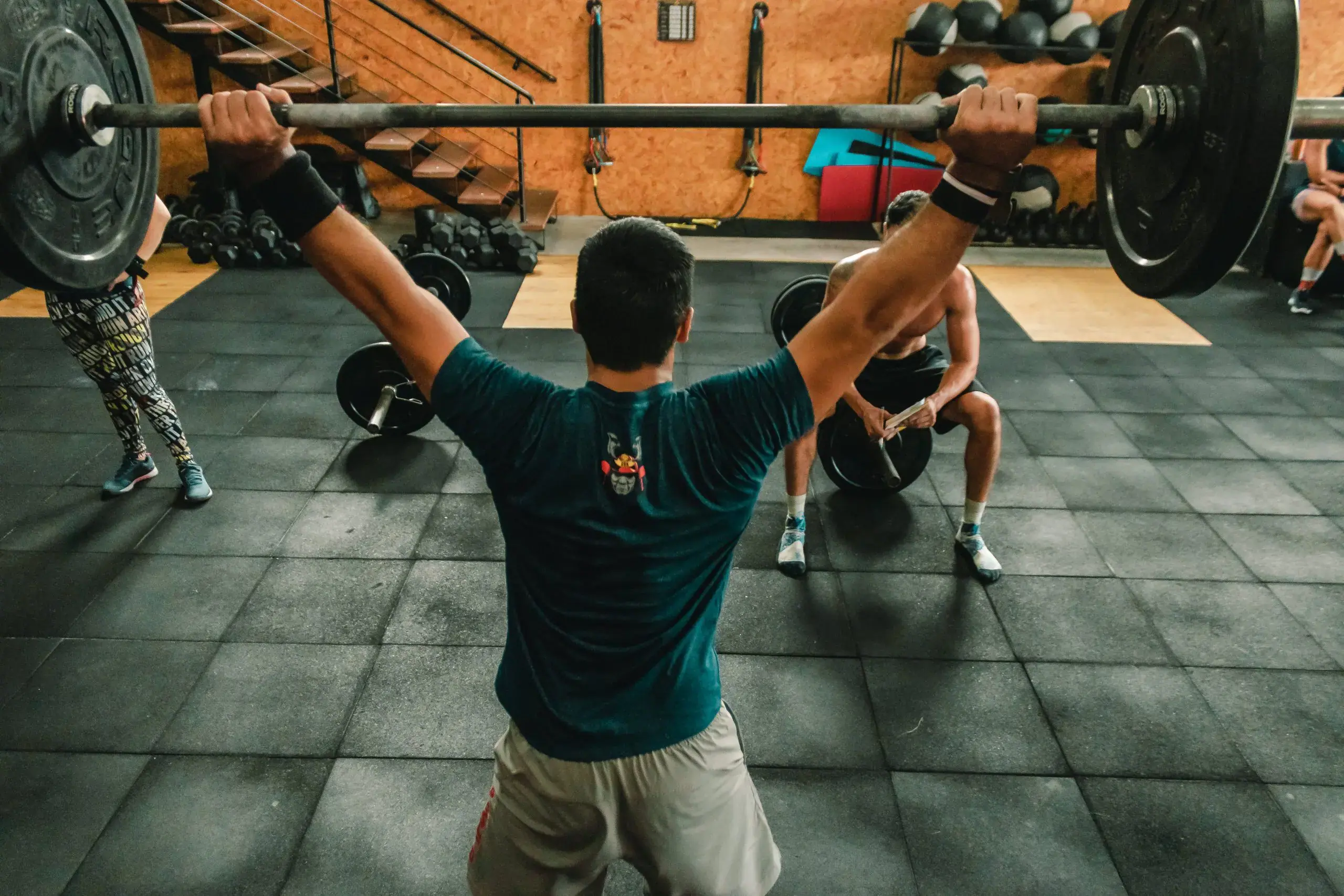
7. Clean and jerk. An advanced movement combining two phases: the clean, bringing the bar to the shoulders, and the jerk, driving it overhead. It loads the legs, shoulders and back and develops power and general strength. Floor requirement: certified bumper plates, competition-grade barbells and clear overhead space with nothing suspended above the lifting zone.
8. Wall balls. A squat combined with a medicine ball throw against a wall. Holding the ball at the chest, the athlete squats, then drives up and throws the ball high against the target. It loads the legs, trunk and shoulders. Floor requirement: a wall able to take repeated impact, or a dedicated wall ball target on the rig, plus enough ceiling height.
9. Double unders. A cardiovascular movement in which the rope passes twice under the feet during a single jump. It is demanding on coordination and endurance. Floor requirement: ceiling clearance and a surface that will not shred ropes, which in practice means an even, dense floor rather than a soft one.
10. Kettlebell swings. With feet at shoulder width, the athlete hinges, swings the kettlebell between the legs with a flat back and drives up to bring it forward to shoulder height. It loads the legs, glutes and lower back and builds trunk stability. Floor requirement: a full weight range in commercial-grade kettlebells, because the same class will swing very different loads.
Programming these movements safely in a supervised facility
Warm-up and mobility before every session. A proper warm-up prepares muscles and joints for the work ahead. It usually combines light cardiovascular work, dynamic stretching and movement-specific preparation for whatever the session contains. From an operator perspective, this is also a scheduling question: the warm-up needs floor space that is not already occupied by the previous class.
Respecting limits and progressing gradually. Athletes should not force load or intensity beyond what feels controlled. Loads and movement variations must be scaled to the individual, then progressed slowly and deliberately. That requires equipment with genuine adjustability and a wide load range, not a single fixed setup.
Hydration and recovery. These sessions are intense and produce heavy sweating, so members need to drink throughout and take the time to stretch and recover afterwards. Recovery space, whether that means a stretching zone, mats or dedicated wellness equipment, is part of the facility, not an afterthought.
Building the floor around the ten movements
Read the ten movements back as a shopping list and a coherent facility emerges. You need a structure that carries pull-ups, muscle-ups, wall ball targets and storage: that is the role of a CrossFit and Hyrox cage, freestanding or wall-mounted depending on your ceiling and your span. You need barbells and bumpers that survive being dropped, and a full range of professional kettlebells so that scaling is genuinely possible.
Above all you need the right surface under all of it. Deadlifts and the clean and jerk demand rubber tiles designed for weightlifting, thicker and denser than general training flooring, while conditioning zones and lunging lanes can run on lighter surfaces. Mixing the two intelligently is usually cheaper than covering the whole room in the heaviest specification.
Frequently asked questions
Do I need to equip for all ten movements from day one?
No, but you should plan the layout for all ten. Rigs are modular and can be extended, and flooring can be zoned in phases. What is expensive is discovering after installation that the ceiling height or the anchoring points will never allow overhead work.
Can these movements be programmed for beginners?
Yes. Functional training suits every fitness level because loads, ranges and movement variations are scaled to the individual. That flexibility is a specification requirement: your equipment has to accommodate both a first-week member and an experienced athlete in the same class.
What distinguishes professional equipment from consumer equipment here?
Duty rating, materials and serviceability. Equipment for a supervised commercial facility should be specified to EN ISO 20957-1 class S, with replaceable wear parts and structures designed for continuous multi-user operation.
Does outdoor training change the specification?
Yes. Permanently installed outdoor adult training equipment falls under EN 16630, a different standard with its own requirements for materials, anchoring and free space. Indoor and outdoor ranges are not interchangeable.
Planning your box
The ten movements above are not a training plan, they are a specification brief. Work out which of them your programming will genuinely use, how many athletes need to perform each one simultaneously, and what your building will physically allow. From there, the rig configuration, the barbell count and the flooring plan follow logically.
Light In Fitness has been equipping professional training facilities since 2013, from single rigs to complete turnkey fit-outs. Send us your floor plan, your class sizes and your programming, and we will come back with a configuration and a costed proposal. Request a quote and we will work through it with you.