V-Ups in CrossFit: Technique, Common Faults and Scaling
The V-up occupies a particular place in class programming: it needs almost nothing, it scales in both directions, and it exposes a midline that a plank can hide. That combination is why coaches reach for it in warm ups, in finishers and in conditioning couplets. It is also why it is done badly so often, since an exercise that requires no equipment also receives very little set-up attention. This article covers what the movement actually trains, how to coach it, the faults that recur in every class, and what the floor has to provide for a group to do it properly.
What a V-up is
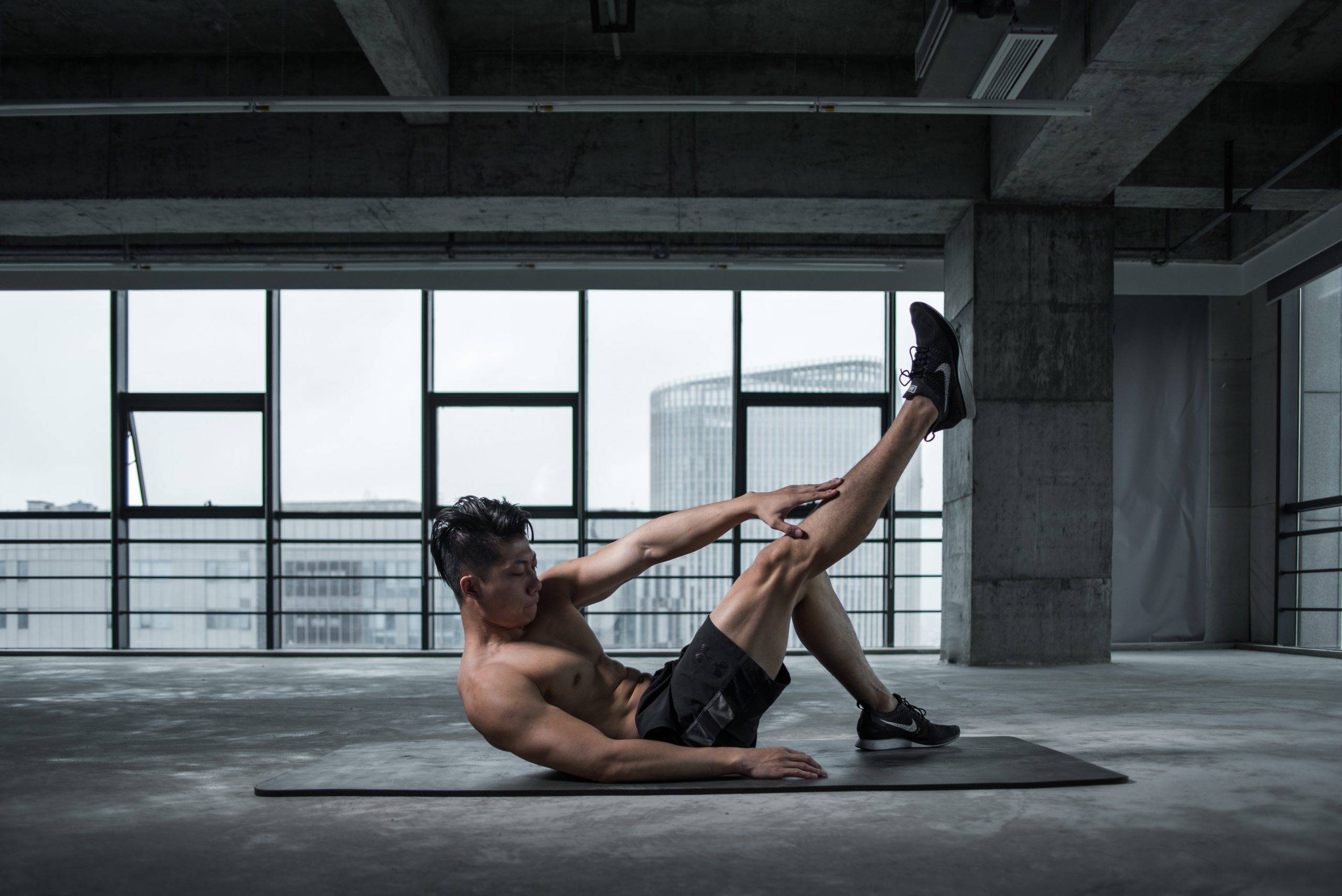
The athlete lies supine, arms extended overhead and legs straight. On the effort, torso and legs rise at the same time so that the body forms a V, hands travelling towards the feet, before returning under control to the floor. It is a closed chain flexion of the whole trunk rather than the partial flexion of a crunch, which is why the same athlete can do thirty crunches and fail at eight V-ups.
The movement recruits the abdominal wall as a unit, rectus abdominis, obliques and the deep transverse layer, and it demands hip flexor strength and hamstring length at the same time. That is the reason it also gets used as a screening movement: an athlete who cannot keep the legs straight is usually short in the hamstrings rather than weak in the midline.
Why coaches programme it
- Midline strength: the trunk is loaded through a full range rather than in a partial one, and the obliques work to stop rotation as the legs rise.
- Balance and control: raising torso and legs simultaneously demands coordination between the two ends of the body, which transfers to every other lift in the programme.
- Mobility: the position requires hamstring length and a lower back that tolerates flexion, and the movement maintains both when it is trained regularly.
- Whole body carryover: several muscle groups work together, which is what makes it a conditioning movement and not only an abdominal one.
How to perform it
- Lie flat, arms extended overhead, legs straight, lower back in contact with the floor.
- Breathe in and set the midline before moving.
- Raise legs and torso together, arms staying extended and reaching forward.
- Bring the hands towards the feet at the top, forming the V.
- Hold the top position briefly, then return to the floor under control rather than dropping into it.
Breathing follows the movement: in at the bottom, out through the rise. The descent is part of the repetition, not a rest, and it is the half of the movement that most athletes give away first.
The four faults that recur in every class
| Fault | What you see | Coaching cue |
|---|---|---|
| Using momentum | The athlete rocks to launch the rep | Slow the tempo, hold the top position for a count |
| Holding the breath | Breathing stops for whole sets | Exhale on the way up, inhale on the way down |
| Going too fast | Range shortens rep after rep | Cap the set at the last full range repetition |
| Losing the midline | Lower back lifts, legs bend, chest collapses | Scale the movement rather than continue the set |
The last one matters most in a group setting. A V-up done with a lumbar spine that has left the floor is no longer the same exercise, and in a class of fifteen it is the fault a single coach misses most easily.
Scaling in both directions
The movement scales cleanly, which is what makes it usable with a mixed class. Downwards: bent knees, half V-ups, or tuck-ups where the knees come to the chest instead of the legs staying straight. These build the same pattern while the athlete gains midline strength and hamstring length. Upwards: a longer pause at the top, a slower eccentric, or a light load held in the hands. Adding load should come after the range is complete, never as a way of compensating for a range that is not.
A useful progression is to move an athlete on only when a full set can be completed with straight legs, contact with the hands and a controlled descent. Everything before that point is a scaled version, and there is no reason to hide the fact.
Fitting it into a session
The V-up works as the main movement of a midline block rather than as an isolated set. A simple circuit that many boxes use looks like this:
- V-ups: 3 sets of 12 repetitions
- Crunches: 3 sets of 15 repetitions
- Plank: hold 30 seconds, 3 times
- Hanging leg raises: 3 sets of 10 repetitions
Two to three sessions a week with a rest day between them is enough to produce a visible change, with a warm up before and stretching afterwards. Hanging leg raises are the part that needs hardware: a pull-up bar on a CrossFit rig or a wall mounted station, with clear space underneath and enough bars for the class size.
What the floor has to provide
A movement performed lying down is only as comfortable as the surface underneath it. A bare rubber tile is hard on the lumbar spine and unhygienic in a class where fifteen people lie down in sequence, which is why exercise and gym mats belong in the equipment list of any box that programmes floor work. Storage matters as much as the mats themselves: mats that have nowhere to go end up on the floor at the edge of the training area. Bands, medicine balls and the rest of the fitness accessories used around midline blocks follow the same rule.
Frequently asked questions
Is the V-up suitable for beginners?
In its scaled versions, yes. Bent knee and half V-ups give the same pattern at a level a beginner can control, and the full version follows once the range is available.
Does it replace other midline work?
No. It works best inside a block that also contains an isometric hold and a hanging movement, since each loads the trunk differently.
How many repetitions should be programmed?
Enough to stay within full range. Sets in the range used in the circuit above are typical, and a set should end at the last correct repetition rather than at the planned number.
Who should avoid it?
Anyone for whom repeated loaded spinal flexion is contraindicated. In those cases an anti-extension hold replaces it without losing the training effect.
Equipping the floor for midline work
Programming floor work for a full class is a question of mats, storage and available bars far more than of exercise selection. Send the size of your training area and your class numbers, and the flooring, mats and rig configuration can be specified around them: request a quote.