Artificial turf tracks for CrossFit and functional training

Artificial turf tracks for functional training: performance, protection and presentation
The synthetic turf lane has become a standard component of CrossFit and cross training layouts, and for good operational reasons. Against concrete, rubber or timber it offers a surface that is hard wearing, versatile and visually distinct, and it changes how a conditioning zone is used. This guide covers what the surface delivers, the technical specification that decides whether it lasts, and what a facility manager needs to establish before ordering.
Safety and reduced injury risk
The first argument for synthetic turf is safety. Its cushioning structure reduces the impact on joints during sprints, jumps, burpees and rapid changes of direction. That shock absorption helps prevent the common complaints of a functional training population, from ankle sprains to tendon irritation and knee pain, while giving a stable, slip resistant surface even during explosive work.
Durability under sled work
Turf specified for functional training uses short, very dense fibres able to take repeated friction, dragged loads such as sleds, plates and bars, and continuous traffic. The wear rate stays low even in commercial and club use, which is the whole point: a conditioning lane in a busy box sees more passes in a week than a domestic surface sees in a year.
Versatility and customisation
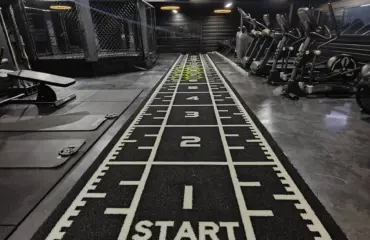
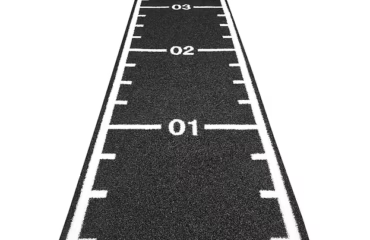
A turf lane suits sprints, sled pushes and pulls, jumps, loaded carries, functional work and full WOD circuits. It can be customised in dimensions, colours and markings, including sprint zones, metre-by-metre numbering and logos, which is how a coach turns an open lane into a structured training tool and how an operator gives a room a recognisable identity.
Performance, comfort and presentation
Training on synthetic turf recruits the stabilising musculature more than a rigid floor, because a slightly compliant surface adds natural resistance to every movement. That raises the intensity of the effort, improves balance and supports functional strength work. Comfort follows: the surface limits joint fatigue, absorbs impact during floor work and remains pleasant underfoot, including barefoot, while a textured pile keeps grip reliable in flat shoes.
Maintenance is minimal compared with natural grass or porous surfaces. There is no watering, mowing or fertilising. A vacuum or a brush keeps it clean and it can be disinfected easily, which matters in a shared facility where the floor is a hygiene surface as much as a training surface.
Available in green, blue, red, black or a custom colour, the turf lane structures the room visually, separates the conditioning zone from the lifting area, and reinforces the professional image of the facility. In a competitive market that is a retention argument as much as a technical one.
Technical specification
| Item | Specification |
|---|---|
| Fibre | High density polyethylene, wear and UV resistant |
| Pile | Short curled pile, 10 to 20 mm, balancing cushioning and firmness |
| Density | Up to 63 000 stitches per square metre |
| Standard lengths | 10, 15, 20, 25 and 30 m, with custom lengths available |
| Widths | 1 to 2 m depending on the layout |
| Markings | Numbering, lines and logos, customisable |
Installation
- Laid over a concrete slab, a timber floor or an existing rubber surface.
- Fixed with double sided tape, adhesive or stapling depending on the substrate.
- Quick and clean to install, and reversible where a facility needs to reconfigure the room later.
The substrate decides the result more than the turf does. The surface below has to be flat and clean, and any unevenness in the slab will read through the lane and show up as a wear line within months. Where the lane sits over rubber tiles, check that the build-up under the sled zone is continuous, because a joint that moves under load will eventually open.
Where turf lanes are used
- Functional training boxes: a sprint and sled zone with metre-by-metre marking for speed and power work.
- Commercial gyms: visual differentiation and a modern, versatile training zone that supports member retention.
- Hotels, clubs and corporate facilities: a compact conditioning lane that adds capability without adding machines.
Frequently asked questions
Does the turf hold up to heavy sleds?
Yes. The short, dense fibre takes repeated passes of loaded sleds, bars and plates without deforming. Sled work is the design case for this type of surface rather than an exception to it.
Can a turf lane be laid on any floor?
It installs over concrete, timber, rubber or asphalt. What it needs is a flat, clean surface; the substrate matters more than the material.
How is it maintained?
Regular vacuuming or brushing, and washing with clean water or a disinfectant product, is enough to keep the lane clean and hygienic.
Can colours and markings be customised?
Yes. Colours include green, blue, red and black, and markings such as numbering, lines and logos can be produced to the layout of the room.
Is it suitable for barefoot work?
Yes. The soft, slip resistant texture works for floor work and barefoot exercises while still providing impact protection.
Specifying your conditioning lane
See the ranges: numbered artificial turf tracks, artificial turf tiles, and the 20 m x 2 m black CrossFit turf track. Light In Fitness has equipped commercial facilities since 2013. Send the length available, the width of the zone and the substrate, and the lane can be specified around them. Request a quote for a costed proposal.