Thruster: technique, loads and the equipment a commercial floor needs
Le thruster enchaîne un front squat et un développé militaire en un seul mouvement fluide, sans temps d'arrêt entre les deux. Il sollicite quadriceps, fessiers, épaules et gainage avec une dépense énergétique parmi les plus élevées du cross training. L'exécution part barre en position front rack, coudes hauts, et utilise l'extension des hanches pour propulser la barre.
The thruster is a front squat and a push press fused into a single uninterrupted movement, and it is the most equipment-hungry exercise on a functional training floor. Programming it properly means a 15 or 20 kg calibrated barbell, solid rubber bumper plates rated for repeated release, at least 40 mm of shock absorbing floor in the drop zone, and roughly 2.5 by 2.5 m of clear footprint per athlete. A single thruster-capable station, barbell plus 100 kg of bumpers plus collars, starts at approximately 700 EUR excluding VAT.
What a thruster is, and why coaches keep programming it
The thruster starts in the front rack position, drops to a full-depth front squat, and converts the hip extension out of the hole directly into overhead drive. There is no pause at the top of the squat. That continuity is the whole point: it recruits quadriceps, glutes, spinal erectors, deltoids and triceps in one chain, and it produces one of the highest oxygen costs per repetition of any loaded barbell movement.
For an operator, that has two consequences. First, thrusters are a throughput exercise: a class of 16 athletes can run a thruster couplet in a 60 minute slot with far less floor area than a squat rack circuit. Second, thrusters are hard on equipment. Every repetition ends with a bar being dropped or lowered onto the floor from shoulder height, and a busy box will see several thousand of those per week.
Technique: the six checkpoints
- Front rack. Bar resting on the deltoids, fingertips under the bar, elbows high. The hands hold the bar in place, they do not carry it.
- Depth. Hip crease below the top of the knee. A partial squat removes the stretch reflex that makes the movement efficient.
- Torso angle. As vertical as ankle and thoracic mobility allow. A forward lean turns the drive into a good morning.
- Transition. No pause at the top of the squat. Hip and knee extension feed straight into the press.
- Lockout. Bar finishes stacked over the mid-foot, biceps beside the ears, elbows locked, ribs down.
- Descent. Bar returns to the rack under control, elbows re-elevated before the next squat begins.
The two errors that cost the most repetitions in a workout are dropping the elbows on the way up, which pitches the bar forward, and pressing before the legs have finished. Both are load problems more often than technique problems: athletes who cannot hold the rack under 60 per cent of their front squat maximum are simply loaded too heavy.
Load benchmarks for programming
Thruster loads are conventionally expressed as a percentage of the athlete’s front squat one-repetition maximum, because the squat is almost never the limiting factor. The overhead lockout is.
| Population | Barbell load, men | Barbell load, women | Typical rep scheme |
|---|---|---|---|
| Beginner, first 8 weeks | Empty 20 kg bar | Empty 15 kg bar | 3 to 4 sets of 8 to 10 |
| Regular member | 30 to 43 kg | 20 to 30 kg | Couplets, 15 to 21 reps per round |
| Competitive age-group | 43 to 61 kg | 30 to 43 kg | Benchmark workouts, unbroken sets of 21 |
| Elite | 61 to 80 kg | 43 to 55 kg | Heavy singles and complexes |
As a planning rule, a well-conditioned athlete can hold an unbroken thruster set at around 40 per cent of front squat maximum and will fragment above 55 per cent. Programme accordingly if the intent is a metabolic stimulus rather than a strength one.
Barbell, dumbbell or kettlebell: what to buy for which room
The three implements are not interchangeable, and most commercial floors end up with all three because they solve different capacity problems.
| Implement | Best for | Floor area per athlete | Main limitation |
|---|---|---|---|
| Olympic barbell and bumpers | Benchmark workouts, heavy loading, competition preparation | 2.5 x 2.5 m | Highest floor and storage cost, demands a drop zone |
| Hex or urethane dumbbells | Large classes, mixed-ability groups, wrist-restricted members | 1.5 x 1.5 m | Unilateral loading limits absolute weight |
| Kettlebells in the double rack | Core and stability emphasis, small studios, hotel gyms | 1.5 x 1.5 m | Rack position is uncomfortable above 24 kg per hand |
For a mixed-membership club with limited square metres, dumbbell thrusters are usually the right default: they remove the mobility barrier of the front rack, they need no drop zone, and a set of professional hex dumbbells serves fifty other exercises. Barbell thrusters belong in a dedicated cross training area.
Equipment specification for a thruster-capable floor
Barbell
Specify a 20 kg men’s bar and a 15 kg women’s bar with a 28 mm and 25 mm shaft respectively, needle or bushing sleeves that spin freely under load, and a tensile strength of at least 190,000 PSI. Dual knurl marks matter for a thruster floor because athletes set both a clean grip and a jerk grip on the same bar. Chrome-finished commercial bars start at 144 EUR excluding VAT for the 150 cm model and 195 EUR excluding VAT for the 220 cm 50 mm reference. Budget 11.50 EUR excluding VAT per pair of collars and treat them as a consumable.
Bumper plates
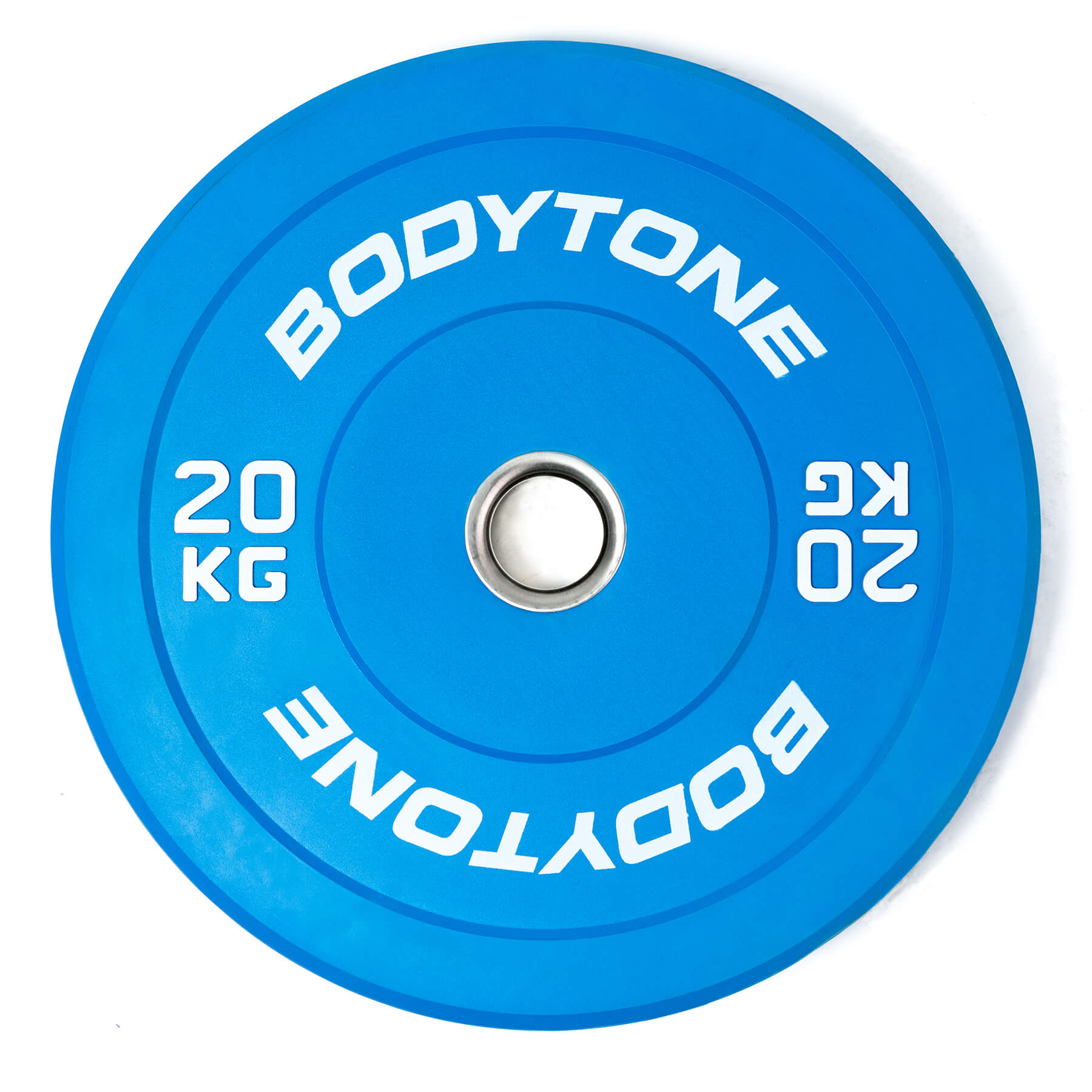
Solid rubber bumpers with a steel insert are mandatory. Cast iron plates crack the floor and the plate. Standard commercial bumpers run 63 EUR excluding VAT for 5 kg, 93 EUR for 10 kg, 118 EUR for 15 kg, 147 EUR for 20 kg and 166 EUR for 25 kg. IWF-specification competition bumpers, with tighter weight tolerance and a lower bounce, cost roughly double: 292 EUR excluding VAT for the 20 kg blue plate. Buy competition plates only for a platform used in competition preparation; the standard grade is the correct choice for class use.
Flooring
This is where thruster programming quietly destroys budgets. A bar released from shoulder height delivers a concentrated impulse to the slab. Specify 40 mm solid rubber tiles across the drop zone as a minimum, moving to 50 or 60 mm where the club also programmes heavy deadlifts or where the room sits above an occupied floor. Fifteen and 20 mm general-purpose tiles are not a drop surface, and replacing them after they fail costs more than specifying correctly. See our drop zone flooring guide for thickness and density thresholds.
Storage
Loose bumpers on a class floor are a trip hazard and a plate-loss problem. A vertical bumper tree at around 499 EUR excluding VAT per unit holds a full class set and pays for itself in avoided plate replacement within two years.
What a thruster station actually costs
The figures below assume a commercial cross training floor equipping ten simultaneous barbell stations.
| Item | Quantity | Unit price excluding VAT | Line total excluding VAT |
|---|---|---|---|
| 20 kg chrome Olympic bar, 220 cm | 10 | 195 EUR | 1,950 EUR |
| Collar pairs | 10 | 11.50 EUR | 115 EUR |
| Bumper set, 2 x 10 kg + 2 x 15 kg + 2 x 20 kg per station | 10 sets | 716 EUR | 7,160 EUR |
| Vertical bumper storage | 4 | 499 EUR | 1,996 EUR |
| 40 mm rubber drop-zone tiles, 65 m2 | 65 m2 | from 38 EUR/m2 | from 2,470 EUR |
Total for a ten-station barbell floor: in the region of 13,700 EUR excluding VAT, excluding installation. The same ten stations equipped with dumbbells instead cost roughly a third of that and need no drop-zone upgrade, which is why hotel and corporate gyms almost always take the dumbbell route.
Standards and duty of care
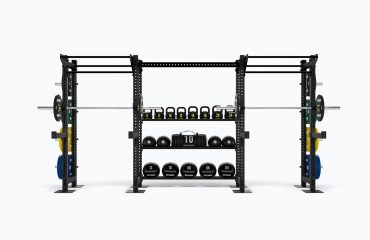
Barbells, plates and racks placed in a supervised commercial environment must be specified to EN ISO 20957-1:2024 class S, the professional and commercial use class. Class H equipment is designed for domestic use and has no place on a paying floor; class I covers inclusive professional equipment intended for supervised use by people with disabilities. Cross training rigs used to store or rack thruster bars should be anchored and inspected on a documented schedule. Our rig anchoring and maintenance guide sets out the inspection intervals commercial operators are expected to hold records for.
Frequently asked questions
What weight should a beginner use for thrusters?
An empty 15 or 20 kg Olympic bar for the first six to eight weeks. The thruster is a coordination exercise before it is a strength exercise, and adding load before the squat-to-press transition is smooth simply reinforces a stall at the top of the squat.
Which muscles does the thruster work?
Quadriceps and glutes drive the squat, spinal erectors and the whole trunk stabilise the front rack, and the deltoids and triceps finish the overhead lockout. It is one of the few movements that loads the entire posterior and anterior chain in a single repetition, which is why it dominates conditioning workouts.
Are dumbbell thrusters better than barbell thrusters?
They are better for most commercial memberships. Dumbbells allow a neutral wrist and independent arm paths, they remove the front-rack mobility barrier that stops many new members, and they need no drop-zone flooring. The barbell wins on absolute load and on competition specificity.
How much floor space does a thruster station need?
Allow 2.5 by 2.5 m per barbell station, including the plate footprint and the safety margin around a dropped bar, and 1.5 by 1.5 m per dumbbell or kettlebell station. Ceiling height should be at least 2.9 m so that a tall athlete can lock out overhead without contact.
Do thrusters require a competition-grade lifting platform?
No. A platform is for weightlifting and heavy deadlifts. A thruster floor needs a continuous 40 mm shock absorbing surface across the working zone, which is a cheaper and more flexible specification than a set of discrete platforms.
Planning a cross training floor? Light In Fitness has supplied and installed functional training equipment across Europe and export markets since 2013, from single barbell zones to complete boxes. Send us your floor plan, your class size and your ceiling height, and we will return a costed specification covering bars, plates, storage and flooring. Request a quote or browse our cross training rigs and cages.