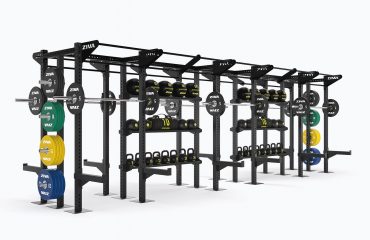
Professional CrossFit Equipment: What a Box Actually Needs
Un équipement CrossFit professionnel se distingue par sa tenue aux charges lâchées et à la rotation intensive : rigs, barres, disques bumper et sols renforcés. La section des tubes, la qualité des soudures et l'épaisseur du sol sous les zones de levée en sont les critères. Light In Fitness fournit l'ensemble avec étude d'implantation et pose.
A cross-training box is one of the harshest environments a piece of fitness equipment will ever live in. Loads are dropped rather than lowered, classes turn over every hour, and the same rig carries pull-ups, muscle-ups and rack work all day long. Equipment that performs well in a conventional gym can fail quickly here. This guide sets out what actually distinguishes professional CrossFit equipment, and how to specify a box that will still be sound in five years.
What makes CrossFit equipment professional
Professional cross-training equipment is defined by how it copes with dropped loads and intensive rotation: rigs, barbells, bumper plates and reinforced flooring. Three technical points decide that: the section of the tube used in the structure, the quality of the welds, and the thickness of the floor under the lifting zones. Everything else follows from those three.
Indoor equipment installed in a commercial facility falls under EN ISO 20957-1 class S, the class intended for supervised professional use. Name it in your specification. Class I is a professional class covering inclusive access, not a level above class S, and the two are not points on an intensity scale.
The rig is the backbone of the box
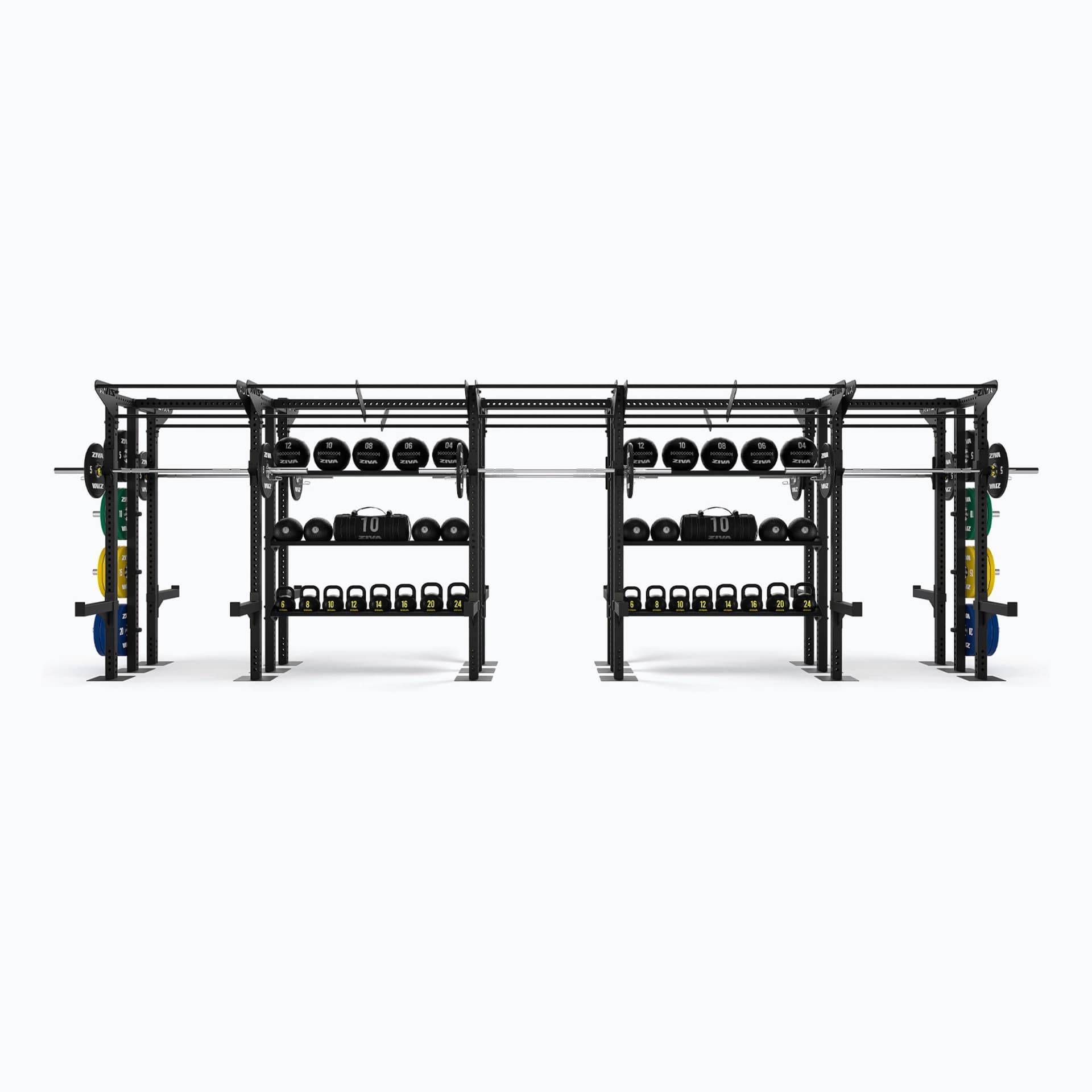
The rig defines how many athletes you can run through a class and what those classes can contain. A freestanding structure gives you flexibility of placement and can be reconfigured later; a wall-mounted structure saves floor area where space is tight. What matters in both cases is the steel: the tube section carries the dynamic load of an athlete kipping, and the welds are what fatigue first under repeated shock.
Specify the attachment points before you specify the frame. Rings, climbing ropes, monkey bars, barbell storage and rack positions all mount to the same structure, and retrofitting them later is more expensive than ordering them in the first place. Browse the range of CrossFit rigs and CrossFit and HYROX cages to see how configurations scale.
Barbells and bumper plates
Barbells in a box are consumables with a long life if you buy correctly and a short one if you do not. Look at the sleeve bearings, the knurl and the shaft rating, and match the bar to the population using it. Bumper plates protect the bar, the floor and the athlete, and are not interchangeable with cast iron plates in any zone where loads are dropped. Stock Olympic barbells in more than one specification if you run both technique classes and competition training.
Flooring is where budgets usually go wrong
| Zone | What it takes | Consequence of getting it wrong |
|---|---|---|
| Lifting platforms and drop zones | Thick reinforced rubber | Slab damage, noise complaints and premature plate wear. |
| General training floor | Rubber tiles or rolls | Rapid surface wear and joint gaps that become a trip hazard. |
| Sled and conditioning lanes | Dedicated track surface | Surface tears under repeated loaded pushes. |
The rule of thumb is simple: the floor thickness under the lifting zones is a structural decision, not a finishing one. Specify weightlifting rubber tiles for those areas rather than extending the general floor across the whole room.
Layout and installation
A box is a circulation problem as much as an equipment problem. Rig bays, drop zones, sled lanes and storage have to coexist without athletes crossing a loaded lane during a workout. A layout study done before ordering catches conflicts that are impossible to fix once the structure is bolted down, and it usually pays for itself in equipment you end up not buying. Light In Fitness supplies the full set of equipment together with a layout study and installation.
Frequently asked questions
What separates professional cross-training equipment from lighter equipment?
Its ability to take dropped loads and intensive rotation. In practice that comes down to the tube section of the structure, the quality of the welds and the floor thickness under the lifting zones.
Freestanding or wall-mounted rig?
Freestanding structures can be repositioned and reconfigured and do not depend on the building fabric. Wall-mounted structures free up floor area but tie you to the wall you chose. If the lease is short or the layout may change, freestanding is the safer specification.
Which standard applies to equipment in a box?
EN ISO 20957-1 class S applies to indoor equipment for supervised professional use. Ask for the declaration on the specific model rather than on the range.
Do I need different flooring in different zones?
Yes. A single floor specification across a whole box either overspends on the general floor or underspecifies the drop zones. Zoning the floor is normally the cheaper and the more durable route.
Equipping your box
Send us the floor plan, the class sizes you intend to run and the ceiling height, and we will come back with a configuration and a layout. Request a quote and we will cost the rig, the flooring and the accessories together rather than in isolation.