Essential Cross-Training Equipment for a Successful Session

Cross-training has become one of the fastest-growing disciplines of the last decade. Blending gymnastics, weightlifting and conditioning, it needs a specific set of equipment to be programmed properly. This guide covers what a box, club or functional training area actually needs on the floor, and how to size each item for the members you serve.
Free weights: dumbbells and kettlebells
Free weights are non-negotiable in cross-training. Dumbbells and kettlebells are the most versatile items on the floor: they cover a wide exercise catalogue, they load different muscle groups, and they develop balance and conditioning alongside strength.
Kettlebells in particular have advantages nothing else replicates. The offset handle allows a greater range of motion, which is what makes them right for the ballistic movements central to the discipline:
- Swings
- Snatches
- Cleans
Dumbbells cover the strength side — curls, presses and flyes — and their easy handling and wide weight range make them usable by every level on the floor at once.
Sizing your free weights
The purchase depends on current fitness level and training objectives. For beginners, a set of light dumbbells from 2 to 10 kg is the usual starting point, with heavier weights added as strength develops.
Kettlebells are generally available from 4 to 48 kg and should be selected the same way. The working rule is a weight that can be lifted without major difficulty but that still offers noticeable resistance. Our professional kettlebell range covers the full spread.
Slam balls and medicine balls
Slam balls and medicine balls are the other essential pieces. These weighted balls cover power, mobility and stability work in a very small footprint.
Slam balls absorb impact without bouncing, which is what makes them safe for explosive movements such as slams and throws. Medicine balls are more versatile for trunk and general conditioning work, because they adapt to a broader range of exercises.
Using weighted balls effectively
To get the most from slam balls, programme dynamic movements: overhead slams, Russian twists and squat-to-throws. Varying ball weight is the simplest way to adjust the difficulty of each exercise.
Medicine balls support a wide catalogue, including:
- Weighted sit-ups
- Wall ball shots
- Lateral passes
Both come in different sizes and weights, so stock a spread rather than a single specification.
The jump rope
Frequently underestimated, the jump rope is one of the most productive items on a cross-training floor. It builds coordination and agility and delivers genuine cardiovascular work, all with almost no storage requirement.
Stock more than one type. PVC ropes suit newcomers; plastic-coated steel cable versions suit advanced users working on double-unders or triple-unders.
Getting the most from rope work
- Make sure the rope length matches the user height.
- Master single unders before progressing to double unders.
- Train consistently to build endurance and coordination.
Barbells, plates and benches
Barbells and weight plates are essential for the WODs (Workouts of the Day). Combined with benches, they cover bench press, squats and deadlifts.
Three things decide the specification:
- Choose a standard olympic barbell rated for heavy loading.
- Make sure the plates and bumpers match the lifts being programmed — bumpers are required wherever the bar is dropped.
- Invest in a robust bench offering several incline settings.
Technique and safety supervision matter more here than anywhere else on the floor. Equipment used in a supervised multi-user setting should be specified to EN ISO 20957-1 class S.
Pull-up bars, rigs and gymnastic equipment
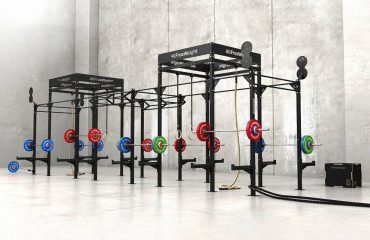
Pull-up bars are indispensable for upper-body strength and agility, covering pull-ups, chin-ups and muscle-ups. In a professional setting they are rarely standalone: they are integrated into a rig, which is what makes the same footprint serve several athletes at once.
Gymnastic rings belong on the same list. They develop functional strength and mobility, and they need adequate clearance and a correctly engineered anchor point to be used safely. A properly specified cross-training rig provides both, along with the attachment points for ropes, bands and storage.
Programming pull-up work
- Vary hand position (pronated, supinated) to target different muscle groups.
- Use band assistance for beginners and intermediate users.
- Programme regularly to build both strength and endurance.
Frequently asked questions
What equipment should a new box start with?
Dumbbells, kettlebells, jump ropes and slam balls. They are versatile, they take almost no floor area, and they let you programme a full session before the rig is even installed.
How should kettlebell weights be selected?
Start from the current strength level of the membership. Beginners are generally served by 4 to 12 kg, with the range extended upward as the group develops. Stock the increments in between rather than only the extremes.
What is the advantage of slam balls over medicine balls?
Slam balls absorb impact without bouncing, which makes them safe for explosive throwing movements. Medicine balls offer more versatility for conditioning work, including weighted sit-ups and wall ball shots.
What does a complete cross-training area need?
An olympic barbell set, a spread of plates and bumpers, an adjustable bench, and a rig carrying pull-up bars and ring attachment points. Those four cover the large majority of programmable movements.
Equipping your cross-training area
Rig configuration is the decision that shapes everything else, because it fixes the number of simultaneous athletes and the circulation around the floor. Send us your floor plan, ceiling height and class sizes and we will build a costed configuration. Request a quote.