Squat Cage, Power Rack or Smith Machine: How to Choose
In short: a squat cage, a power rack, a half rack and a Smith machine solve four different problems. The cage encloses the lifter and lets one person train heavy without a spotter. The half rack saves floor area. The rig extends the same idea across a wall for group training. The Smith machine guides the bar on a fixed path. Choosing between them is a floor-plan decision before it is a product decision.
What a squat cage actually is
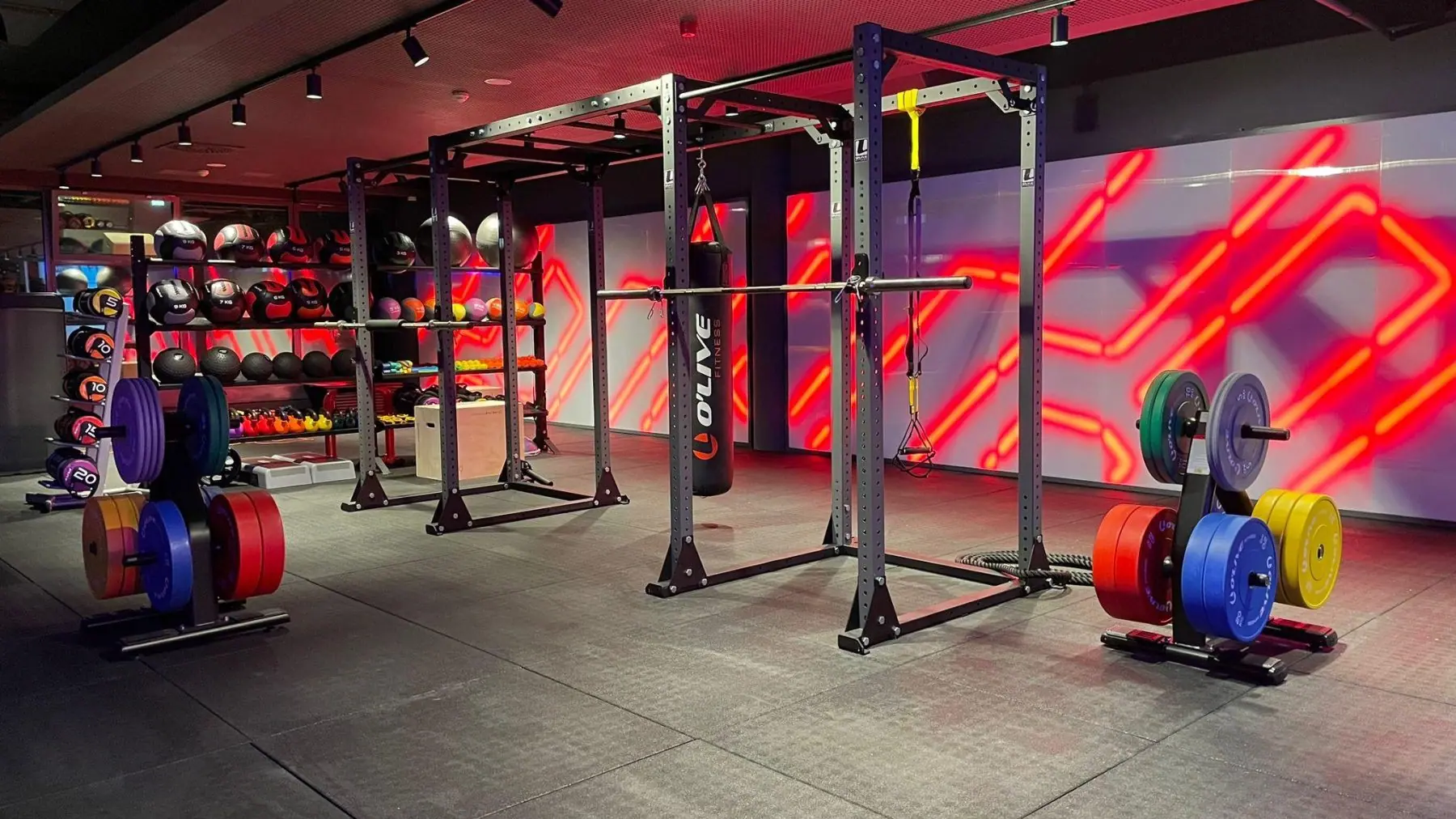
A squat cage, also called a power rack, is a steel structure built to carry a barbell and to catch it when the lifter cannot. The construction is consistent across manufacturers:
- Reinforced vertical uprights.
- Adjustable crossbars and safety spotter arms.
- J-hooks for the barbell.
- Pull-up bars, dip stations, rings or cable attachments as options.
- Storage horns for plates and bars.
The point of the enclosure is the safety line. Set the spotter arms below the bottom of the lift and a failed repetition ends with the bar on the arms rather than on the lifter. That single property is what makes a cage usable by a paying membership without a member of staff standing next to it.
The four formats compared
| Format | What it is | Floor area | Best fit |
|---|---|---|---|
| Power rack / squat cage | Four uprights, fully enclosed, catch bars on both sides | Largest of the four | Main lifting station in a commercial strength area |
| Half rack | Two uprights with a rear support, open front | Compact | Corporate gyms, hotel facilities, tight floor plans |
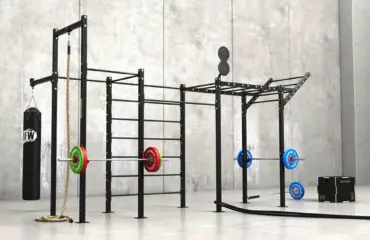
| Rig | Modular structure extended along a wall or free-standing | Scales with the number of bays | Cross-training boxes, group training, high throughput |
| Smith machine | Barbell fixed to a guided vertical path | Moderate | Beginners, unsupervised hours, isolated heavy work |
The difference between a cage and a rack is often blurred in catalogues. A rack is usually the simpler structure, frequently a half frame; a cage is the complete enclosure with integrated safeties and attachment points. The distinction matters when you are writing a specification, because they are not substitutable for the same use case.
Our squat racks and power racks cover the free-standing formats; the professional Smith machines cover the guided-bar option.
Why one station carries so much of the floor
Safety without staffing. A member can work at a heavy load alone, which is what makes off-peak hours viable.
Exercise range. Squats, bench press, overhead press, rack pulls, pull-ups, dips, core work and band work all happen inside one footprint.
Density. One structure replaces several single-purpose stations, which is the whole argument for a cage in a small facility.
Durability. Heavy steel sections with an anti-corrosion treatment, which is also what makes galvanised and stainless versions viable outdoors.
Configurability. Wall-mounted rigs, free-standing cages, added bays, storage, custom colours to the club identity.
Specifying by facility type
Commercial gym. A modular cage that can be worked from all sides and used by more than one member at once. Add pull-up stations, a cable crossover attachment and integrated storage so that plates do not end up on the floor.
Cross-training box. A wall-mounted structure with extensions for pull-ups, muscle-ups and rings, sized to the class you actually run. Our cross-training and Hyrox rigs are configured by bay count rather than sold as fixed models.
Hotel, corporate and small facility. A compact half rack is usually the right answer: modular, unobtrusive and safe, in a room where a full cage would eat the floor.
Rehabilitation and clinical settings. A guided-bar station is often preferred, because the fixed path removes the balance requirement while still allowing loaded work.
Outdoor installations. Galvanised steel or stainless models are designed to withstand weather. Note that permanently installed outdoor fitness equipment for adults falls under EN 16630, not EN ISO 20957-1, and the specification has to say so.
Standards and load
Indoor equipment for a commercial facility must be built and marked to EN ISO 20957-1 class S, the professional class for equipment installed in commercial premises, supervised or unsupervised. Ask for the class marking on the frame plate and the declaration of conformity. Class I is the professional class for inclusive access, a separate requirement rather than a level above class S.
On load, ask what was tested and on which component. The figure we publish for the guided bar is a maximum tested load of 400 kg. That is a value for that component, and a load figure quoted for one part of a structure should never be read as a rating for every configuration of it. If your specification needs a load figure, ask for it for the exact configuration you are buying.
Frequently asked questions
What is the difference between a cage and a rack?
A rack is usually the simpler structure, often a half frame. A cage is the complete enclosure, with integrated safeties and attachment points on all four uprights.
How much floor area does a cage need?
Allow 4 to 6 m2 for a complete cage including the circulation space around it. That figure is for the station alone; the loading and unloading zone for plates has to be added on your plan.
Can a cage be installed outdoors?
Yes, in galvanised steel or stainless versions built to withstand weather. Remember that outdoor adult fitness installations are covered by EN 16630 rather than by the indoor standard.
Can the colours be customised?
Yes. Structures can be finished to a RAL reference in your club or company colours.
Cage or Smith machine for a mixed membership?
Both, if the floor allows. The cage carries the members who train with free weights and want progression; the Smith machine carries the beginners and the unsupervised hours. Specifying only one of the two leaves a segment of your membership without a heavy station they will use.
Specifying your lifting area
The cage is normally the most heavily used square metre in a strength area, which is why it is worth planning around rather than fitting in afterwards. The decisions that matter are the format, the number of bays, the attachments, and the clearance you leave for loading plates and for pull-ups overhead.
Send us your floor plan and how you intend to run the space, and we will return a configured structure: request a quote.
Réalisations documentées
- Functional Rig inox – installations sur trois continents
- iGreenMill, tapis de course extérieur – installations sur trois continents
À lire aussi sur le même thème
- The Smith Machine: A Practical Guide for Gym Operators
- Power Rack: Complete Buying Guide and Comparison 2026
- Smith machine buying guide for commercial gyms: types, specification and layout
- Crossfit : Meilleurs Exercices d’Étirement et de Mobilité pour Améliorer vos Performances
- Artificial turf tracks for CrossFit and functional training