Artificial Turf Tracks for Cross-Training Boxes
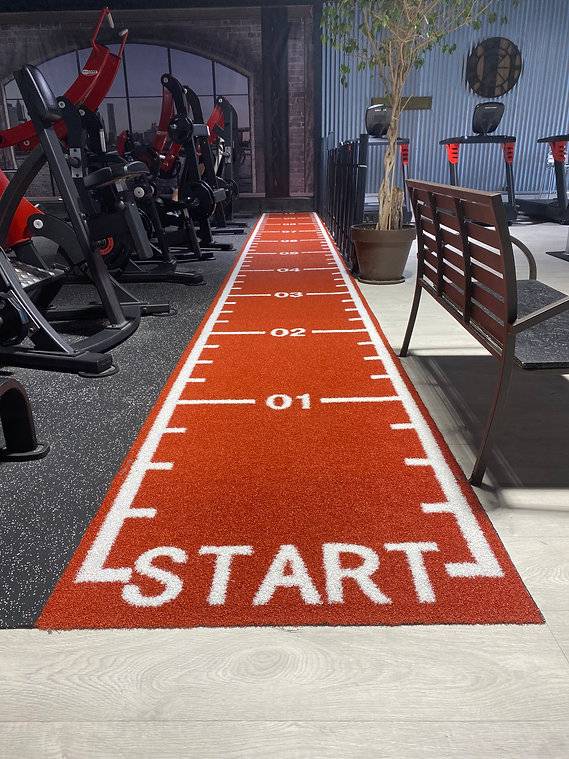
The floor is the one piece of equipment every member touches in every session, and in a cross-training box it is also the piece that decides what you can programme. An artificial turf sprint track running down one side of the room turns dead circulation space into a working lane for sled pushes, sprints, carries and bodyweight conditioning. This guide covers what a turf lane actually changes for a box operator, how to size one, and what to specify.
Why a turf lane changes what you can programme
On rubber tiles, a loaded sled either grinds or skates depending on the tile surface, and repeated sprint starts chew the joints between tiles. A turf lane is a continuous, high-friction, low-abrasion running surface. That single change opens up sled push and sled pull, prowler work, farmer carries, bear crawls and short sprints inside the building, without the noise and joint load of the same work on concrete.
It also gives you a lane that reads as a lane. Members self-organise along it, coaches can run heats down it, and the visual break between turf and rubber does more for floor flow than any amount of signage.
Joint load and training density
Turf laid over the correct underlay absorbs part of the impact that concrete or bitumen returns straight into the ankle, knee and hip. For a box running high-repetition jumping and sprint work several times a day, that matters commercially as much as physiologically: it widens the population you can programme for, including deconditioned members and people returning from injury who cannot yet take repeated impact on a hard surface.
The surface is also more forgiving of contact work. Burpees, crawls and floor-based conditioning are more comfortable on turf than on textured rubber, which in practice means members actually complete the prescribed volume.
Friction as a training variable
Turf pile height and infill determine how hard a sled is to move. That is a genuine programming variable: the same sled at the same load is a different exercise on a short dense pile than on a longer pile. Sprinting on turf also demands more from the stabilisers of the foot and ankle than a rigid surface does, because the surface yields slightly under load.
Used deliberately, that means a box can scale conditioning intensity by changing lane and load rather than by buying more equipment. Our power sleds are designed for exactly this pairing.
Sizing and laying out the lane
A turf lane needs length more than width. Most boxes run a single lane along the longest clear wall, wide enough for one sled or two athletes side by side, with the rubber floor carrying the rig, the lifting platforms and the free-weight zone. Metre markings printed into the turf let coaches call distances without measuring, which is why numbered artificial turf tracks have largely replaced plain turf in competition-format boxes.
Where a full lane will not fit, artificial turf tiles allow a shorter working area to be built up and reconfigured, including in hotel and corporate gyms where the same room has to serve several formats.
Sample conditioning session on a turf lane
A straightforward way to introduce the lane into your programming:
- Warm-up: dynamic mobility, easy shuttle runs down the lane, progressive build-ups.
- Circuit: lane sprint, burpees, walking lunges down the lane, push-ups. Run the circuit as a continuous rotation with short transitions, repeated for the prescribed number of rounds.
- Strength finisher: sled push or sled pull down the lane, alternating with a squat or hinge pattern from the rig.
- Cool-down: easy lane walk and mobility work.
Distances, loads and round counts are set by the coach against the group in front of them; the lane simply makes them repeatable and measurable week to week.
Specifying turf for commercial traffic
Turf sold for landscaping will not survive a box. What matters for a training lane is pile density and stitch rate, backing and drainage construction, the shock pad or underlay beneath it, UV stability if any part of the installation is outdoors or under glass, and how the seams are joined. Ask specifically about abrasion resistance at the start of the lane, which is where sled and sprint wear concentrates.
For outdoor installations, the base preparation matters as much as the turf: a lane laid on an unstable base will show ruts within a season regardless of the turf specification. Fire classification, where the room requires one, must be taken from the product documentation exactly as stated, including the smoke index.
Frequently asked questions
Is artificial turf better than rubber flooring for a cross-training box?
They do different jobs. Rubber tiles protect the slab under dropped barbells and carry the rig and platforms. Turf gives you a sled and sprint lane. Most boxes install both, with the turf lane along one wall and rubber across the training floor.
Can you push a sled on artificial turf?
Yes, and it is the main reason boxes install a turf lane. Pile height and infill determine how much resistance the sled meets, so the same load can be made harder or easier by choosing the lane specification.
How long should a turf sprint lane be?
As long as the clear run of your longest wall allows. The lane is sized to the building rather than to a fixed standard; numbered turf lets you programme fixed distances within whatever length you have.
Does a turf lane work outdoors?
Yes, provided the turf is UV-stable, the drainage construction is specified for outdoor use and the base is properly prepared. Outdoor lanes are common where a box wants to extend capacity without extending the building.
Planning a turf lane for your box
The right lane depends on your clear length, your slab, your programming and whether the installation is indoor, outdoor or both. Send us your floor plan and we will come back with a lane layout, a turf specification and a costed proposal: request a quote.