Selectorised, plate loaded or cable: choosing the resistance system for your strength floor
Trois systèmes de charge structurent un plateau de musculation professionnel : la charge guidée sélectorisée, la charge à disques plate-loaded et la charge libre. Le sélectorisé permet un réglage rapide entre utilisateurs, le plate-loaded une sensation de charge plus proche du libre, la charge libre le transfert le plus large. Le ratio entre les trois dépend du public accueilli.
Three resistance systems structure every professional strength floor: selectorised weight stacks, plate loaded machines and cable stations. They are complementary rather than competing, and the ratio you set between them decides who can actually train in your venue, how fast the floor turns over at peak hours, and what the fleet costs you over twenty years. This guide sets out how each system behaves in commercial service and how the mix is specified on a real project.
Why one system alone never covers a commercial floor
The most expensive specification error is fitting a single system. Three outcomes recur on the projects we are called in to correct:
- A mid market club fitted entirely with plate loaded machines loses a large share of its beginner, senior and returning members, who will not handle loose discs.
- A club fitted entirely with selectorised machines and no cable station plateaus with intermediate and advanced members, who leave once progression stops.
- A cross training box fitted only with guided load machines fails the audience that came for free weights.
System one: selectorised machines, throughput and unsupervised safety
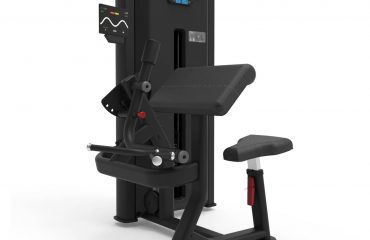
Also called weight stack or guided load machines, these carry the resistance inside the frame as a stack of cast iron or steel plates. The user moves a pin. Key characteristics in commercial service:
- Plates of 5 to 10 kg, load change in roughly two seconds, 5 kg increments with 2.5 kg micro plates on some ranges.
- Fully guided path through steel cables, pulleys and levers.
- Maximum load typically 80 to 150 kg, capped by stack height.
- Wear parts: nylon sheathed steel cables and aluminium pulleys, typically replaced every five to eight years.
The operational case is throughput and risk. Nothing can be dropped, nothing has to be carried, and a circuit class can move a group through the floor without queueing. That makes this system the default for open access spaces, rehabilitation floors and venues serving older or deconditioned users. The trade off is the load ceiling and a shorter fleet life than plate loaded equipment.
System two: plate loaded machines, progression and service life
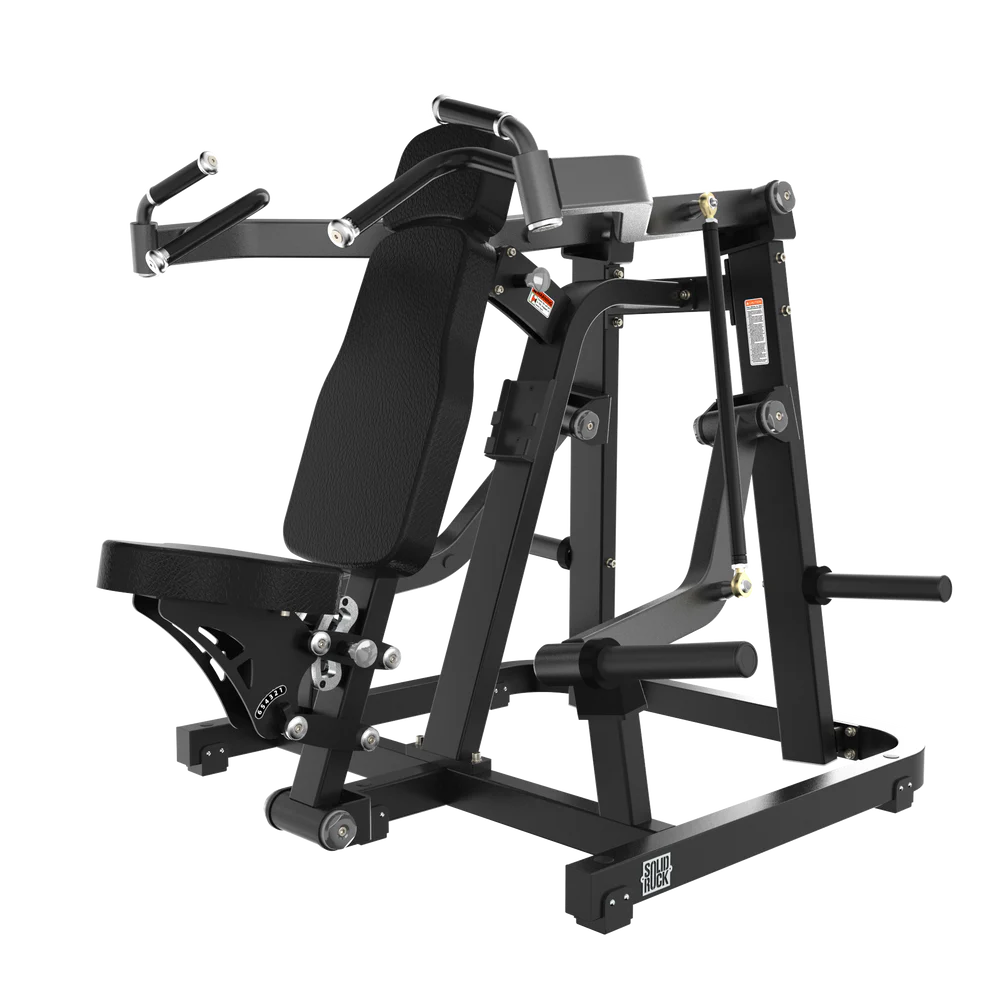
Plate loaded machines take Olympic discs on 51 mm sleeves and guide the movement through converging or iso-lateral levers rather than cables. Capacity runs from roughly 200 kg to 600 kg on the heavy leg stations, and increments follow the disc range from 1.25 kg to 25 kg.
Because there are no cables to replace, the maintenance profile is simpler and the service life longer. Our field data across supplied fleets puts well maintained plate loaded machines at twenty five to thirty years of intensive service, against fifteen to twenty for weight stack equipment. Set against that: a load change takes thirty to sixty seconds, which rules the system out of fast circuit formats, and each machine needs a realistic disc budget, typically 200 to 400 kg of plates for full commercial use.
System three: cable stations, versatility per square metre
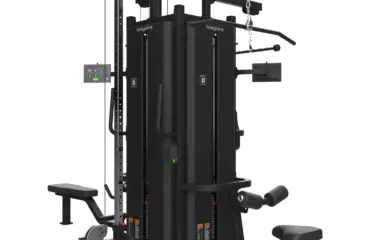
Cable crossovers, functional trainers and multi-pulley towers deliver the widest exercise range from one footprint. Two figures decide the specification.
The first is the pulley ratio. A 2:1 ratio, the most common arrangement on professional machines, means the user feels half the selected load: a 120 kg column gives 60 kg in the hand, which covers the large majority of upper body work. A 1:1 ratio suits maximal strength work but uses a longer cable run and needs servicing more often. Check this on the datasheet before ordering, because it is rarely stated in the headline specification.
The second is column load. For a commercial floor, specify at least 2 x 90 kg; premium ranges reach 2 x 160 kg. A two station crossover such as the Bodytone FC02 v2 lists at 4,950 EUR excluding VAT, while a ten station Forza crossover lists at 14,500 EUR excluding VAT. A compact functional trainer such as the Etenon PC1001B sits at 2,716 EUR excluding VAT.
Side by side comparison
| Criterion | Selectorised | Plate loaded | Cable station |
|---|---|---|---|
| Load change | About 2 seconds | 30 to 60 seconds | About 2 seconds |
| Load ceiling | 80 to 150 kg | 200 to 600 kg | 2 x 90 to 2 x 160 kg on the column |
| Indicative service life | 15 to 20 years | 25 to 30 years | 15 to 20 years |
| Main wear parts | Cables, pulleys, upholstery | Bushings, upholstery | Cables, pulleys, handles |
| Unsupervised access | Best suited | Needs supervision or an experienced membership | Suited to coached use |
| Additional budget | None | 200 to 400 kg of discs per machine | Handle and attachment set |
Setting the ratio for your venue
The ratio is a commercial decision before it is a technical one. The figures below are the starting points we apply, then adjust against the actual membership profile.
| Venue | Selectorised | Plate loaded | Cable and functional |
|---|---|---|---|
| Family and mid market club | 60 to 70 percent | 30 to 40 percent | One crossover or functional station minimum |
| Urban premium club | About 50 percent | About 50 percent | Two or more stations |
| Strength led positioning | About 40 percent | About 60 percent | Two or more stations |
| Cross training box | Marginal | 20 to 30 percent | One station, plus free weights for the balance |
| Hotel, residential and workplace | Dominant, often a multi-station gym | Rarely justified | Optional, if supervised |
| Rehabilitation and care settings | Dominant, low starting loads | Not recommended | Useful for graded work |
Use classes: what the standard actually says
Specification documents still circulate the term semi-professional. It has no standing. Under ISO 20957-1:2024, class S covers professional and commercial use, class H covers domestic use, and class I covers inclusive professional use. Classes A, B and C are accuracy classes describing how closely displayed values match measured values, not durability grades. For a commercial strength floor, the line to write into your specification is class S, with class I where inclusive access is part of the brief. Some older French language sources, including earlier versions of our own material, describe class I as very intensive use; that reading is incorrect and has been superseded.
Frequently asked questions
Can plate loaded machines replace free weights?
No. A plate loaded machine guides the path and removes most of the stabilisation demand. It complements a rack and barbell area, it does not substitute for it. Budget for both if your positioning is strength led.
How many cable stations does a floor need?
One two station crossover serves a floor up to roughly 200 m2. Beyond that, a second station or a multi-station tower prevents the queueing that pushes members towards machines that suit them less well.
What is the real maintenance cost difference?
Cable driven equipment carries a consumable line that plate loaded equipment does not: sheathed cables and pulleys on a five to eight year cycle. As an operating provision, budget 3 to 5 percent of fleet value per year for preventive maintenance across the whole floor.
Which system suits an unstaffed access gym?
Selectorised machines, with a multi-station gym where floor area is tight. Nothing can fall, load selection is intuitive and no induction is required. Reserve plate loaded stations for hours when a coach is present.
Specify your strength floor with us
Light In Fitness has manufactured and distributed professional fitness equipment from Tours, France, since 2013, and has equipped more than 2,500 customers. We issue quotations within 24 working hours, ship in five to ten working days from stock, and deliver across France, Belgium, Switzerland and Luxembourg, with export costed project by project. Steel structures carry a twenty year warranty and machine ranges two to five years.
Browse the strength training machines and plate loaded machines ranges, or request a quote with your floor area and membership profile and we will return a ratio and a layout.
Réalisations documentées
- Dalles et sols sportifs : livraisons documentées – plusieurs chantiers
- Sol sportif extérieur, square Georges-Vallerey – Taverny (95)
- Functional Rig inox – installations sur trois continents
- iGreenMill, tapis de course extérieur – installations sur trois continents
Sources et références
- NF EN ISO 20957-1 – équipement d’entraînement fixe, partie 1 : exigences générales de sécurité et méthodes d’essai (AFNOR)
- AFNOR Normalisation – dossier thématique sur les appareils d’entraînement fixes et leurs classes d’usage
- Code du sport, articles R322-4 à R322-43 – garanties d’hygiène et de sécurité applicables aux établissements d’activités physiques et sportives (Légifrance)