The Most Effective Muscle-Building Programmes and the Equipment Behind Them

Building muscle takes a well-structured training programme and the right equipment to run it on. For a gym operator that second half is the part you control: a member can follow the best plan in the world and still stall if the machine they need is occupied every evening, or if the load increments are too coarse to progress. This article sets out the programmes that work, and what each one asks of a professional strength floor.
The basic principles of hypertrophy
- Progressive overload: increase the load gradually to keep stimulating muscle growth.
- Consistency: train regularly, with sessions that are planned rather than improvised.
- Nutrition: follow a protein-rich diet to support muscle growth.
Only the first of these depends on your equipment, and it is the one operators most often get wrong. Progressive overload requires a load range wide enough for a beginner and a regular alike, and increments fine enough that a member can add work every few weeks instead of jumping to a weight they cannot control.
Three effective programmes
1. The split programme
Muscle groups are divided across different days so each session can concentrate on one area: chest on Monday, back on Tuesday, legs on Wednesday, and so on.
For the floor, a split routine means demand concentrates on a few stations at a time. It is the programme that most often creates queues, because a whole cohort of members trains chest on the same evening. Duplicating the two or three most popular stations is usually cheaper than adding new families of equipment.
2. The full body programme
Every major muscle group is worked in each session, built around compound exercises such as the squat, the bench press and the deadlift.
This is the programme that beginners and time-poor members follow, and it depends on free weights and racks more than on machines. It also concentrates load in one place, so this is where flooring, bar quality and rack stability matter most.
3. The push pull legs programme
Exercises are separated into pushing movements, pulling movements and leg work: push on Monday (chest, shoulders, triceps), pull on Wednesday (back, biceps), legs on Friday.
Push pull legs spreads demand more evenly than a split and is the easiest of the three to support in a medium-sized club, because the three days call on different families of equipment rather than the same one.
Recommended equipment
Leg press
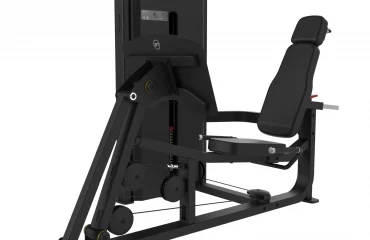
The reference station for developing the legs, and the one that lets a member load heavily without the technical demands of a barbell squat. A plate-loaded model such as the Bodytone Solid Rock SR06E plate-loaded leg press suits a floor where several members train at once.
Dumbbells and barbells
Essential for the widest variety of strength exercises, and the backbone of any full body programme. A set of fixed rubber-coated hex dumbbells such as the Ziva Performance Hexagon RPU dumbbells is more robust in commercial use than adjustable sets, together with professional Olympic bars for the compound lifts.
Cable machines
Ideal for both isolation and compound work, and the most versatile square metre on the floor: a dual pulley station serves push, pull and accessory work for several members in rotation.
All indoor equipment placed in a supervised commercial facility should comply with EN ISO 20957-1 class S, the professional class for high-frequency use.
Frequently asked questions
Which programme should a new club plan for?
Assume push pull legs and full body dominate at opening, and that splits appear as your membership matures. Buying for splits first is how floors end up with three chest stations and one rack.
Do machines or free weights build more muscle?
Both work when the load progresses. Machines are easier for beginners and safer without a spotter; free weights recruit more stabilising musculature. A floor that sells memberships needs both.
How many stations per member?
The useful ratio is stations per member present at peak hour, not per member on the books. Measure your busiest evening before adding equipment.
Building a floor that supports every programme
An effective training programme combined with high-quality equipment is what actually produces muscle growth. Explore the full range of professional strength training machines to see what fits your space, your audience and the programmes they follow.
Tell us your surface area and the profile of your members, and we will propose a complete layout. Request a quote to receive a costed proposal.