Which Strength Machine Should You Choose for Your Facility?
Le choix d'une machine part du groupe musculaire visé et de la trajectoire proposée, puis de l'adaptation des réglages à la morphologie de l'utilisateur. Une machine dont les réglages ne conviennent pas dégrade la biomécanique du mouvement. En salle, la classe d'usage et la disponibilité des pièces s'ajoutent à ces critères.
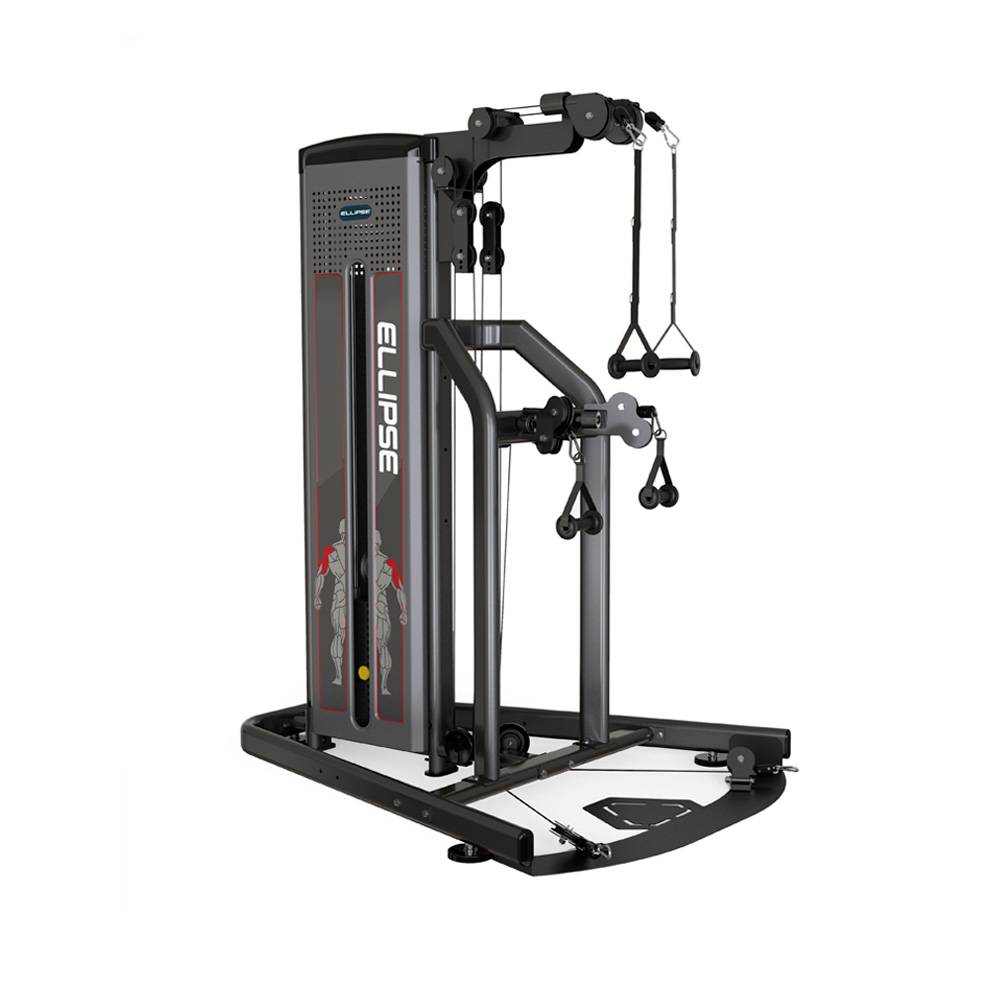
In short: choosing a strength machine starts with the muscle group you need to cover and the trajectory the machine imposes, then with how far the settings adapt to the morphology of the people who will use it. A machine whose adjustments do not fit degrades the biomechanics of the movement. On a commercial floor, usage class and spare-part availability come on top of those criteria.
Start from the muscle group, not from the brand
Every equipment catalogue is organised by family: chest, back, shoulders, arms, legs, core. A purchasing decision that starts from a brand tends to produce a floor with three chest stations and no posterior chain. Starting from the muscle map produces a balanced line, and the balance is what members feel.
Write the list of movement patterns you want covered before you look at a single product page: horizontal push, vertical push, horizontal pull, vertical pull, knee-dominant, hip-dominant, core. One well-specified station per pattern is worth more than four machines that all train the same thing.
The trajectory decides the quality of the movement
Two machines for the same muscle group can behave very differently depending on how their arms travel.
| Trajectory | Behaviour | Best suited to |
|---|---|---|
| Converging | The arms close towards the centre line at the end of the movement | Chest press, incline press, shoulder press |
| Diverging | The arms move apart at the end of the movement | Seated row, lat pulldown |
| Independent arms | Each side moves separately | Correcting strength asymmetries, rehabilitation |
| Fixed bar | Both hands on one rigid path | High-throughput stations, beginners |
None of these is better in the abstract. A fixed bar is faster to use and cheaper to maintain, which suits a hotel gym or a municipal facility with short sessions. Independent arms are slower to set up but indispensable in a rehabilitation centre or a performance club.
Adjustment range is the real usability test
This is the criterion most often skipped at the demo stage, and the one that decides whether a machine is used or avoided. Check the seat height range, the back pad depth, the start position of the arms and the range of the foot plates against the actual population of your site. A club with a mixed adult membership and a school gym do not need the same amplitude.
Two practical tests when a supplier brings a demo unit: have the shortest and the tallest member of your team sit on it, and time how long a settings change takes. A machine that needs a tool to be adjusted will never be adjusted during a busy hour.
Usage class: what it commits you to
For indoor equipment, the relevant reference is EN ISO 20957-1 class S. Class S is the professional category, designed for supervised commercial use with continuous throughput. Class I is a professional class with inclusive access, not an intensity level above class S, and the two answer different questions: class S is about traffic, class I is about who can get onto the machine.
Ask for the declaration in writing at the quotation stage rather than after delivery. An operator whose insurer or public client asks for evidence of conformity needs the document, not a sales assertion.
Selectorised, plate-loaded or free weights
Selectorised machines with a weight stack are the fastest to use and the safest to leave unsupervised: the load changes with one pin, and nothing can fall. They are the backbone of a general fitness floor.
Plate-loaded machines give a different loading feel and a lower purchase price per station, at the cost of plate storage, plate handling and a floor team that has to tidy up. They suit strength-oriented clubs and cross-training boxes where members are used to handling discs.
Free weights cover what no machine covers, but they need supervision, flooring and space. In practice a coherent floor uses all three, in a proportion that follows your membership, not a catalogue.
Spare parts and service, the criterion nobody demos
A commercial strength machine is bought for ten to fifteen years of service. Over that period, cables, bearings, upholstery and grips are consumables. Before signing, ask three questions: how long are wear parts guaranteed to be available, what is the lead time on a cable or a pad, and who performs the intervention on site. A cheaper machine whose upholstery cannot be reordered in year six is not cheaper.
Light In Fitness has been equipping professional sites since 2013. Our full line is listed under professional strength training machines, with the stack-loaded range under selectorised machines; a typical shoulder station on a general floor is the Gold SPG003 shoulder press.
Safety and induction
Whatever you install, the machine only performs if it is used correctly. Keep the instruction plate legible, run an induction for new members, and keep a general joint and muscle warm-up in the routine before the first working set. Most incidents on strength equipment come from a badly set seat, not from a badly designed machine.
Frequently asked questions
Which strength machine should a small facility buy first?
Cover the movement patterns before you multiply stations: one vertical pull, one horizontal pull, one chest press, one leg station. That gives full-body coverage on the smallest possible footprint.
Selectorised or plate-loaded?
Selectorised for speed, safety and unsupervised use; plate-loaded for strength-oriented members and a lower price per station. Most commercial floors mix the two.
What does class S mean?
Class S under EN ISO 20957-1 is the professional usage class for indoor equipment used in supervised commercial settings. It is what you should be specifying for a gym, a club or a public facility.
How much space does a strength station need?
It depends on the machine and on the circulation you want around it, so it is set on the layout drawing rather than by a rule of thumb. Send us the surface area and we will lay it out.
Specifying your line
Gym, cross-training box, hotel, campsite, municipal facility, school, club, rehabilitation centre or armed forces site: the right machine is the one that matches your members, your throughput and your floor plan. Tell us the surface area, the profile of your users and your budget, and we will come back with a specification and a costed proposal: request a quote.