Dual Pulldown Machine: How to Use It Correctly
La machine dual pulldown permet un tirage vertical bras indépendants, ce qui évite la compensation du côté dominant. Elle cible le grand dorsal, les rhomboïdes et le biceps selon la prise adoptée. Le réglage du cale-cuisses conditionne la stabilité du bassin pendant le mouvement.
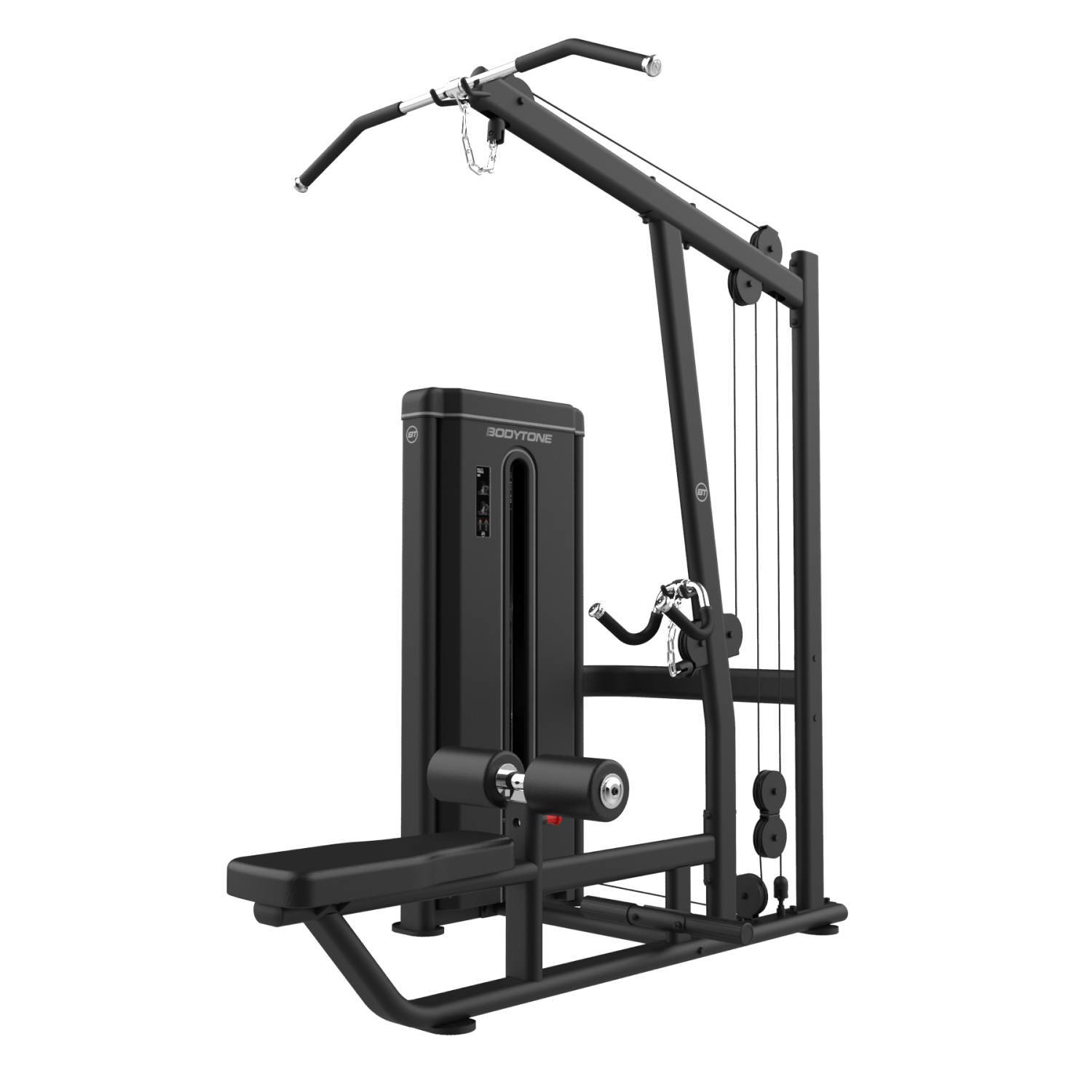
The dual pulldown is one of the most heavily used stations in any commercial strength area. Its defining feature is independent arms: each side pulls against its own load path, so the dominant side cannot quietly take over the movement. That makes it a strong choice for mixed-ability rooms, for return-to-training programmes and for any facility where staff have to correct technique quickly between members. Here is how it should be set up and used, and what that implies when you specify one.
1. Setting up the station
Start with the seat height. The user should sit with the feet flat on the floor and the thighs locked under the pad, hips and knees at roughly a right angle. The thigh pad is not a detail: it is what anchors the pelvis and stops the user lifting off the seat as the load increases. If the pad cannot be brought down onto the thighs, the seat height is wrong.
Then select the load. On a selectorised station this is a pin; on a plate-loaded station it is discs on each arm. Either way, the working load must allow a full range of motion under control. A load that forces the user to lean back and drive with the lower back is too heavy, whatever the number on the stack.
2. Body position
Seated, chest up, spine long, feet firmly on the floor. The user takes the handles with a secure grip and starts with the arms extended overhead, without letting the shoulders ride up into the ears. A slight backward lean of the torso, held constant through the set, is acceptable; a lean that changes during the set is a compensation and should be corrected.
3. Working the back
To load the latissimus dorsi and the mid-back, the cue is to pull the elbows down and slightly back, driving the movement from the shoulder blades rather than the hands. The handles come down toward the upper chest, the shoulder blades depress and retract, and the return to the start position is controlled rather than dropped. On a dual station, each arm can be watched independently, which is exactly the point: an uneven finish position shows a strength or mobility asymmetry that a fixed bar would hide.
- Wide pronated grip – emphasis on the latissimus dorsi and the width of the back.
- Neutral grip – more comfortable on the shoulder, well suited to beginners and to rehabilitation contexts.
- Narrow supinated grip – shortens the lever, brings the lower lats and the elbow flexors more into play.
4. The biceps in the movement
The biceps and the brachialis are always involved as elbow flexors in a vertical pull; they are secondary movers, not the target. A supinated or neutral narrow grip increases their share, and coaching the user to finish the pull with the elbows fully closed increases it further. A vertical pulldown station is not a substitute for a dedicated biceps curl: if the programme calls for direct arm work, it belongs on a bench or a low pulley, not here.
What the dual pulldown actually recruits
| Muscle group | Role | Level of recruitment |
|---|---|---|
| Latissimus dorsi | Shoulder adduction and extension | Primary |
| Teres major, rhomboids, mid trapezius | Scapular retraction and depression | Strong secondary |
| Biceps brachii and brachialis | Elbow flexion | Secondary, varies with grip |
| Posterior deltoid | Assists the pull | Secondary |
| Trunk | Isometric stabilisation against the load | Support |
Why operators choose a dual station
- Symmetry. Independent arms expose and then correct side-to-side imbalances instead of masking them. This is the argument that matters most in rehabilitation and in return-to-sport work.
- Range of use. One station serves a beginner on a light load and an experienced lifter on a heavy one, with no change to the setup other than the pin or the plates.
- Supervision. A guided path and a thigh pad make the movement easy to teach and easy to police in a busy room.
Our range covers both loading systems, from the selectorised Forza Dual FD04 pulldown and row station to the plate-loaded SRX14 rotary lat pulldown. The full selectorised machine range is the usual starting point for a high-traffic circuit.
Specification checklist
- Certification. For indoor commercial use, require EN ISO 20957-1 class S. Nothing below that class belongs in a supervised facility.
- Adjustment range. Check the number of seat positions and the travel of the thigh pad: they determine how wide a range of body sizes the station can serve.
- Cables and pulleys. Ask about cable diameter, pulley bearings and the availability of spare parts, since these are the wear items on a high-traffic pulling station.
- Handles. Confirm which grips are supplied as standard and which are options; grip variety is what makes one station cover several programmes.
- Footprint. Allow clearance behind the seat for access and for staff to coach from the side.
Frequently asked questions
Should the bar be pulled behind the neck?
No. Pulling behind the neck places the shoulder in extreme external rotation and abduction and offers no advantage over pulling to the upper chest. In a facility open to the general public it should simply not be taught.
Is the dual pulldown suitable for beginners?
Yes, provided the seat and thigh pad are set correctly and the load allows a controlled return. The neutral grip is usually the easiest entry point.
What is the difference from a fixed-bar lat pulldown?
A fixed bar links the two sides, so the stronger side can compensate. Independent arms make each side work for itself and reveal asymmetries.
Which station complements it in a back circuit?
Usually a seated row or a low pulley, so that the horizontal pull is trained alongside the vertical one. Several combined pulldown and row stations cover both in a single footprint.
Specifying your strength area
Selectorised or plate-loaded, single station or combined pulldown and row: the right answer depends on your floor area, your traffic and the profile of your members. Send us your plan and your usage brief and we will return a configured proposal – request a quote.