Chest Press Machine: How to Use and Specify It in a Commercial Gym
La machine chest press travaille les pectoraux, les triceps et le deltoide antérieur sur une trajectoire de poussée guidée. Le réglage de la hauteur d'assise doit aligner les poignées sur la mi-poitrine pour préserver l'épaule. C'est une alternative sécurisée au développé couché pour les publics sans pareur.
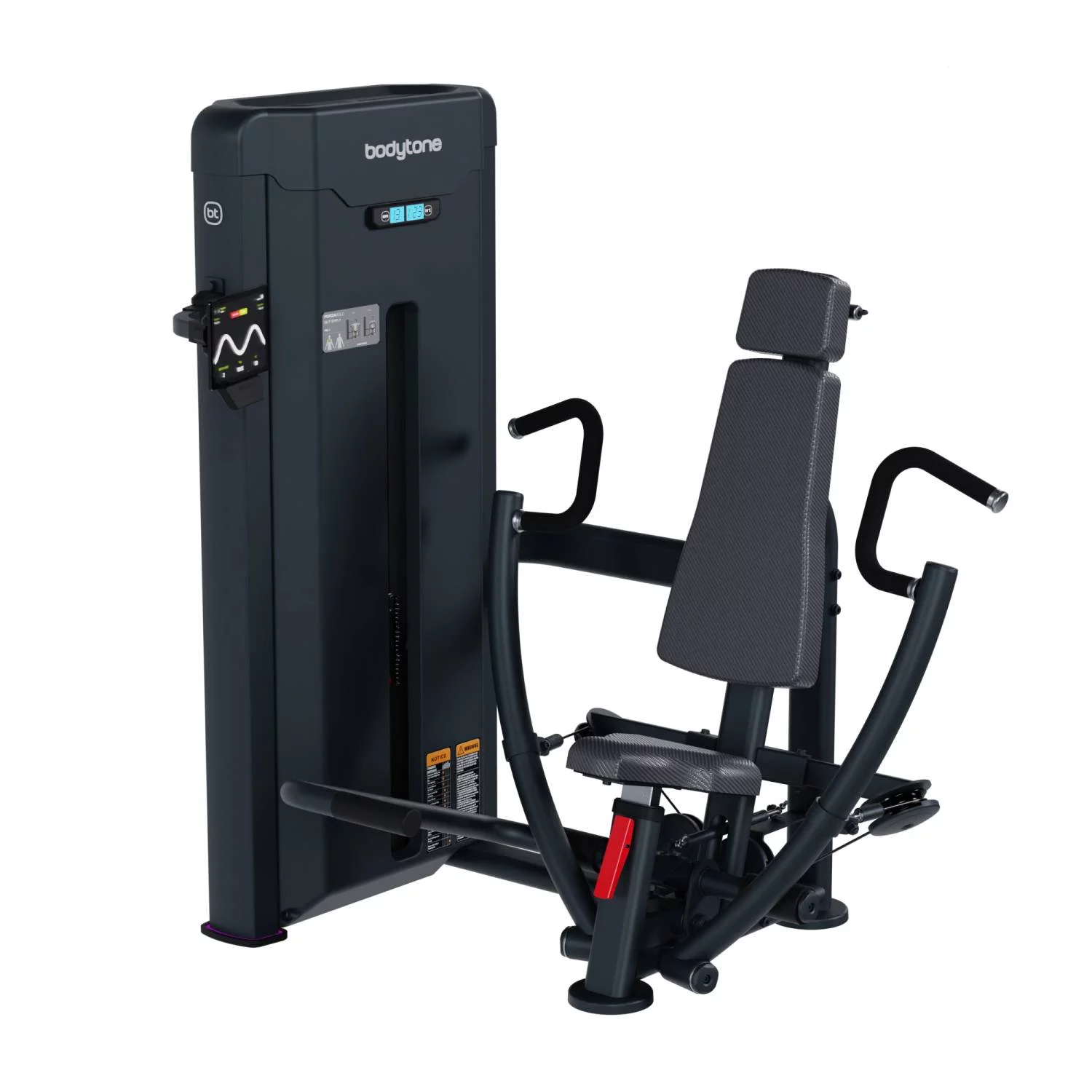
The chest press is one of the busiest strength stations on any commercial gym floor. For a club operator, a hotel leisure manager, a municipal sports centre or a rehabilitation unit, it is the station that lets a member push a heavy horizontal load safely without a spotter. That is exactly why it deserves to be specified, positioned and set up properly rather than bought on price alone.
What the chest press machine actually loads
The chest press drives a guided pushing path in front of the torso. The pectorals do most of the work, with the triceps and the anterior deltoid acting as the main supporting groups. Because the path is guided, the shoulder is not asked to stabilise a free bar, which makes the station appropriate for beginners, older members and populations returning to training who would not be safe under an Olympic barbell.
Several models are built around an adjustable-incline seat or bench. An inclined position shifts emphasis towards the upper portion of the chest; a horizontal position loads the pectorals more evenly. Alternating the incline across a training block is what keeps the stimulus balanced over time, and it is a useful coaching point to include in your induction script.
Correct set-up: the two adjustments that matter
Seat height comes first. The handles must line up with the middle of the chest. Set too high, the shoulder is pushed towards an impingement position; set too low, the triceps take over and the chest is under-loaded. The second adjustment is starting depth: elbows bent to roughly ninety degrees at the start of the push, forearms in line with the handles.
The user sits with feet flat on the floor, back in contact with the pad and hands slightly wider than shoulder width. Inhale, push through the arms and the chest together, exhale as the arms extend, then control the return instead of letting the stack drop. Eight to twelve repetitions with a load the user genuinely controls is the standard working range, with progressive increases rather than jumps.
Five to ten minutes of warm-up on a treadmill or a rowing machine before the first working set raises circulation and prepares the shoulder joint. Building that instruction into your onboarding reduces both injury risk and equipment misuse.
Programming it alongside the rest of the floor
The chest press works best as part of a balanced upper-body block: a horizontal push on the chest press, a vertical or horizontal pull on a lat pulldown or seated row, and an isolation movement such as a triceps extension. Adequate rest between sets is part of the prescription, not an optional extra. Programmed this way, a single station serves a wide range of member profiles without creating queues at your free-weight area.
Specifying a chest press for a commercial site
Indoor strength equipment installed in a facility open to users must be built to EN ISO 20957-1 class S, the professional class. Only class S carries the durability, stability and safety requirements expected of equipment in commercial and supervised use; the lower classes of the same standard fall outside the scope of a professional installation. Ask your supplier for the declaration in writing before ordering.
Beyond the standard, the questions that determine cost of ownership are practical ones: frame gauge and weld quality, guarding of the weight stack, whether pads and upholstery can be replaced individually, cable and bearing service intervals, and how long spare parts will remain available after purchase.
Iso-lateral versions with independent arms let each side work through its own range, which is valuable in rehabilitation and in clubs with a mixed member base. Plate-loaded units cost less per station and suit strength-focused rooms; selectorised units turn over faster between users and suit high-traffic circuits. Our full range of chest press machines covers both formats, including the iso-lateral Bodytone SRX02 chest press, and sits within the wider strength training machines catalogue.
Positioning the station on the floor plan
Leave clear circulation behind the seat so that a user can enter and leave without stepping across another station, and keep the loading side of a plate-loaded unit accessible for staff. Grouping the chest press with the other horizontal pushing and pulling stations shortens circuits and makes supervision easier from a single point on the floor. In smaller spaces, an iso-lateral unit often replaces two separate stations.
Frequently asked questions
Can the chest press replace the bench press?
It replaces it safely for unsupervised users, because there is no bar to control overhead and no spotter required. For strength-focused athletes it complements the bench press rather than replacing it, since the guided path removes the stabilisation demand.
Which equipment class is required for a commercial gym?
EN ISO 20957-1 class S for indoor professional equipment. Class I within the same standard is a professional class designed for inclusive access, not a higher intensity level above class S.
Plate-loaded or selectorised?
Selectorised for high member throughput and quick load changes, plate-loaded for strength rooms and for a lower cost per station. Many facilities install one of each.
Is the chest press suitable for rehabilitation settings?
Yes, provided the seat is adjusted so the handles sit at mid-chest and the range of motion is limited to what the clinician prescribes. Iso-lateral arms are preferred where there is a strength asymmetry between sides.
Equipping your facility
Choosing a chest press is a specification decision as much as a training one: the right class, the right load format and the right footprint for your floor. Send us your floor plan and your member profile and we will come back with a configuration and a costed proposal through our quotation request page.