Lat Pulldown: The Complete Technique and Coaching Guide
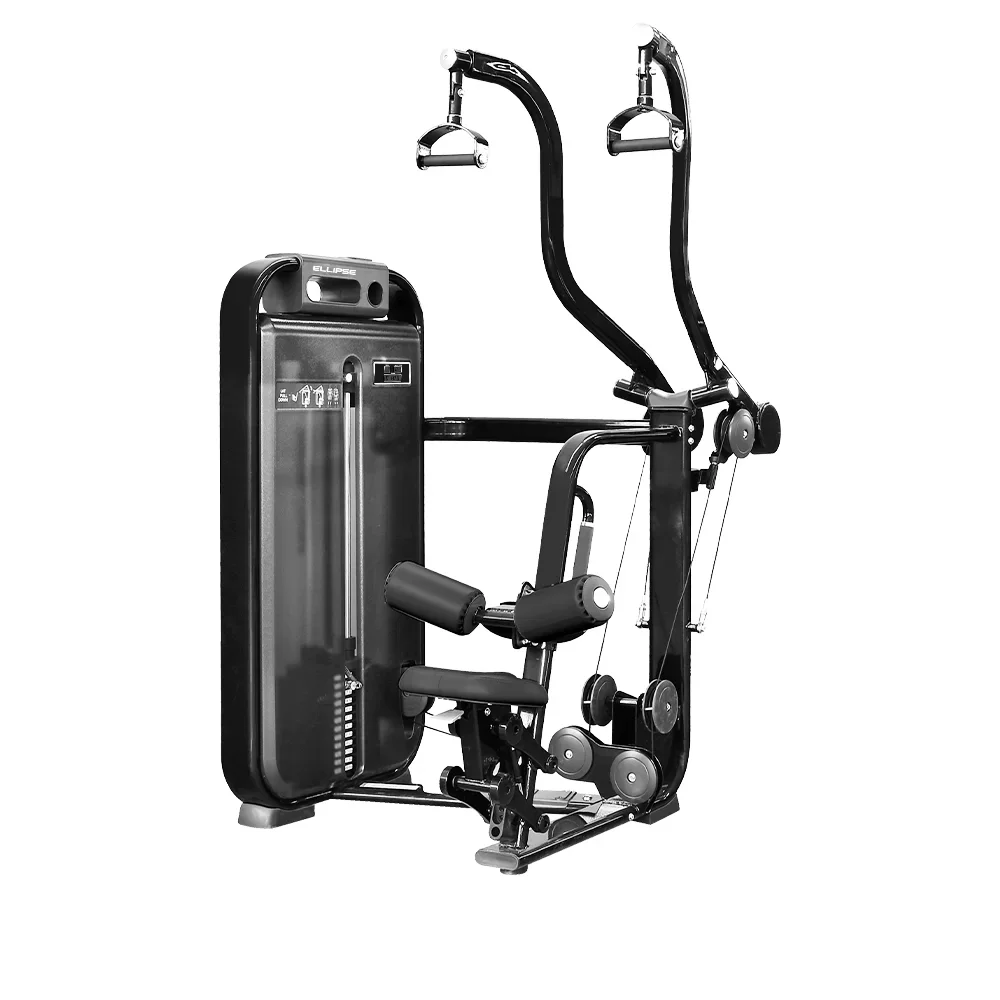
The lat pulldown is the most used vertical pulling station on a commercial floor, and the one most often used badly. Almost every fault a coach sees on it comes from one of three things: a seat and thigh pad set for the previous member, a grip chosen without a reason, or a tempo fast enough to turn the movement into a swing. This guide covers the setup, the grip variations and the coaching cues that make the station work for your members.
Setting up the machine
Setup takes ten seconds and determines everything that follows.
- Seat height: feet flat on the floor, knees bent at roughly 90 degrees. If the feet dangle, the member has no base to pull against.
- Thigh pad: firm contact on the thighs, tight enough that the member stays seated under load. A loose pad is what lets a heavy set lift the rider off the seat.
- Starting position: seated tall, trunk braced, a slight backward lean of the torso held throughout – not a lean that increases as the set goes on.
Executing the movement
Take a pronated grip slightly wider than shoulder width. Set the shoulder blades down and back before the elbows move at all: the pull starts at the scapula, not at the hands. Draw the bar towards the collarbone with the elbows tracking down and back, then return the bar under control on a slow exhale-free eccentric rather than letting the stack pull the arms up.
The single most useful cue is to think of driving the elbows into the back pockets. Members who think about pulling with their hands recruit the biceps and leave the lats barely worked, which is why they report arm fatigue and no back development after months on the station.
Grip variations and what each one does
Wide pronated grip
Emphasises the outer and upper portion of the latissimus dorsi. It is the default variation and the one most members should spend most of their volume on.
Supinated (reverse) grip
Brings the biceps and the lower trapezius into the movement and shortens the range at the top. Useful for members who cannot yet feel the lats working, because the stronger arm position lets them complete quality repetitions while the pattern is learned.
Close or neutral grip
Shifts emphasis towards the lower lats and the mid-back. A neutral grip is also the most joint-friendly option for members with shoulder restrictions, which makes it worth having the handle available on the floor.
The three faults worth correcting on sight
Posture collapse
Rounded upper back, shrugged shoulders and the head thrown backwards to help the bar down. It usually means the load is too heavy, and it is the fault that turns a back exercise into a neck complaint. Reduce the stack, restore the tall seated position, rebuild from there.
Pulling behind the neck
Bringing the bar behind the head forces the shoulder into extreme external rotation with a load on it. There is no benefit that the front version does not give more safely. On a public floor it is worth correcting every time it appears.
Uncontrolled tempo
Yanking the bar down and letting the stack drag the arms back up removes tension exactly where the muscle grows. A controlled return is not a detail; it is most of the training effect. If a member cannot control the return, the load is wrong.
Programming it on your floor
The lat pulldown is the vertical pulling movement in a balanced strength programme, and it belongs opposite the pressing stations rather than as an afterthought. Two to four working sets, in a repetition range that lets the member control the return on every repetition, is enough for most members. For those working towards a pull-up, the pulldown is the progression station, and the load should be tracked against bodyweight so progress is visible.
From an operator point of view, the station is a queue point at peak hours. If members are waiting for it, a second vertical pulling option – a cable station with a high pulley, or an assisted pull-up unit – relieves the bottleneck more cheaply than a second identical machine.
Frequently asked questions
Which muscles does the lat pulldown work?
Primarily the latissimus dorsi, with the teres major, the rhomboids, the lower trapezius and the biceps assisting. The grip determines the balance between them.
Should the bar be pulled behind the neck?
No. The behind-the-neck version loads the shoulder in a vulnerable position without adding anything the front version does not provide.
Is the lat pulldown a substitute for pull-ups?
It is the progression towards them rather than a replacement. Its advantage is that the load is adjustable, which makes it usable by every member on the floor from the first session.
Browse the selectorised strength machines and the cable stations, or request a quote for a complete pulling zone.