Lat Pulldown Machine: Front, Behind-the-Neck and Reverse Grips
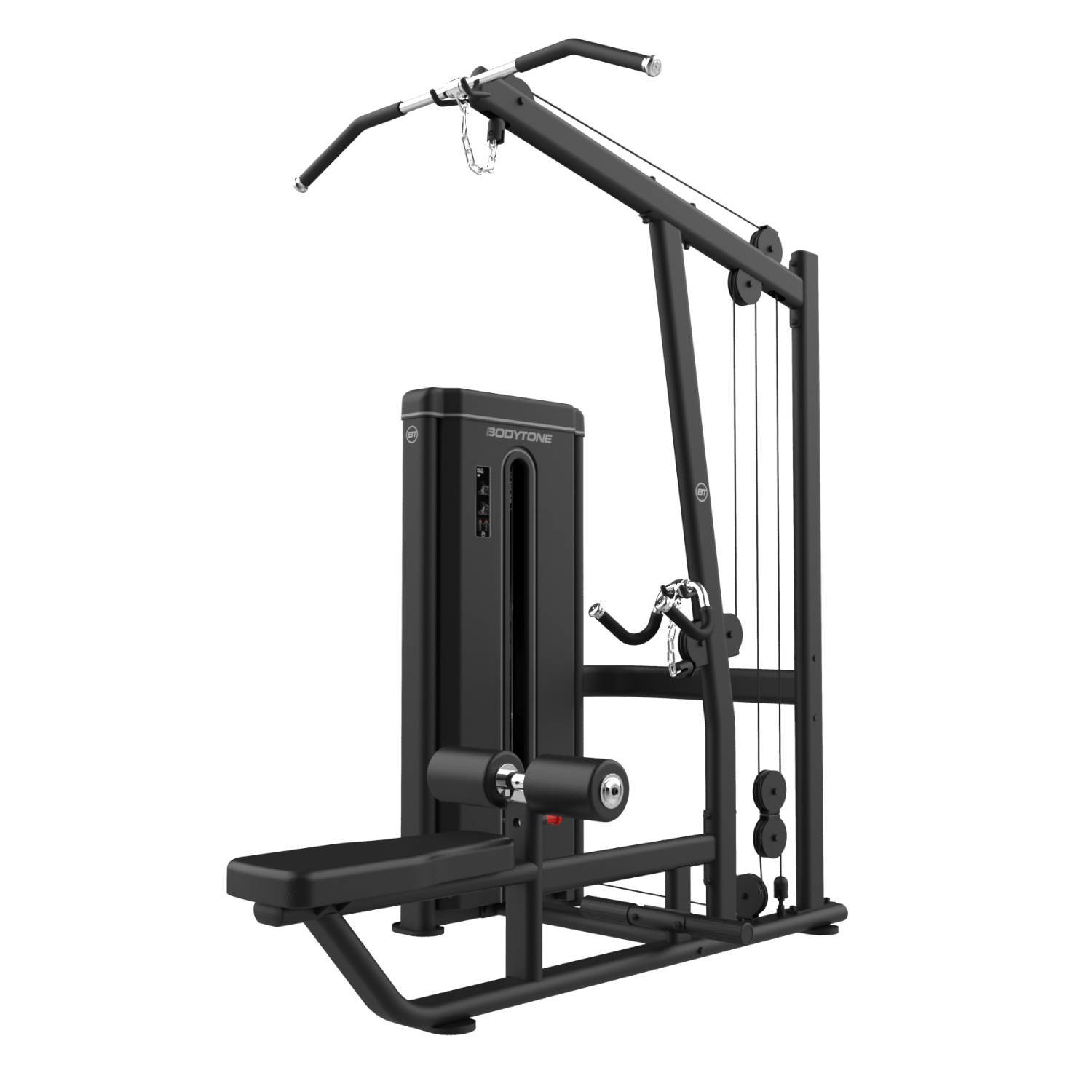
The lat pulldown is the machine that carries the pulling work of an entire gym floor. It gives every member, whatever their level, access to a vertical pull that a strict pull-up would put out of reach, and it does so under a load the coach controls to the kilo. For an operator, that makes it one of the highest-traffic stations in the strength area, and one where grip choice, seat setup and coaching quality decide whether members progress or accumulate shoulder complaints. This guide sets out the three grip variations – front, behind the neck and reverse – what each one actually trains, and what to look for in the machine you install.
Why the lat pulldown earns its floor space
A vertical pull reproduces the movement pattern of a pull-up in a seated, stabilised position, with the resistance selected rather than imposed by bodyweight. That single property is what makes the station work in a commercial setting: a beginner can train the same pattern as an advanced member on the same machine, five minutes apart, simply by moving the pin.
The back musculature is not a cosmetic concern. It carries posture, it stabilises the trunk in every lifting and carrying task, and it is the region most often under-trained in members who arrive with a desk-based working life. A station that trains it reliably, safely and without a queue is a commercial asset, not just a piece of equipment.
Whatever the variation, four coaching points apply to all of them. Set the thigh pads so the knees are held firmly and the pelvis cannot lift. Keep the torso upright and stop the swing: momentum from the hips converts a back exercise into a general effort with no target. Maintain tension through the whole range instead of letting the stack fall back, and return under control – the eccentric phase is where the training effect and the injury risk both sit. Breathe out on the pull, in on the return, and let the abdominal wall hold the trunk firm, which matters most as the load goes up.
Grip width sets the emphasis. A narrow grip drives thickness through the central back; a wide grip biases the outer portion of the latissimus dorsi and the width of the upper back. Neither is superior: they are two different jobs, and a well-programmed block uses both.
Front lat pulldown: the default for a commercial floor
Here the bar travels down in front of the face until it reaches the upper chest. The prime mover is the latissimus dorsi, supported by the teres major, the mid and lower trapezius, the rhomboids and the posterior deltoid, with the biceps brachii, brachialis and brachioradialis contributing at the elbow and the long head of the triceps acting across the shoulder. The shoulder, elbow and wrist joints all work through a range most people own without preparation, which is exactly why this is the version to program by default for a general membership.
Execution
- Sit down, lock the knees under the pads, and take the bar with the palms facing away from you.
- Keep the elbows tracking outwards, in the plane of the bar.
- Hold the torso upright and perpendicular to the floor to load the outer latissimus; a slight backward lean shifts emphasis towards the mid trapezius and the central back.
- Pull the bar down in front of the face until it reaches the top of the chest.
- Squeeze, then return slowly to the starting position.
Behind-the-neck lat pulldown: a technical variation, not a default
In this version the bar passes behind the head. It recruits the same muscle group, but it demands that the shoulder sit in maximum external rotation and horizontal abduction throughout the movement. Members who do not own that range compensate by pushing the head forward, and the load then lands on structures that were never meant to receive it.
Treat it accordingly. It belongs to supervised, experienced members with demonstrated shoulder mobility, and it is a poor choice for open-access hours. The bar should descend to around ear level and stop where the shoulder position is still controlled; there is no benefit in forcing it down onto the neck or the upper trapezius, and doing so is the single most common way this variation produces complaints. If the range is not there, the correct answer is the front version, not a lighter load behind the neck.
Execution
- Sit down, lock the knees under the pads, and take the bar with the palms facing away from you.
- Set a grip wider than shoulder width and hold the torso upright and perpendicular to the floor.
- Pull the bar down behind the head, stopping while the shoulders remain externally rotated and the neck stays neutral.
- Squeeze, then return slowly to the starting position.
Reverse-grip lat pulldown: more elbow, same prime mover
With the palms turned towards you, the shoulder works more in the sagittal plane and less in the frontal plane. The latissimus dorsi remains the prime mover – this is still a back exercise, not an arm exercise – but the biceps brachii contributes considerably more than in the pronated versions, and many lifters find the lower portion of the latissimus easier to feel. Leaning the trunk back slightly increases the involvement of the upper and lateral back.
The bar is normally a straight bar taken at around shoulder width; a triangle handle with a neutral, parallel grip is a useful alternative for members whose wrists or elbows object to full supination.
Execution
- Sit down, lock the knees under the pads, and take the bar with the palms facing towards you.
- Set the hands at about shoulder width and keep the elbows tucked in.
- Hold the torso upright, shoulders down and open.
- Pull the bar towards you until it reaches the sternum, or at least the upper chest below the chin.
- Squeeze, then return slowly to the starting position.
One caution belongs in the coaching brief. A supinated grip under load puts the forearm and elbow in a demanding position, and members who use it as their only variation frequently report forearm and elbow discomfort over time. Rotate it with the pronated versions rather than making it the whole programme, and have a coach decide how it fits an individual member’s plan.
Selectorised or converging: choosing the machine, not just the exercise
Two families of equipment cover the vertical pull. A cable-and-stack selectorised machine gives the fastest load changes and the widest choice of handles, which is what a busy floor needs at peak hour. A converging, lever-driven machine takes a different approach: the arms move along paths that converge as they descend, which follows the natural line of the movement and lets each side work independently, exposing and correcting side-to-side differences.
Most commercial rooms end up with both, and the sizing question is simply throughput: how many members are in the strength area at once, and how long does a set plus a stack change take. You can compare configurations across our selectorised strength machines, from the Bodytone Forza FB14 lat pulldown for a stack-based station to the Ellipse converging lat pulldown for a plate-loaded, lever-driven layout.
Whichever family you specify, the machine must be built for supervised, publicly accessible use: EN ISO 20957-1 class S. That is the class that governs the structure, the guards, the cable and stack safety and the durability expected of equipment in a facility open to members. Ask for the declaration for the exact reference you are ordering, and keep it in the site file with the installation records.
Frequently asked questions
Which grip should a general membership be taught first?
The front pulldown with a grip slightly wider than the shoulders. It trains the pattern with the least mobility prerequisite and the fewest ways to go wrong, and it is the version most members will keep using.
Is the behind-the-neck version worth keeping in the programme?
For experienced, supervised members with the shoulder range to hold the position, it is a legitimate technical variation. For everyone else it offers nothing the front version does not, at a higher risk. Judge it member by member, not as a house default.
Does a narrow grip build a wider back?
A narrow grip develops thickness through the central and mid back; a wide grip emphasises the outer latissimus and therefore the visual width of the upper back. Programme both rather than choosing one.
How many vertical pull stations does a club need?
It depends on the size of the strength area and on peak attendance rather than on total membership. Count the members present at peak hour, not on the register, and plan station numbers from the busiest sixty minutes of the week.
Can the same station cover pulldown and seated row?
Combined high pulldown and low row units exist and are an efficient use of floor area in compact rooms. In a high-traffic strength area, separating the two stations avoids a queue on a single frame.
Specifying your vertical pull station
The lat pulldown is a simple machine that rewards a precise brief: the right load range for your membership, the right handle set, the right footprint for your floor plan, and a build class that matches supervised public use. Light In Fitness has equipped clubs, hotels, local authorities, schools and rehabilitation centres since 2013, and we size strength areas from the plan up rather than from a catalogue down.
Send us your floor plan, your peak attendance and the disciplines you programme, and we will come back with a layout, a station count and a costed proposal: request a quotation.