Power towers, pull-up bars and wall bars: the bodyweight equipment specification guide
La chaise romaine combine barre de traction haute, poignées de dips et dossier pour relevés de jambes sur une seule emprise au sol. La barre de traction murale demande un support maçonné sain, l'espalier un linéaire de mur libre. En extérieur, ces trois équipements relèvent de la norme EN 16630 et se posent sur un sol amortissant.
A power tower, a pull-up bar and a set of wall bars will cover the entire bodyweight training programme for under 4,000 EUR excluding VAT, occupy less than 6 m2, and outlast every selectorised machine in the building. The specification thresholds that matter are a 150 kg minimum rated load per user indoors, 2 mm minimum steel wall thickness, and hot-dip galvanised or stainless steel plus EN 16630 compliance for anything installed outdoors in free public access.
Three products, three different problems
Buyers often treat these as interchangeable. They are not. Each solves a distinct capacity problem on a floor.
| Equipment | Solves | Footprint | Typical price excluding VAT |
|---|---|---|---|
| Power tower (Roman chair) | Pull-ups, dips, hanging leg raises and push-ups in one freestanding station | 1.2 x 1.4 m | From 1,175 EUR |
| Pull-up bar, wall or ceiling mounted | Pulling volume in a room with no spare floor area | Zero floor area | From 190 EUR as a rig module |
| Wall bars (Swedish ladder) | Mobility, rehabilitation, school and physiotherapy programmes, anchoring point for bands | Wall-mounted, 0.9 m wide | From 650 EUR indoors, 1,550 EUR galvanised outdoor version |
The power tower: specification that separates commercial from domestic
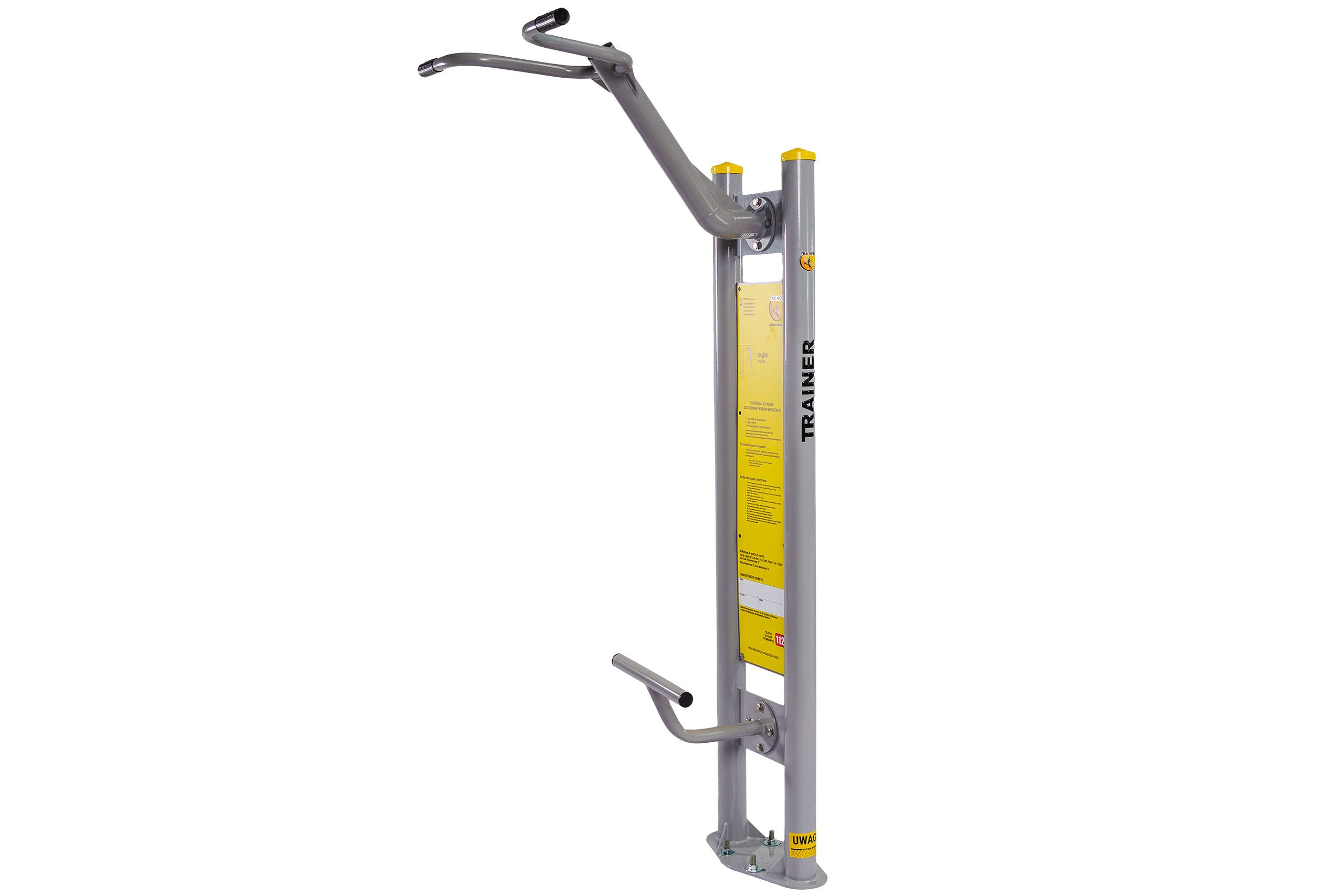
A power tower combines a high pull-up bar, dip handles, a back pad for hanging or supported leg raises and, on most models, a push-up station. It is the most productive square metre in a small studio, because it replaces four separate pieces of equipment.
Four numbers decide whether a given model belongs on a paying floor:
- Rated load per user: 150 kg minimum for a commercial installation. Public-sector and defence specifications commonly require 250 kg. Ask for the figure in writing; it is a design value, not a marketing one.
- Steel wall thickness: 2 mm or more. Below that, welded joints at the dip handles fatigue within two to three years of class use.
- Base footprint and anchoring. A freestanding tower must either have a base wide enough to resist the moment produced by a kipping pull-up, or be bolted down. Most failures on gym floors are tipping events, not structural ones.
- Use classification. Specify EN ISO 20957-1:2024 class S, the professional and commercial class. Class H is the domestic class and is not appropriate for supervised or unsupervised paid-access use; class I covers inclusive professional equipment intended for supervised use by people with disabilities.
Pull-up bars: wall, ceiling or freestanding
The mounting decision is structural before it is functional.
| Mounting | Best for | Substrate requirement | Limitation |
|---|---|---|---|
| Wall mounted | Studios, hotel gyms, physiotherapy rooms, strict pull-ups | Solid concrete or reinforced masonry; chemical anchors, not plasterboard fixings | Wall clearance restricts kipping and muscle-ups |
| Ceiling mounted | Dynamic work, gymnastic movements, freeing the wall for storage | Structural slab with verified pull-out capacity | Requires a structural survey; retrofits are expensive |
| Freestanding rig module | Cross training floors, circuits, multi-station use | Level slab, usually bolted | Consumes floor area, 2.5 m clear height minimum |
| Outdoor freestanding | Parks, schools, barracks, residential developments | Concrete foundations sized to the manufacturer drawing | Must meet EN 16630 and carry an impact-attenuating surface where the free height of fall requires it |
Bar diameter is the detail most specifications omit. A 32 to 35 mm bar suits general adult use; 28 to 30 mm suits youth and mixed populations; anything above 40 mm becomes a grip exercise rather than a back exercise. On outdoor installations, a knurled or textured finish is a safety requirement in wet weather, not a preference.
Wall bars: the classic that came back
Wall bars, or Swedish ladders, disappeared from commercial gyms for two decades and returned with mobility and rehabilitation programming. They now appear in three settings: school and university gymnasia, physiotherapy and rehabilitation clinics, and the mobility corner of performance-oriented clubs.
Specify rung diameter at 35 to 40 mm, rung spacing at 15 cm, and a fixing pattern that spreads load across at least three structural points. Timber remains the reference indoors for grip comfort; hot-dip galvanised steel is the only sensible choice outdoors. A galvanised outdoor unit with an integrated flying pull-up bar sits at 1,550 EUR excluding VAT and turns a bare wall or a park perimeter into a full calisthenics station. Our outdoor wall bars range covers both freestanding and wall-fixed configurations.
Outdoor installations: the standards that apply
Once bodyweight equipment is installed in a publicly accessible space, the regulatory picture changes completely.
- EN 16630 governs permanently installed outdoor fitness equipment: geometry, entrapment, free height of fall, safety distances and durability.
- EN 1176 and EN 1177 apply where the equipment sits in or adjoins a playground, and EN 1177 defines the critical fall height performance the surfacing must deliver.
- EN 16899 covers obstacle and ninja-style equipment, which is a separate family with its own requirements. Our note on EN 16899 and parkour equipment safety explains where the boundary sits.
Material choice follows exposure. Hot-dip galvanised steel is the baseline. Within roughly 3 km of a coastline, or anywhere subject to de-icing salt, stainless steel grade 316 is the specification that avoids a repaint cycle every four years. The cost premium is typically 30 to 45 per cent and the whole-life comparison favours stainless in those environments. Our guide to street workout steel grades sets out the comparison in detail.
Budget planning: three realistic scenarios
| Scenario | Equipment | Indicative budget excluding VAT |
|---|---|---|
| Hotel or corporate gym, bodyweight corner | 1 power tower, 1 wall-mounted pull-up bar, 1 set of wall bars, 12 m2 of 20 mm rubber tiles | 2,200 to 3,000 EUR |
| School or club indoor gymnasium | 4 sets of wall bars, 2 power towers, 1 freestanding pull-up frame | 6,000 to 9,000 EUR |
| Public outdoor calisthenics area | Compact street workout cage with pull-up bars, dip station and wall bars, plus foundations and EN 1177 surfacing | From 2,450 EUR for the smallest cage; 12,000 to 30,000 EUR for a complete installed area |
Compact street workout cages start at 2,450 EUR excluding VAT for a wall-bar and rope-climb module and reach 4,490 EUR excluding VAT for a monkey ladder, pull-up, biceps bar and dip configuration. Installation, foundations and impact-attenuating surfacing are separate line items and commonly add 40 to 80 per cent to the equipment cost on a public project.
Frequently asked questions
What load should a commercial power tower support?
A minimum of 150 kg per user for a fitness club or hotel, built from steel of at least 2 mm wall thickness with a base wide enough to resist tipping. Public authority, university and defence specifications commonly call for 250 kg, and the manufacturer should state the figure in the technical file rather than in a brochure.
Wall-mounted or freestanding pull-up bar: which is better?
Wall mounting is the right answer for compact rooms and strict pull-ups, provided the substrate is solid concrete or reinforced masonry and chemical anchors are used. A freestanding rig is necessary as soon as the programme includes kipping, muscle-ups or circuit work, because those movements need clearance in front of and behind the bar.
Which standard applies to outdoor street workout equipment?
EN 16630 covers permanently installed outdoor fitness equipment in free public access, setting requirements for heights, safety distances, entrapment and durability. Where the installation adjoins or forms part of a play area, EN 1176 and EN 1177 also apply, and EN 1177 determines the impact-attenuating surface required for the free height of fall.
Are wall bars still relevant in a modern gym?
Yes, and demand has grown. They serve mobility programming, rehabilitation protocols, school physical education and as a fixed anchor point for resistance bands and suspension trainers. They also occupy no floor area, which makes them one of the highest-value items per square metre in a small studio.
What ceiling height is needed for a pull-up station?
Allow 2.5 m of clear height above floor level for the bar itself, and a minimum of 2.9 to 3.0 m of room height so that a tall user can hang and perform a strict pull-up without contact. Dynamic gymnastic work needs 3.2 m or more.
Planning a bodyweight or calisthenics area? Light In Fitness manufactures steel and stainless steel outdoor training structures in France and supplies indoor bodyweight equipment across Europe and export markets, with layout studies, foundation drawings, certified surfacing and installation included. Send us the site dimensions and the user profile and we will return a costed specification. Request a quote or browse our street workout structures.
Réalisations documentées
- Cage street workout ultime, Carcassonne – armée française
- Cage street workout ultime, Tahiti – armée française, Polynésie
- Cage SP Max, centre EPIDE de Combrée – établissement public d’insertion
- Cage SP Max, lycée Saint-Bénigne de Dijon – établissement scolaire
Sources et références
- NF EN 16630 – modules fixes d’entraînement physique de plein air : exigences de sécurité et méthodes d’essai (AFNOR)
- Code du sport, article L322-2 – garanties d’hygiène et de sécurité des établissements d’activités physiques et sportives (Légifrance)
À lire aussi sur le même thème
- TRAINER : la gamme de fitness extérieur en 6 familles
- Outdoor Twister: What It Is For and Which Version to Choose
- Arm Wheels, Helm and Back Massager: Upper-Body Stations for Outdoor Trails
- Battle ropes: exercises, specification and how to anchor them properly
- Gymnastics grips, chalk and grip training: the facility guide