Street workout cages: choosing between S275JR, S355JR and stainless steel
Trois nuances d'acier structurent une cage de street workout professionnelle, à commencer par le S275JR (limite d'élasticité 275 MPa, EN 10025-2) pour les éléments modulaires. Le choix de la nuance détermine la résistance de la structure, son comportement dans le temps et le traitement de surface applicable. Cet article détaille les trois aciers et leur emploi poste par poste.
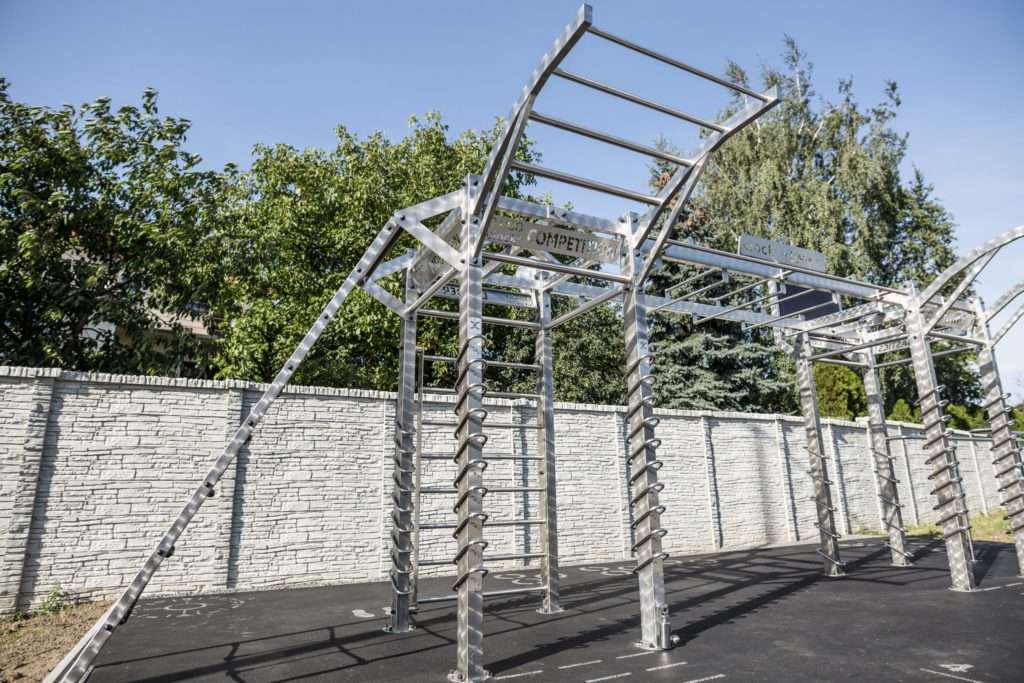
Three steels are used on professional street workout structures: S275JR for secondary modular parts, S355JR for load-bearing uprights, and austenitic stainless 304 or 316 for structures that must survive an aggressive atmosphere without maintenance. The choice is not made from a catalogue. It is driven by the installation environment and by the depreciation period the buyer has set. This guide covers the grades, the corrosion protection that goes with them, and what to write into a tender document.
S275JR: the construction steel for secondary members
S275JR is a non-alloy structural steel from the EN 10025-2 family. The designation follows the European convention: S for structural, 275 for the minimum yield strength in megapascals, JR for a guaranteed impact energy of 27 J at ambient temperature. Minimum yield strength is 275 MPa, tensile strength 370 to 530 MPa, elongation at break around 23 per cent, density 7850 kg per cubic metre. Weldability is excellent at common wall thicknesses without preheating.
On an outdoor calisthenics structure it suits fixing plates that carry no load, accessory brackets, gussets, non-bearing cross members and signage plates. Its strength to cost ratio makes it the reference grade for components that do not directly take the dynamic loads generated by users.
S355JR: the higher grade for load-bearing uprights
An athlete performing an explosive muscle-up, a kipping pull-up or a dyno applies an instantaneous load on the bar of roughly three to four times body weight, around 320 kg for an 80 kg user. Repeated thousands of times a year on a freely accessible structure, that cyclic loading justifies a higher grade on the vertical bearing members.
S355JR comes from the same EN 10025-2 family with a yield strength 29 per cent above S275JR and 51 per cent above S235JR. Minimum yield is 355 MPa, tensile strength 470 to 630 MPa, elongation around 22 per cent, Charpy impact 27 J at plus 20 degrees. J0 and J2 variants, tested at 0 and minus 20 degrees, exist for mountain and high altitude sites. A freely accessible structure carries three cumulative load cases: static (self weight, snow, wind), dynamic (explosive user movements) and cyclic fatigue over the whole service life. The extra 29 per cent of elastic margin means less deflection under load, better fatigue behaviour, and the option of thinner tube sections for the same capacity, which helps both appearance and transport.
Hot-dip galvanising: what to specify, not just what to accept
Any carbon steel exposed to weather must be hot-dip galvanised to EN ISO 1461, meaning the complete structure is immersed in molten zinc at around 450 degrees so the coating is metallurgically bonded to the steel. For tubes 3 to 5 mm thick the standard requires a mean coating thickness of at least 70 micrometres, with a 55 micrometre local minimum. Light In Fitness specifies 85 micrometres, a deliberate reserve above the normative floor, verifiable on the galvanising certificate. That protection gives roughly 10 to 15 years in a C3 atmosphere, the moderate urban and industrial corrosivity class defined by ISO 9223, after which touch-up work becomes necessary. A duplex system, galvanising followed by powder coating, extends that and opens up RAL colour matching for authorities working to an urban design code.
Stainless 304 and 316: the long-life option
Stainless 304 (X5CrNi18-10) contains around 18 per cent chromium and 8 to 10.5 per cent nickel, with yield strength around 210 MPa in the annealed condition, tensile strength 520 to 720 MPa and elongation around 45 per cent, to EN 10088-2. It performs very well in C1 to C4 atmospheres, covering rural, urban and moderate industrial sites.
Stainless 316 and 316L (X5CrNiMo17-12-2) add 2 to 3 per cent molybdenum to 16 to 18 per cent chromium and 10 to 14 per cent nickel, with yield around 220 MPa and tensile strength 520 to 670 MPa. The molybdenum is what delivers chloride resistance, so 316 is the grade for C5-M marine and C5-I severe industrial atmospheres, spa environments and the surroundings of outdoor pools. A target of 25 years or more without structural maintenance is realistic, though periodic cleaning is still recommended to preserve appearance and the passive layer.
The point most product sheets leave out
Austenitic stainless has a lower yield strength than carbon structural steel: 210 to 220 MPa against 275 MPa for S275 and 355 MPa for S355. Stainless does not mechanically replace a construction steel at identical section. For the same load it needs larger sections or greater wall thickness, which accounts for part of the price gap. Its advantage is not instantaneous strength but the retention of properties over time, with no corrosion and no weakening of welds. A supplier selling stainless while reusing the section sizes of its galvanised range has not done the calculation.
Comparison of the three grades
| Criterion | S275JR galvanised | S355JR galvanised | Stainless 304/316 |
|---|---|---|---|
| Yield strength | 275 MPa | 355 MPa | 210 to 220 MPa |
| Tensile strength | 370 to 530 MPa | 470 to 630 MPa | 520 to 720 MPa |
| Material standard | EN 10025-2 | EN 10025-2 | EN 10088-2 |
| Corrosion protection | Galvanising mandatory outdoors | Hot-dip to EN ISO 1461, powder coating optional | None needed, native passive layer |
| Role on the structure | Secondary and modular parts | Load-bearing uprights | Complete structure |
| Service life in C3 | 10 to 12 years | 15 to 20 years with duplex system | 25 years and beyond |
| Service life in C5-M marine | Not advised | 5 to 8 years | 25 years and beyond with 316 |
| Structural maintenance | Annual inspection | Periodic coating repair | None |
| Material cost index | 100 | 115 to 125 | 280 to 350 |
Matching the grade to the site
| Site | Corrosivity class | Recommended specification |
|---|---|---|
| Inland urban park, sports complex | C2 to C3 | S355JR galvanised, duplex system if colour matching required |
| Rural or residential site, continental climate | C2 | S355JR galvanised or stainless 304 |
| Within about 5 km of the coast, seafront hotel, coastal campsite | C5-M | Stainless 316 or 316L |
| Spa town, outdoor aquatic centre | C4 to C5 | Stainless 316 or 316L |
| Site treated with de-icing salt | C4 to C5 | Stainless 316 |
| Mountain or high altitude | C3 | S355J0 or S355J2, tested at 0 or minus 20 degrees |
Four things to write into the tender
First, the grade by function, not a blanket statement: S355JR or stainless on the bearing uprights. Second, an EN 10204 type 3.1 material certificate tracing the steel cast, which a credible supplier can always produce. Third, the galvanising thickness in micrometres, with the certificate. Fourth, the contractual structural and anti-corrosion warranty; anything under 5 years signals a manufacturer with limited confidence in its own product. Light In Fitness offers 20 years on steel structures and a lifetime warranty on stainless.
Compliance the steel grade does not cover
Freely accessible outdoor fitness equipment falls under EN 16630, which sets safety requirements, free space and safety zones, free fall height calculation, entrapment prevention and permanent marking carrying the manufacturer identification, the year of manufacture and the standard reference. That permanent marking is not CE marking. Freely accessible outdoor fitness equipment is not covered by a directive requiring CE marking, so a tender demanding CE marking to EN 16630 is asking for a document that does not exist. What the supplier issues is a declaration of conformity to EN 16630 with the third-party test report where applicable. Under equipment presenting a free fall height, the impact-attenuating surface is assessed to EN 1177. Indoor rigs are a different category and fall under EN ISO 20957.
Frequently asked questions
Is stainless mechanically stronger than construction steel?
No, and this is a common misreading. Austenitic stainless yields at around 210 to 220 MPa against 355 MPa for S355. At equal load a stainless structure needs larger sections. The benefit is durability, not instantaneous strength.
When is 316 worth the extra over 304?
Near the coast, usually taken as within 5 km, in spa environments, around outdoor pools and on sites exposed to de-icing salt. Inland in a continental urban atmosphere, 304 is sufficient and costs less.
Is hot-dip galvanising as durable as stainless?
No. Galvanising to EN ISO 1461 gives roughly 10 to 20 years in a C3 atmosphere and much less in a marine one. Stainless 316 targets 25 years and more without structural maintenance regardless of corrosivity class. Galvanising remains the sound economic choice inland over a short depreciation period.
What galvanising thickness should be demanded?
For 3 to 5 mm tubes, EN ISO 1461 sets a 70 micrometre mean minimum and a 55 micrometre local minimum. Specifying 85 micrometres is a useful reserve in urban or industrial atmospheres and is checked on the galvanising certificate.
Specify your structure with the right grade
Light In Fitness has manufactured and supplied outdoor training structures from Tours, France, since 2013, with site audit, corrosivity assessment, 3D layout and material specification included. Quotations are returned within 24 working hours. Browse our street workout rigs and stainless steel outdoor fitness ranges, or request a quote.
Réalisations documentées
- Cage street workout ultime, Carcassonne – armée française
- Cage street workout ultime, Tahiti – armée française, Polynésie
- Cage SP Max, centre EPIDE de Combrée – établissement public d’insertion
- Cage SP Max, lycée Saint-Bénigne de Dijon – établissement scolaire
Sources et références
- NF EN 16630 – modules fixes d’entraînement physique de plein air : exigences de sécurité et méthodes d’essai (AFNOR)
- Code du sport, article L322-2 – garanties d’hygiène et de sécurité des établissements d’activités physiques et sportives (Légifrance)
- Décret n° 96-1136 du 18 décembre 1996 – prescriptions de sécurité relatives aux aires collectives de jeux (Légifrance)
- NF EN 1176-1 – Équipements et sols d’aires de jeux, partie 1 : exigences de sécurité et méthodes d’essai générales (AFNOR)