Outdoor Fitness for 4–5 Star Campsites: Differentiation and ROI
Le fitness outdoor constitue un facteur de différenciation pour un camping 4 ou 5 étoiles, là où piscine, tennis et animations sont déjà généralisés. Les équipements conformes à la norme EN 16630 fonctionnent sans encadrement, donc sans coût d'animation. L'installation se planifie en inter-saison pour être opérationnelle à l'ouverture.
An outdoor fitness area is one of the few investments a 4–5 star campsite or holiday resort can make for 8,000–25,000 EUR excluding VAT that measurably lifts occupancy: pools, tennis courts and entertainment programmes are now table stakes, while the large majority of premium sites still have no certified outdoor gym. Because guests increasingly filter bookings by wellness and sport amenities, an EN 16630-compliant fitness zone photographs well, ranks well and converts — and the payback maths work from the first season. This guide covers the ROI model, equipment configurations by site type, compliance duties and the installation timeline.
The ROI model: occupancy points, not admissions
Outdoor fitness earns nothing directly — it earns through occupancy, ancillary revenue and repeat bookings. A worked model for a 200-pitch site trading 120 nights per season at 35 EUR average pitch revenue:
| Scenario | Occupancy gain | Additional nights | Additional annual revenue |
|---|---|---|---|
| Conservative | +3% (75% → 78%) | 720 | 25,200 EUR |
| Realistic | +6% (75% → 81%) | 1,440 | 50,400 EUR |
| Optimistic | +10% (75% → 85%) | 2,400 | 84,000 EUR |
Against an investment of 8,000–15,000 EUR excluding VAT installed, even the conservative case pays back within the first season. Secondary levers add margin: coached sessions (5–15 EUR per participant), equipment hire, and premium pitch packages with fitness-zone proximity at a 5–10 EUR per night supplement.
Differentiation: why it moves bookings
- Digital visibility: a photogenic fitness zone feeds listing photos, social content and OTA amenity filters — amenities guests can filter by are worth more than amenities they merely enjoy.
- Active families: the fastest-growing premium-camping segment plans holidays around maintaining training routines; a certified zone removes a booking objection.
- Shoulder-season appeal: sport groups, retreats and workation guests book off-peak weeks specifically for facilities.
Configurations by site type
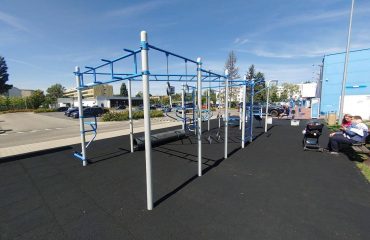
- Compact (up to 150 pitches): one multi-station street workout structure plus 2–3 cardio stations on 90–120 m² — 8,000–12,000 EUR excluding VAT installed. Verified anchors: the TRAINER 12-station street workout park in hot-dip galvanised steel at 5,454 EUR excluding VAT, plus the TRAINER Steel4Fit outdoor elliptical at 2,196 EUR excluding VAT.
- Full zone (150–400 pitches): strength stations, cardio line, street workout structure and a senior/accessible corner on 200–300 m² — 18,000–25,000 EUR excluding VAT.
- Fitness trail: 5–8 stations along 200–400 m of paths — 8,000–10,000 EUR excluding VAT — the natural format for wooded sites; see our resort fitness trail guide.
Material note: specify hot-dip galvanised steel as standard; within 500 m of the sea, step up to stainless steel 316L ranges.
Compliance: the operator’s duties under EN 16630
- Buy only stations with EN 16630 type-test reports — the standard for free-access outdoor fitness equipment (distinct from playground standard EN 1176; if you also operate a playground, the two zones must be separated — see EN 16630 vs EN 1176);
- Respect protective zones and impact surfacing per station free-fall height;
- Display user information panels (age/height limits, usage guidance);
- Keep an inspection log: routine visual checks weekly in season, operational inspection monthly, main annual inspection documented. This log is your liability defence.
Installation: one week on site
A typical project runs: siting study and 3D layout (week 1–2), equipment production/delivery (4–8 weeks), groundworks and foundations (2–3 days), station installation and surfacing (2–4 days), handover with conformity file. Winter installation ahead of the season opening is the standard schedule — full sequence in the outdoor gym installation guide. Site requirements: a reasonably level area, machine access for the mini-digger, and drainage — no utilities needed for self-powered stations.
Funding
Depending on country and region, tourism-modernisation grants, rural development programmes and health-promotion schemes routinely co-fund outdoor sports amenities at 20–40%; leasing over 36–48 months aligns payments with seasonal cash flow. Your supplier should provide the technical file (certificates, maintenance plan, visuals) that funding applications require.
Frequently asked questions
Which outdoor fitness equipment suits a campsite best?
A combination serving mixed ages and levels: one street workout structure for younger guests, 2–4 self-powered cardio stations, and low-entry strength or mobility stations for seniors. Single-audience zones underperform — the family mix is the point.
What ROI can a 4–5 star site expect?
On the worked model above, a +3% occupancy gain returns 25,200 EUR per year on a 200-pitch site — payback inside one season on a 8,000–15,000 EUR investment. Smaller sites (100 pitches) still reach payback in 2–5 seasons on the compact configuration.
Does outdoor equipment survive coastal and intensive holiday use?
Yes, if specified correctly: hot-dip galvanised steel with powder coating inland (15–20 year service life), stainless steel 316L within coastal spray range, EN 16630 test reports either way, and the inspection log kept in season.
How much space does a campsite fitness zone need?
From 90 m² for a compact configuration to 300 m² for a full zone including protective clearances — or almost no dedicated footprint if you thread a trail format along existing paths.
Get your campsite fitness file
Light In Fitness equips campsites, holiday villages and resorts across Europe with EN 16630-certified outdoor fitness — siting study, 3D visuals for your marketing, installation and maintenance contract included (range: campsite and holiday village equipment). Request your complete project file — configurations, visuals and pricing — and receive it within 24 working hours.
Réalisations documentées
- Cage street workout ultime, Carcassonne – armée française
- Cage street workout ultime, Tahiti – armée française, Polynésie
- Cage SP Max, centre EPIDE de Combrée – établissement public d’insertion
- Cage SP Max, lycée Saint-Bénigne de Dijon – établissement scolaire
Sources et références
- NF EN 16630 – modules fixes d’entraînement physique de plein air : exigences de sécurité et méthodes d’essai (AFNOR)
- Code du sport, article L322-2 – garanties d’hygiène et de sécurité des établissements d’activités physiques et sportives (Légifrance)