Women's Bodybuilding: Equipping a Gym for Female Strength Athletes
In short: women’s bodybuilding is no longer a niche within a niche, and the facilities that serve it well are the ones that specified for it deliberately. Load increments, bench and machine geometry, barbell choice and the layout of the free weight area all decide whether female strength athletes train with you or somewhere else.
From exclusion to a mainstream segment
Strength and visible muscle were treated as male territory for a long time, and the women who competed from the 1970s onwards did so against open resistance. That argument is settled. What followed the cultural shift is a commercial fact operators can measure: women now make up a substantial share of the strength floor rather than of the studio timetable alone, and they arrive with the same range of goals as anyone else, from general conditioning to competitive preparation.
For a gym, a health club, a hotel fitness room or a university facility, the practical question is no longer whether to serve this audience. It is whether the equipment on the floor was chosen with that audience in the specification, or whether it was chosen for a different one and is now expected to cope.
What women’s bodybuilding is, in practice
The discipline is the same as its male counterpart in principle: developing muscle mass, symmetry and definition through progressive resistance training and controlled nutrition. The adjustments sit in the detail. Hormonal and physiological differences change how programmes are periodised, and women generally carry a higher body fat percentage than men, which changes how a preparation phase is planned. None of this makes the training fundamentally different; it makes the programming specific.
The persistent myth that heavy training produces an involuntarily bulky physique is worth dispatching plainly, because it still influences how some facilities lay out their floor. It does not. Muscle development at that level is the result of years of deliberate work, and it does not happen by accident to someone squatting twice a week.
The competition categories
Understanding the categories helps an operator anticipate what athletes will need from the room.
Bodybuilding
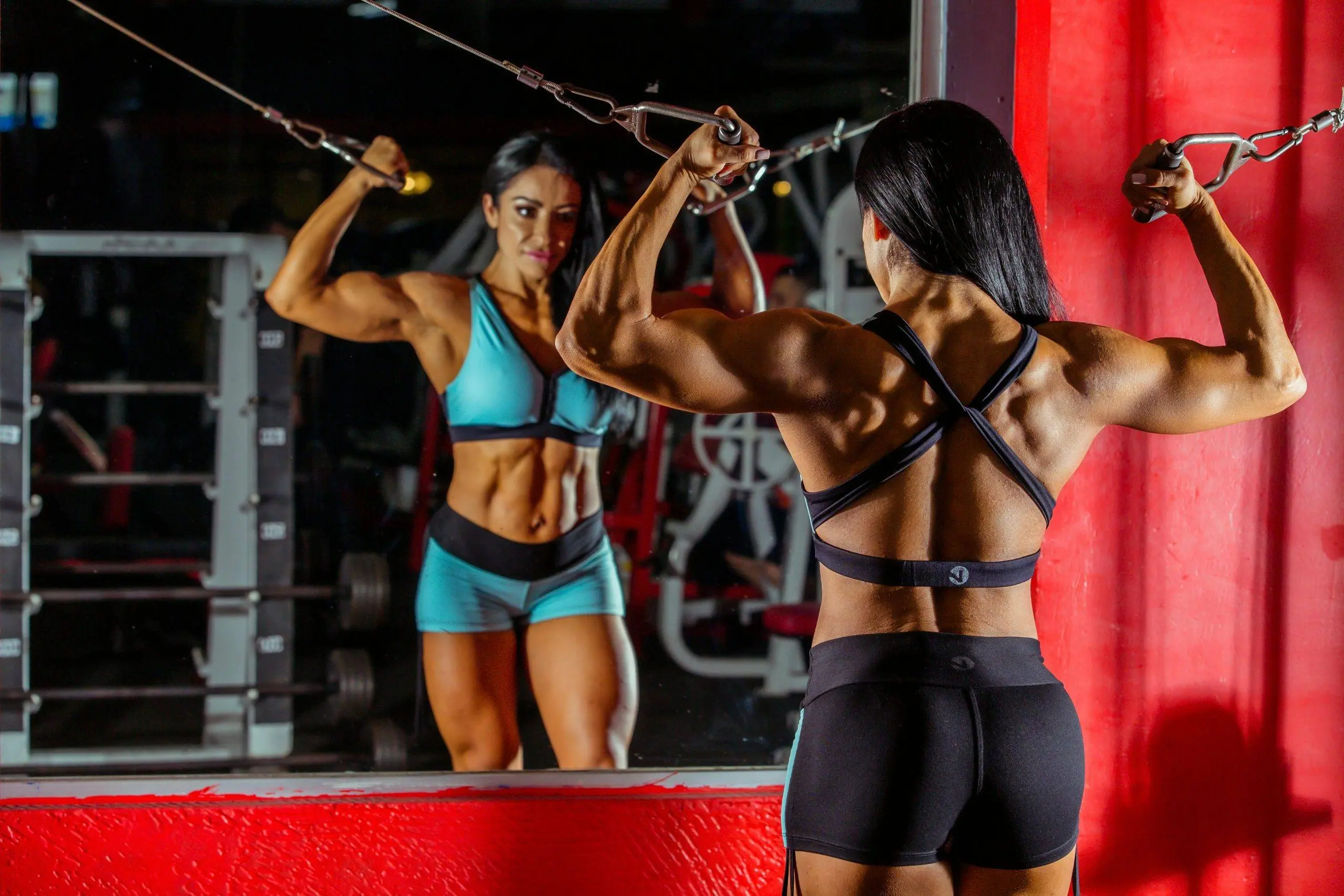
Judged on muscularity, symmetry and definition. It is the most demanding category in terms of training volume and years invested, and the athletes preparing for it need consistent access to heavy free weights and to the full range of movement patterns.
Fitness
Combines muscularity with athletic ability and a staged routine. Preparation includes gymnastic and plyometric work, so these athletes need clear floor space and functional equipment as well as machines.
Physique
Less pronounced muscularity than bodybuilding but still clearly defined, judged with a strong emphasis on line and aesthetic balance. Programmes lean on isolation work and precise control, which is where good machine geometry earns its place.
Bikini
The most accessible entry point, rewarding a toned physique with balanced proportions. Preparation concentrates on the glutes, shoulders and core, which is why a dedicated glute area is one of the most heavily used zones in a modern facility.
Nutrition: the part the facility does not control
Nutrition is what makes visible on stage the work done on the floor, and it is a matter of macronutrients, total intake, micronutrients and timing rather than of any single food. It is also outside the gym’s remit. What a facility can usefully do is avoid giving nutritional prescriptions it is not qualified to give, and instead make it easy for members to work with a registered dietitian. Diet plans handed out casually are a liability, not a service.
Training: what the programme demands from the floor
A serious preparation combines resistance training with conditioning. Alongside the classic strength and cardio pairing, functional training for whole body work, interval conditioning and Pilates for deep stabilising muscles all appear in well-built programmes. The floor therefore has to support heavy compound lifting, precise isolation work and open space for movement work, at the same hours.
That is a zoning problem before it is a purchasing problem. If the only clear floor is inside the free weight area, movement sessions and heavy lifting will collide at peak times, and the athletes will leave.
What this means when you specify equipment
Four points decide whether a strength floor works for this audience.
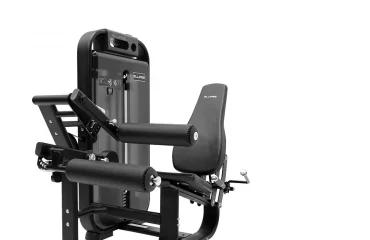
Load increments. Selectorised stacks with coarse increments make progression impossible in the lower and middle range. Fine increments, or add-on weights, are what allow a linear progression to continue. Our selectorised machines cover the main movement patterns with adjustment ranges suited to a mixed population.
Geometry and adjustability. Seat height, back pad position, handle spacing and start position have to accommodate a wide range of statures. A machine that only fits users above a certain height silently excludes part of your membership.
Plate loaded and free weights. Athletes preparing for competition will use them, and they need barbells of appropriate diameters and a bar selection that does not force everyone onto a single specification. Plate loaded machines bridge the gap between guided work and pure free weights.
A properly equipped glute and posterior chain zone. This is now one of the busiest areas of any commercial floor, and treating it as an afterthought creates queues. A dedicated glute training area concentrates the stations that get used most.
All indoor equipment for a commercial facility must be built and certified to EN ISO 20957-1 class S, the studio class for supervised professional use.
Frequently asked questions
Does heavy training make women bulky?
No. Substantial muscle development is the result of years of deliberate training and controlled nutrition. Regular resistance training builds strength and body composition without producing a competitive physique by accident.
What equipment matters most for female members on a strength floor?
Fine load increments, adjustable geometry that fits a wide range of statures, and a well-sized glute and posterior chain zone. Those three points affect usage more than the total machine count.
Do the competition categories change what a gym needs to provide?
Yes, at the margins. Bodybuilding and physique athletes need heavy free weights and precise isolation machines; fitness competitors need open floor and functional equipment; bikini athletes concentrate on glutes, shoulders and core. A floor that covers all three is a floor that keeps them.
Specifying your strength floor
Send us your floor plan, your peak occupancy and the profile of your membership, and we will propose a strength layout and a costed equipment list. Request a quote and we will build it around who actually trains with you.