How to Choose Professional Strength and Fitness Equipment

Choosing strength and fitness equipment for a commercial facility is a specification exercise, not a shopping exercise. The right list depends on who trains in your building, what they are trying to achieve, how much floor area you have and what supervision you can provide. This guide works through the decisions in the order a professional buyer should take them.
Start with the training outcomes you sell
Before committing budget, define what the facility is actually for. The equipment mix changes substantially depending on which of these dominates your membership:
- Weight management and body composition
- Muscle toning and general conditioning
- Cardiovascular endurance
- Building muscle mass and maximal strength
A facility oriented towards muscular development needs adjustable benches, free weights and multi-function strength stations as its backbone. A facility built around endurance and class formats will weight the budget very differently. Most commercial sites need a defensible balance rather than a single specialism, but the balance should be a decision, not an accident.
The core equipment families
Free weights
Dumbbells and barbells cover a wide range of muscle groups and movement patterns, from bench pressing to squatting to isolated arm work. They are the most flexible euro per square metre on the floor, and they scale with the user rather than constraining them. Their cost is supervision: free weight areas need staff sightlines and correctly specified flooring.
Benches
A bench is required for pressing work, seated and supported exercises and abdominal work. Adjustable benches offer far more programming versatility than fixed flat benches and are worth the price difference in a commercial setting. Note that pull-ups are not a bench exercise: they require a bar or a rig station, which is a separate line in the specification. See the professional weight benches.
Strength machines
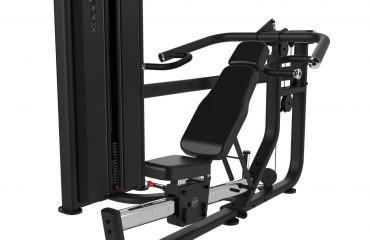
Selectorised and plate-loaded machines guide the movement path, which lowers the technical barrier and the supervision load. Multi-station units let several muscle groups be trained from a single footprint, which matters where floor area is the binding constraint. See the professional strength training machines.
Cardio equipment
Treadmills, exercise bikes, rowing machines and cross-trainers complete the offer and carry a large share of peak-hour attendance in most facilities. See the professional cardio equipment range.
Bands, cables and small equipment
Resistance bands and cable attachments add load variation, and they are genuinely useful in warm-ups to prepare joints and reduce injury risk. They cost little and consume almost no floor space, which makes them the easiest part of the budget to get right. See the fitness accessories range.
Functional constraints: space and versatility
Two practical filters narrow any shortlist.
Fit to the space. Where floor area is tight, prioritise equipment with a small footprint and high utilisation: adjustable benches, high-and-low pulley stations, parallel bars for bodyweight work. Measure circulation as well as equipment footprint – a machine that fits on paper but blocks a route is a machine that will be moved within a year.
Versatility. Multi-function stations that train several muscle groups from one frame deliver more programming per square metre than a row of single-purpose machines. That said, versatility has a throughput cost: one member on a multi-station occupies everything it does. Balance the two according to your peak-hour attendance.
Safety, standards and comfort
Indoor equipment installed in a facility open to the public should be certified to EN ISO 20957-1 class S. Class S is the professional class covering supervised commercial use; it is the reference to write into a tender or a purchase order. Class I is a separate professional class covering inclusive access – it is not a higher intensity tier above class S.
Beyond certification, check the detail that users touch: handles and grips should be ergonomic and non-slip, adjustment mechanisms should be operable without tools, and the range of motion should let each muscle group be worked without forcing a painful joint position. Comfort is not a luxury criterion in a commercial setting; uncomfortable equipment simply does not get used, and unused equipment is dead capital.
Equipment for beginners
New members are the population most at risk of poor technique and the most likely to leave. Guided-path equipment is the answer: selectorised machines let a beginner learn a movement, work safely and build confidence with a limited chance of doing it badly. A commercial floor that wants to convert trial members should have enough guided stations that a beginner never has to start on a barbell.
Tracking and progression
Equipment that makes progress visible keeps members training. Repetition counters, clear load indication and console-based tracking of work performed all give members something to compare week to week, and they give your coaching team data to base a programme review on. Where connectivity is available, it also feeds retention reporting.
Frequently asked questions
Machines or free weights for a new facility?
Both, in a ratio set by your membership. Beginner-heavy and lightly supervised sites weight machines; performance-oriented and well-staffed sites weight free weights.
What standard should appear in my tender?
EN ISO 20957-1, with the class stated. For indoor equipment in a supervised commercial facility that is class S. Do not cite the withdrawn EN 957 reference alone.
How do I size the equipment count?
From peak-hour attendance, not from total membership. Our technical team works from your attendance profile and floor plan.
Is multi-function equipment a good idea?
In small facilities, yes – it maximises programming per square metre. In busy facilities it can create queues, because one user occupies every function at once.
Getting your equipment list specified
The best equipment list is the one matched to your objectives, your available surface area and the people who will actually use it, and certified for professional use throughout. Send us your floor plan, your membership profile and your budget, and our team will return a full equipment schedule and layout proposal. Request a quote.
À lire aussi sur le même thème
- Comment choisir le meilleur Vélo biking magnétique pour votre salle de fitness ?
- Comment acheter un sol souple en caoutchouc au meilleur prix ?
- Protéine Musculation: Les Meilleures Protéines Whey Pour La Musculation
- Quel est le meilleur coach en IA pour booster vos performances sportives ? Comparatif complet des solutions Mental Gym