Pump Track Design, Installation and Budget for Local Authorities
Un pump track est un circuit fermé de bosses et de virages relevés, parcouru sans pédaler grâce au transfert de poids du corps. Il accueille vélos, trottinettes, skateboards et rollers sur la même infrastructure, en accès libre et sans encadrement. Pour une collectivité, le budget dépend du linéaire, du revêtement retenu et des terrassements.
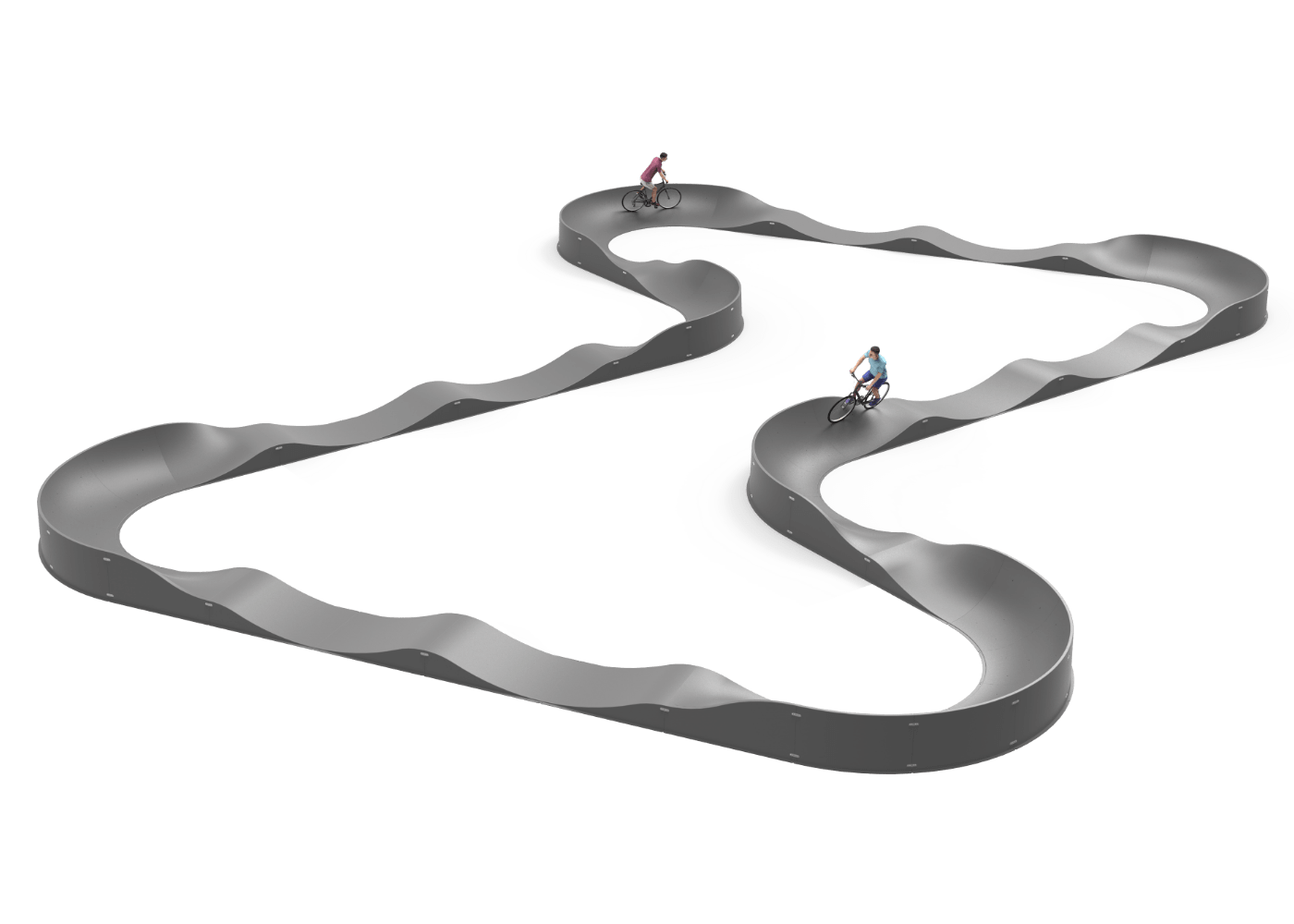
The pump track is one of the most innovative and in-demand sports facilities for municipalities in recent years. This closed circuit of rollers and banked turns is designed to be ridden without pedalling — riders generate speed by “pumping” with their body — and it attracts an exceptionally wide public: BMX and mountain bikes, scooters, skateboards, inline skates and even balance bikes for toddlers. Accessible, spectacular and genuinely intergenerational, a pump track turns any open space into a living sports hub. Here is the complete guide for local authorities and developers.
A universal concept
A pump track is a closed loop of rollers (rounded humps), berms (banked turns) and sometimes jumps. The rider moves forward by flexing and extending legs and arms to generate speed without pedalling or pushing — a natural, intuitive movement children master in minutes.
Compatible uses:
- BMX: the original pump track discipline
- Mountain bike: ideal for technical skills work
- Scooter: the number-one user group among 8–15-year-olds
- Skateboard and inline skates: on smooth surfaces
- Balance bike: children of 2–5 discover balance safely
- Sports wheelchair: accessible pump tracks are developing fast
Its greatest strength is the public it draws: a three-year-old on a balance bike shares the venue with a teenager on a scooter and an adult on a mountain bike. Few sports facilities are this genuinely intergenerational.
Types of pump track
| Type | Strengths | Limitations | Lifespan |
|---|---|---|---|
| Modular (prefabricated) | Installed in days; layout can be modified, extended or relocated; consistent factory quality; minimal maintenance; designed for compliance | Less bespoke than sculpted concrete | 15–25 years |
| Cast concrete | Fully bespoke design, landscape integration, very fast surface | Higher cost, long build time, unmodifiable, concrete upkeep (cracks, moss) | 20–30 years with regular maintenance |
| Earth | Very low cost, natural look | Rapid degradation, constant upkeep, unusable in wet weather, unsuitable for scooters and skates | Short without continuous work |
Modular tracks — prefabricated composite or precast concrete elements assembled like a puzzle — are the preferred solution for most municipalities. See our range of modular pump tracks from 32 to 90 linear metres.
Design and sizing
The building blocks: rollers 20–60 cm high depending on level, berms banked at 30–60 degrees, optional jumps (tables, doubles, step-ups) for advanced layouts, straights of aligned rollers, and a start hill for initial speed.
- Small pump track (200–400 m2): a simple circuit with 3–4 turns and 2–3 roller lines — ideal for small urban spaces, school grounds and neighbourhood parks.
- Medium pump track (400–800 m2): multiple sections with varied difficulty, beginner and advanced zones — suited to municipal parks and leisure centres.
- Large pump track (800–2,000+ m2): a full complex with several loops, competition and initiation zones, jumps and spectator areas — for major municipal projects.
Our design process: site and needs study, route proposal with 2D plan and 3D visualisation, module and difficulty selection, validation with the authority, manufacture, delivery and installation by our teams. Contact us for a free 3D plan of your project.
Surrounding surfaces
Around the track itself, ground treatment matters for safety and aesthetics: rubber tiles or interlocking rubber pavers for access routes and spectator zones — see our outdoor sports flooring range — and grass, wood chips or planting for landscape integration.
Integrating the pump track into a wider project
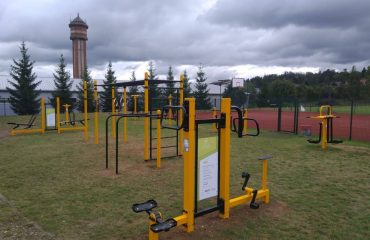
A pump track combines naturally with other outdoor facilities to create a multi-activity complex that serves every age group: street workout parks for teenagers and adults, outdoor ninja courses, parkour modules, outdoor gym machines, pickleball courts and playground equipment for the youngest. This multi-activity approach maximises the attractiveness and utilisation of the site.
Budget and funding
The cost of a modular pump track depends on size, layout complexity, ground preparation and peripheral works — every project is unique, so request a tailored quote. Funding routes available to local authorities typically include:
- Municipal capital investment budgets
- National and regional sports agency grants
- Rural and local investment support schemes
- EU regional development funds, where eligible
- Sponsorship and private partnerships
Light In Fitness helps authorities identify available funding and assemble application files — our guide to public funding for outdoor fitness projects is a good starting point.
Standards and safety
- Pump tracks have no dedicated European standard yet; they fall under the general safety principles for sports equipment.
- EN 14974 (skateparks) is commonly used as the reference framework.
- EN 1177 applies to impact-attenuating surfacing in landing zones.
- Accessible routes must be provided for users with reduced mobility.
Mandatory signage: usage rules (helmet recommendation, direction of travel, priorities), pictograms of permitted uses, emergency numbers and operator contact details, and difficulty-level information.
Maintenance and durability
Modular tracks: monthly visual inspection of modules and fixings, quarterly cleaning (sweeping, water jet), annual check of inter-module joints — for a lifespan of 15–25 years with minimal effort. Concrete tracks: annual crack inspection and repairs, twice-yearly moss treatment and re-jointing — for 20–30 years with regular upkeep.
Why choose Light In Fitness
Light In Fitness is a manufacturer and distributor of outdoor sports infrastructure: professional modular pump tracks, free bespoke 3D design, a complete outdoor range to build multi-activity complexes, turnkey service from design to installation, and full support through public tender procedures. Request a free quote.
Site selection and ground preparation
The right site does half the work. Look for a visible, accessible location — near a school, leisure centre or existing skatepark — with natural supervision from passing footfall, some distance from the nearest housing (rolling noise is modest but real), and existing lighting if evening use is expected. Ground requirements for modular tracks are simple: a stable, level, free-draining base such as compacted aggregate or existing asphalt; steep or waterlogged ground raises costs quickly. Allow space around the circuit for a rest zone with benches and bike racks, and check utility plans before fixing the layout. A site visit at the design stage — included in our free 3D study — catches almost every issue that would otherwise surface during installation.
Running and animating the facility
A pump track largely runs itself, but light animation multiplies its value: an opening event with a local BMX or scooter club, school sessions in curriculum time, holiday initiation courses and an annual amateur competition all build community ownership — which in turn reduces vandalism and strengthens the case for future phases. Several of our municipal clients pair the track with a youth-club partnership so equipment loans (helmets, balance bikes) remove the last barrier to participation.
FAQ — Pump tracks
What is the minimum area for a pump track?
A functional small circuit fits on 200–300 m2. A complete track with varied difficulty levels needs 500–1,000 m2 or more.
Is a pump track suitable for young children?
Yes — that is one of its great strengths. Children from age 2–3 can ride it on balance bikes; the low rollers and wide turns of initiation sections are designed for safe learning.
How long does a modular pump track last?
15–25 years with minimal maintenance: regular visual inspection and cleaning.
Can a pump track be combined with other equipment?
Absolutely. It integrates perfectly with a street workout park, a ninja course, a pickleball court or outdoor gym machines to form a multi-activity complex.
Does Light In Fitness support public procurement procedures?
Yes — we assist local authorities at every stage of the tender process, from technical specifications to compliance documentation.
Réalisations documentées
- Cage street workout ultime, Carcassonne – armée française
- Cage street workout ultime, Tahiti – armée française, Polynésie
- Cage SP Max, centre EPIDE de Combrée – établissement public d’insertion
- Cage SP Max, lycée Saint-Bénigne de Dijon – établissement scolaire
Sources et références
- Décret n° 96-1136 du 18 décembre 1996 – prescriptions de sécurité relatives aux aires collectives de jeux (Légifrance)
- NF EN 1176-1 – Équipements et sols d’aires de jeux, partie 1 : exigences de sécurité et méthodes d’essai générales (AFNOR)
- NF EN 1177 – revêtements de surface amortissants : détermination de la hauteur de chute critique (AFNOR)
- Code de la commande publique – texte intégral en vigueur (Légifrance)