Care Home Gym: How to Equip a Fitness Room for Residents
In brief: a fitness room in a residential care setting is not a scaled-down commercial gym. The equipment has to start at a very low resistance, be usable with minimal adjustment, be reachable from a wheelchair and be stable under a resident who may need to pull on it to stand. Get those four things right and the room will be used; get them wrong and it becomes storage.
Adapted physical activity in residential care is no longer optional. Strength work, fall prevention, preservation of independence and quality of life are documented, measurable benefits. Yet a large share of residents never take part in regular exercise sessions, most often because the building has no suitable space or the equipment on site does not fit their capabilities. This guide is written for care home directors, heads of care, architects and public authorities creating or refurbishing a fitness room in a residential care home or a senior living scheme. It covers the clinical rationale, the equipment, the layout, the applicable standards, supervision and how to structure the budget.
Why physical activity matters in residential care
Falls are the central risk
Roughly one older person in three falls at least once a year, and the proportion rises with age. In a care setting the consequences are disproportionate: hip fracture, accelerated loss of independence, post-traumatic depression and a step up in the level of dependency. Everything else in the room exists to reduce that risk.
Exercise is the most effective countermeasure
The clinical picture is consistent. Programmes combining strength work, balance and proprioception reduce fall risk by 20 to 40 percent according to the available meta-analyses, which places adapted physical activity at the top of any fall-prevention plan.
Resistance training on strength machines specifically improves lower-limb force, walking speed and balance, and self-confidence. Published work reports a knee extension gain of around 33 percent over 12 weeks, and a 12-week programme at three sessions a week has shown gains of about 29 percent on leg press alongside the 33 percent on knee extension. Those gains translate directly into the ability to rise from a chair, climb stairs and walk unaided, which is what delays the move into heavy dependency.
Cognitive and social benefits
Beyond the physical, group sessions structure the day, create shared moments and counter isolation, itself a major risk factor for dependent older people. Improved attention and a slower cognitive decline are also reported. In practice, the social effect is often what keeps attendance up once the novelty has worn off.
Equipment selection criteria
| Criterion | Specific requirement in a care setting |
|---|---|
| Ease of use | Intuitive controls, few or no adjustments to make |
| Passive safety | Emergency stop on powered equipment, anti-fall features, low load range |
| Wheelchair access | Reachable from a chair, seats adjustable in height, swing-away or removable seats |
| Low starting resistance | Load starting at zero or at 1 to 2 kg |
| Stability | Wide base, low centre of gravity, safe to pull on when standing up |
| Simple maintenance | Easy to clean, few exposed moving parts |
Equipment by activity type
Guided-load strength machines
This is the most relevant category for residents. Guided-load machines such as leg press, knee extension and seated row work the priority muscle groups, the lower limbs, the back and the trunk, with a precisely controlled load and no risk of losing balance. Models intended for older users are distinguished by very low starting weights, in the region of 2 to 5 kg, by seats adjusted with a simple handle or lever, and by smooth cable guidance. Our selectorised machines cover these movements; specify the low-increment stack option where it exists.
Recumbent and semi-recumbent bikes
The semi-recumbent bike is the natural first machine for residents with reduced mobility. The reclined position relieves the lower back and entry and exit are straightforward. Resistance starts very low and can be set by a carer or an instructor rather than by the resident. Recumbent bikes deliver gentle cardiovascular work matched to the capabilities of the group.
Low-speed treadmills
A treadmill with robust support rails and a speed starting at 0.5 km per hour is a central piece for functional rehabilitation and for maintaining gait. The running surface should be wider than 50 cm so that transfers on and off are safe, and the emergency stop must be reachable from the walking position.
Vibration platforms
Vibration platforms are used in care settings to work on muscle tone, balance and circulation with minimal effort from the resident. They are a complement rather than a substitute for resistance work, and their use should be cleared individually by the medical team, since a number of conditions are contraindications.
Soft-gym accessories
To complete the room or to run group sessions away from the machines: light resistance bands, coordination balls, hoops, small dumbbells of 0.5 to 2 kg and wall-mounted support bars. These allow balance and proprioception work seated or standing with support, and they are what the largest number of residents will actually use.
Sizing and laying out the room
For a home of around 80 residents, a room of 30 to 60 square metres is enough to host four to eight people at a time together with their carers. The room needs to be reachable and usable by wheelchair, with a clear passage width of at least 90 cm, well lit, and kept at a comfortable temperature of roughly 18 to 22 degrees. Confirm the passage widths and access requirements against the accessibility rules that apply in your country before finalising the layout.
A well-planned room divides into three zones.
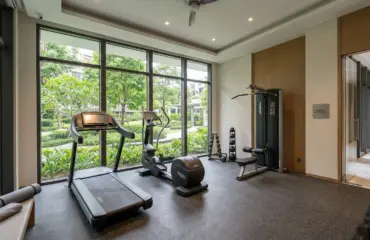
- Machine zone. Two to four guided-load strength machines, one or two semi-recumbent bikes, one treadmill.
- Soft-gym zone. Non-slip resilient floor, wall bars, and clear space for group sessions, allowing 3 to 4 square metres per participant.
- Rest and transition zone. Stable seating with armrests, drinking water and accessible storage for the accessories.
Flooring is a safety component
The floor covering matters more here than in any commercial gym. Rubber sports flooring of at least 20 mm absorbs impact, reduces injury if a resident falls and is easier to clean than a conventional floor. Two properties are non-negotiable: the surface must remain non-slip when wet, and the colour should contrast with the walls and with any change of level, so that residents with impaired vision can read the space. Our rubber gym flooring tiles are specified on that basis.
Standards and classification
Indoor fitness equipment for professional and supervised use is classified under EN ISO 20957-1 class S, the studio class. A care setting is precisely where the second professional class also matters: class I is the professional class covering inclusive access. It is not a level of intensity above class S but a classification chosen because of who uses the machine, and it is the right reference when residents will approach the equipment from a wheelchair or with reduced reach and grip.
Ask the supplier for the declaration per machine, with the class, the maximum user weight and the load range including the minimum resistance. On powered equipment, confirm the emergency stop and the safety key. Beyond the equipment classification, the fitness room forms part of the building and is subject to the fire, accessibility and healthcare-premises rules applicable nationally, which should be checked with the relevant authority at design stage rather than assumed from another country.
Supervision
Two rules hold everywhere, whatever the national framework. Every resident should be assessed by a doctor or physiotherapist before starting resistance work, and sessions on machines should never be run by unqualified staff or used unsupervised. Who is formally qualified to lead prescribed adapted physical activity, and how those sessions may be funded, is defined by national regulation and by the health authority responsible for your establishment, so confirm both locally before you build the programme around them.
In practice, sessions typically run 30 to 45 minutes, two to three times a week, in groups of four to eight residents: around 10 minutes of seated joint mobilisation, 20 minutes of strength and balance work, and 10 minutes of recovery. The World Health Organization recommendation for older adults is a minimum of 150 minutes of moderate physical activity a week, which such a schedule contributes to rather than replaces.
Structuring the budget
Build the budget from six lines rather than from a headline figure: the guided-load strength machines, the semi-recumbent bike or bikes, the treadmill, the floor covering for the whole room, the soft-gym accessories, and the delivery, installation and commissioning. Prices vary considerably with the range and the specification, particularly for treadmills and for bikes, so ask for a quotation against the actual list rather than working from a general budget figure. Set the annual maintenance and inspection alongside it from the start: in a care setting the inspection record is part of the duty of care, not an optional extra.
Frequently asked questions
Can every resident use the strength machines?
Not without prior assessment. Functional capacity should be assessed by the coordinating doctor or the physiotherapist before any resident takes part in resistance work. Residents with the highest dependency will generally work on assisted mobilisation or soft gym, while more autonomous residents can use the machines according to their assessed capacity.
Will standard commercial gym equipment do?
Usually not. Commercial machines are designed for able-bodied adults and their stacks commonly start around 5 to 10 kg. For frail residents, choose models whose resistance starts at 1 or 2 kg, with simplified access and reinforced passive safety. This is where the class I inclusive-access classification is worth asking about explicitly.
How large should the room be?
For a home of around 80 residents, 30 to 60 square metres works, sized for four to eight simultaneous users plus carers. Allow 3 to 4 square metres per participant in the group-session area and keep circulation clear for wheelchairs throughout.
What safety precautions does the room need?
Prior medical assessment for each resident, a qualified instructor present at all times, a formal prohibition on unsupervised use, non-slip flooring, wall-mounted support bars, generous lighting, an accessible defibrillator nearby and a first aid kit in the room.
How long does a session last?
Typically 30 to 45 minutes, two to three times a week, in groups of four to eight. Ten minutes of seated mobilisation, twenty minutes of strength and balance work and ten minutes of recovery is a workable structure.
Does a fitness room really change resident outcomes?
The published results are encouraging. A 12-week strength programme at three sessions a week has shown improvements of roughly 29 percent on leg press and 33 percent on knee extension in older subjects, gains that show up directly in rising from a chair, climbing stairs and walking unaided.
Planning your project
Light In Fitness equips care settings and senior living schemes with strength machines, recumbent bikes, treadmills and impact-absorbing flooring selected for frail users, and supports directors and architects in laying out the room, choosing the equipment for their residents and drafting the technical specification for a public tender. Send us the room dimensions, the resident profile and the number of simultaneous users you plan for, and request a quotation for the complete room.
Réalisations documentées
- Dalles et sols sportifs : livraisons documentées – plusieurs chantiers
- Sol sportif extérieur, square Georges-Vallerey – Taverny (95)
Sources et références
- Code du sport, articles R322-4 à R322-43 – garanties d’hygiène et de sécurité applicables aux établissements d’activités physiques et sportives (Légifrance)
- NF EN ISO 20957-1 – équipement d’entraînement fixe, partie 1 : exigences générales de sécurité et méthodes d’essai (AFNOR)
- AFNOR Normalisation – dossier thématique sur les appareils d’entraînement fixes et leurs classes d’usage