How to Optimise the Layout of a 150 m2 Strength Training Gym
Sur 150 m², l'enjeu est la répartition entre zones plutôt que le nombre de machines : cardio, plateau guidé, charges libres et zone fonctionnelle. Chaque zone appelle une épaisseur de sol et une largeur de circulation propres. Le plan d'implantation se valide avant la commande du matériel.
Optimising a 150 m2 strength training room comes down to three decisions: zoning the space into strength, cardio and recovery areas with at least 1.5 m between machines, choosing equipment by coverage per square metre rather than by catalogue appeal, and matching the budget tier to the business model. A minimal starter fit-out can open at around 10,600 EUR excluding VAT; a professional club-grade fit-out for the same floor typically runs 60,000 to 90,000 EUR excluding VAT. This guide covers the layout logic, both budget tiers and the errors that cost the most to fix later.
Define the need and the budget tier first
A 150 m2 room can serve very different projects: a coaching studio, a workplace gym, a hotel back-of-house facility or a small commercial club. The business model dictates the tier. As a reference point, here is a minimal starter budget that gets a supervised space open:
| Equipment | Indicative unit cost | Quantity | Total |
|---|---|---|---|
| Squat cage | 800 EUR | 1 | 800 EUR |
| Dumbbell set (1-20 kg complete) | 1,200 EUR | 1 | 1,200 EUR |
| Multi-purpose strength machine | 1,500 EUR | 1 | 1,500 EUR |
| Rubber floor tiles (100 m2) | 25 EUR/m2 | 100 | 2,500 EUR |
| Rowers | 500 EUR | 2 | 1,000 EUR |
| Adjustable benches | 300 EUR | 2 | 600 EUR |
| Cardio units (treadmill, bike) | 2,000 EUR | 1 lot | 2,000 EUR |
| Starter total | 10,600 EUR |
All figures are indicative estimates excluding VAT. Be aware of what this tier is: entry-level equipment suited to supervised, low-intensity use. A commercial club open to the public needs class S equipment under EN ISO 20957-1 and should budget 60,000 to 90,000 EUR excluding VAT for 150 m2 in a professional European range, following the cost logic detailed in our guide to gym equipment cost by floor area. Neighbouring formats are covered in our 100 m2 strength floor zoning guide and the 200 m2 strength floor budget.
Zoning the 150 m2
- Strength zone (60-70 m2): squat cage and multi-purpose machine close together to ease transitions between exercises, with a minimum of 1.5 m between units. Free-weight benches and the dumbbell rack along a mirrored wall.
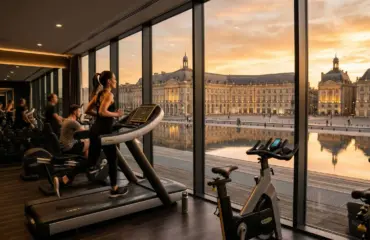
- Cardio zone (30-35 m2): a dedicated block, ideally near windows for ventilation and daylight; rowers can be stored vertically to reclaim floor space.
- Functional and accessories corner (20-25 m2): kettlebells, bands, medicine balls, battle ropes and a turf strip if the clientele wants functional work.
- Recovery and rest corner (10-15 m2): benches, foam rollers and massage balls, positioned away from the high-intensity zones.
- Circulation (remainder): at least 1 m of walking lane between all equipment, and 1.2 m on main routes.
Density is the discipline that keeps a 150 m2 room comfortable: professional planning works to roughly one station per 5-7 m2 all-in. Our guide to gym equipment density per square metre gives the ratios by zone type.
Complementary equipment worth adding
- Strength accessories: resistance bands, kettlebells, medicine balls; low cost, high perceived value.
- Functional equipment: ropes, sandbags and sled space if the membership profile justifies it.
- Recovery equipment: foam rollers and massage balls; the cheapest way to raise session quality and retention.
The errors that cost the most
- Underestimating circulation. Less than 1 m between machines makes simultaneous use impossible and creates safety risks. It is the most common regret on refit projects.
- Ignoring ergonomics. Every machine must be accessible and adjustable for users from 1.55 m to 1.95 m; test adjustment ranges before ordering, not after.
- Treating safety as an afterthought. Equipment must meet the EN ISO 20957 series, flooring should carry a Bfl-s1 fire rating for publicly accessible premises, and a documented maintenance routine is required from day one, not from the first breakdown.
- Buying entry-level for commercial intensity. Domestic-grade equipment in a commercial setting fails within 12-24 months and its warranty is typically void for professional use.
Return on investment: the numbers that matter
The ROI of a 150 m2 facility depends on equipment quality and diversity as much as on the attractiveness of the space. Reference indicators for a small commercial club:
| Indicator | Reference value | Comment |
|---|---|---|
| Members, year one | ~200 | A realistic target for 150 m2 in a mid-size catchment |
| Average monthly membership | 40 EUR | ~8,000 EUR of potential monthly revenue at target |
| Equipment service life | 5-10 years | 5 for entry-level, 8-10 for professional ranges; drives the depreciation line |
| Payback horizon | 18-36 months | For a professional-tier fit-out at target membership |
The full payback modelling method, including sensitivity to membership price and churn, is set out in our guide to gym investment ROI and payback.
Frequently asked questions
How many members can a 150 m2 gym support?
Around 200 to 350 active members depending on zoning quality and opening hours, which translates to 30-50 simultaneous users at peak. Beyond that, waiting at key stations degrades the experience.
Is 10,600 EUR a realistic budget for 150 m2?
Only for a supervised starter space with entry-level equipment: a coaching studio or staff gym. A commercial club on the same floor area should plan 60,000-90,000 EUR excluding VAT in professional ranges. Both figures are estimates to be confirmed by quotation.
How much space between machines?
A minimum of 1.5 m between strength stations and 1 m of clear walking lane everywhere, rising to 1.2 m on main circulation routes. Free-weight areas need extra clearance for the movement envelope of the user plus the bar.
Should the whole 150 m2 be floored in rubber?
The training zones, yes, typically in 20 mm tiles with 30-40 mm under free-weight areas. Reception or rest corners can take a different finish, provided transitions are flush and trip-free.
Get a 3D layout for your 150 m2 project
Send us your plans, your business model and your budget tier. You will receive a free audit, a personalised 3D layout with zoning and circulation, and an itemised quotation within two working days. Request a quote from Light In Fitness, professional gym equipment supplier since 2013.