Motor skills and gym equipment for nurseries, schools and clubs
Équiper une salle de motricité d'école maternelle, une crèche ou un espace périscolaire relève d'un cahier des charges distinct de celui d'une salle de sport. Le matériel doit être modulable, léger, sans point de pincement et posé sur sol amortissant. Les tranches d'âge accueillies commandent la hauteur des modules et la nature du revêtement.
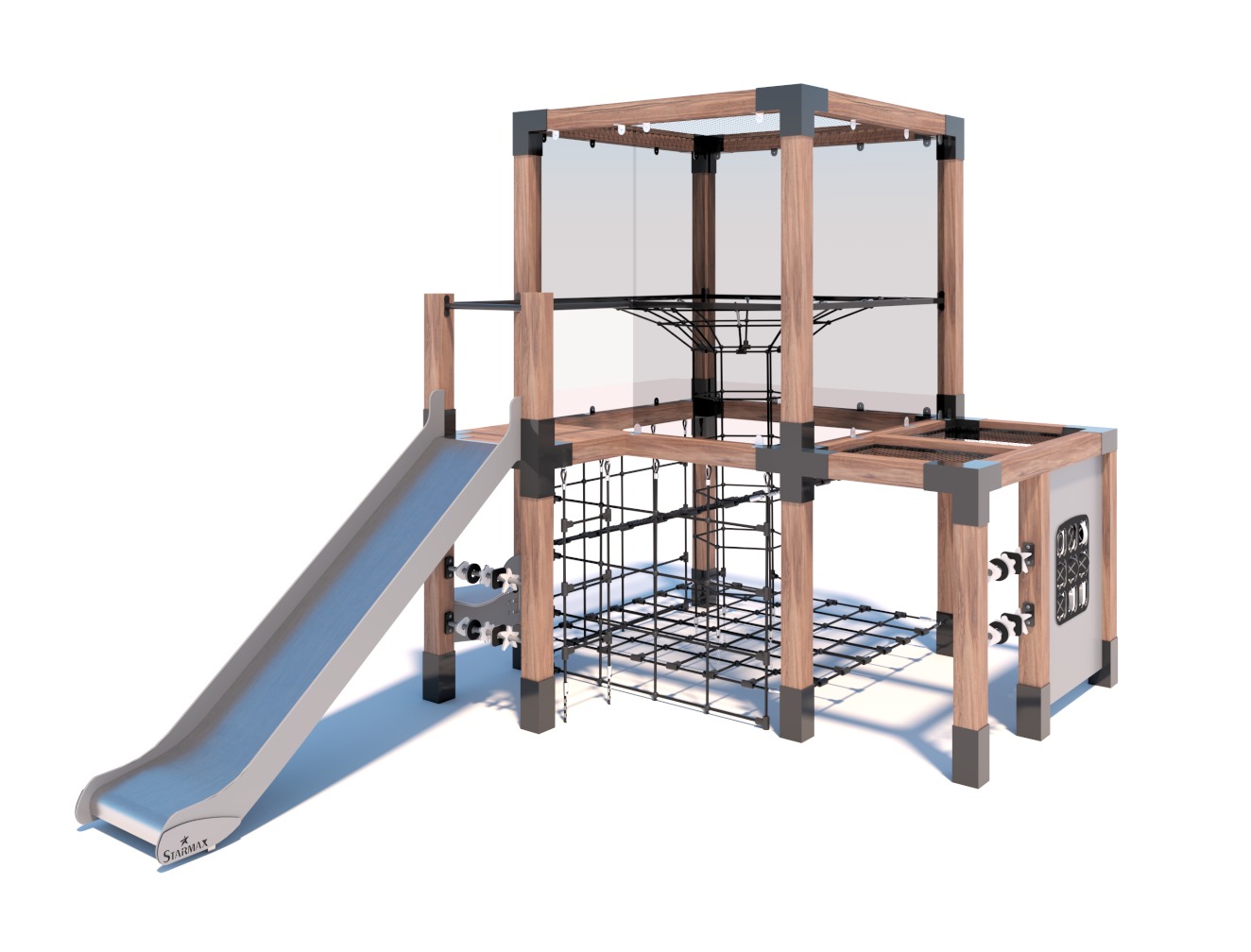
Equipping a motor skills room for a nursery, an infant school or an after school club follows a different logic from equipping an adult gym. Safety comes first, materials have to be age appropriate and washable, modularity has to keep pace with abilities that change quickly, and the standards that apply are a different set entirely: EN 71, EN 913, EN 1176, EN 1177 and EN 13219. This guide sets out the brief by age band, the flooring decision, and typical budgets by type of setting.
Short answer. Three age bands, three distinct equipment sets. From birth to three years, foam motor skills modules and activity mats, everything washable and compliant with toy safety requirements. From three to six, circuits, low beams and mats over impact attenuating flooring. From six to twelve, school gymnastics equipment and beginner tatami. The number one technical decision is the floor: as soon as an item presents a free height of fall above 60 cm, impact attenuating surfacing sized to EN 1177 is required.
Who this is for: heads of nursery and primary schools, nursery and day care managers, after school and holiday club directors, children gymnastics club operators and anyone specifying a sensory motor space.
Why this became an equipment question
World Health Organization guidance is explicit. Children aged one to four should accumulate at least 180 minutes of physical activity a day, of which at least 60 minutes should be moderate to vigorous from the age of three. Children and adolescents from five to seventeen should reach at least 60 minutes a day of moderate to vigorous activity. Those targets are widely missed, with documented effects on motor development, coordination and attention.
Public policy has followed. In France, a daily thirty minutes of physical activity has been generalised in primary schools since 2022, and physical activity is one of the central learning domains of the nursery curriculum, which in both cases assumes that space and equipment are available every day. Comparable programmes exist across Europe, and they turn a pedagogical objective into a procurement line.
The three age bands
| Age band | Setting | Equipment | Typical budget, excluding VAT |
|---|---|---|---|
| 0 to 3 years | Nursery, day care, childminder hub | Dense foam modules with a washable heat sealed cover, cubes, cylinders, ramps and steps; EVA puzzle mats of 20 to 30 mm in strong colours; crawling circuits with tunnels and stabilised walkways; a shatterproof mirror at child height; proprioception balls sized to the age | 6,000 to 15,000 EUR for a 30 place nursery |
| 3 to 6 years | Nursery school, holiday clubs | Motor skills room with a suitable surface; landing mats and tumbling modules; low balance beams, adapted bars, secured mini trampolines; hoops, ropes, batons and motor bricks; low wall bars and child height pull up bars | 12,000 to 25,000 EUR for a four class nursery school |
| 6 to 12 years | Primary school, after school clubs, children clubs | School gymnastics equipment, beams, adapted bars, sprung floor area and landing zones; wall bars, climbing ropes and ladders; 30 to 40 mm beginner tatami for judo, karate or taekwondo; outdoor multi sport surfaces; child scaled basketball at 2.60 m, mini goals and low volleyball nets | 25,000 to 50,000 EUR for a full sports room in an eight class primary school |
Flooring is the decision that carries the liability
| Use | Recommended surface | Thickness |
|---|---|---|
| Nursery and day care | Coloured EVA puzzle mats or a washable resilient covering | 20 to 30 mm |
| Nursery school motor skills room | Puzzle mats with foam landing zones | 30 to 40 mm |
| Playground with play structures | Rubber safety tiles or wood chips, sized to EN 1177 | Set by the critical fall height required |
| Indoor school sports hall | Sports floor compliant with EN 14904 | By system |
| Beginner dojo | Dense puzzle tatami | 30 to 40 mm |
Verified catalogue reference points, excluding VAT: 40 mm dojo puzzle tatami at 36.00 EUR per square metre, 50 mm puzzle tatami at 45.00 EUR per square metre, and 60 mm rubber safety tile tested to EN 1177 at 78.00 EUR per square metre. On any outdoor structure, size the surfacing from the free height of fall of the item and ask for the EN 1177 test report for the exact build up, including any underlay.
The standards that apply
EN 71 covers toy safety and applies to items treated as toys, which includes nursery foam modules, small foam elements and coloured accessories. It addresses mechanical and physical properties, flammability and the migration of certain elements. Restrictions on phthalates sit under the REACH Regulation instead, so ask for both documents; they are not the same certificate and a supplier who offers one in place of the other has not answered the question.
EN 913 covers gymnastic equipment, setting general safety requirements and test methods for beams, bars, vaulting boxes and springboards, covering structural strength, stability and dimensional conformity.
EN 1176 covers playground equipment and defines impact areas; EN 1177 covers impact attenuation of the surfacing and applies wherever an item presents a free height of fall above 60 cm. In France, a decree of 1996 makes compliance with both mandatory for collective play areas and requires a documented maintenance plan, which is the one point in this whole framework where the obligation is carried by regulation rather than by standard.
EN 13219 is specific to gymnastic trampolines and covers protective padding, safety devices and periodic checks.
Five constraints specific to children settings
Daily disinfection. Coverings must be impermeable, non porous and washable in hot water with the products the setting actually uses. That rules out fabric and exposed foam, and it makes chemical compatibility between the disinfectant and the covering a question to ask before ordering, not after the first term.
Evolution. Abilities change fast, so modular systems that can be reconfigured hold their value far better than fixed installations sized to one age.
Storage. Motor skills rooms are almost always shared with other activities, so equipment has to be moved and stored daily. Weight, handles and a defined storage footprint belong in the specification.
Supervision ratios. Equipment that requires close supervision will sit unused if the staffing does not allow it. Specify what the available adults can actually run.
Documentation. Keep the declarations of conformity, the test reports and the inspection log together. In an incident, that file is the evidence.
Frequently asked questions
Does adult fitness equipment have a place in a school?
Not below secondary age. Adult machines are dimensioned for adult limb lengths and adult loads, and using them outside that range is both ineffective and a supervision problem. From secondary age, specify equipment in the correct use class under ISO 20957-1:2024, class S for professional and commercial use or class I for professional inclusive use, and note that semi professional is not a class the standard recognises.
What surfacing thickness do we need under a climbing frame?
It depends entirely on the free height of fall of that item, not on a single figure for the site. Establish the highest free height of fall in each impact area and specify surfacing whose tested critical fall height to EN 1177 meets or exceeds it.
Can we buy foam modules and mats under a single standard?
No, and this trips up a lot of tenders. Foam modules treated as toys fall under EN 71, gymnastic equipment under EN 913, playground items under EN 1176, and sports hall floors under EN 14904. Ask for the correct certificate for each family rather than one blanket statement.
How long does this equipment last?
Foam modules with a heat sealed cover last five to eight years in daily nursery use, puzzle mats three to six years, and gymnastic equipment and steel structures far longer. Budget for covering replacement rather than whole item replacement, and specify replaceable covers at purchase.
Specifying a motor skills or school sports space
Light In Fitness has manufactured and distributed sports and play equipment from Tours, France, since 2013, and has equipped more than 2,500 customers, including schools, local authorities and children clubs. We produce the layout, supply the conformity documentation your file needs, quote within 24 working hours and ship in 5 to 10 working days from stock.
Request a quotation, or browse tatami mats and playground equipment.
Réalisations documentées
- Dalles et sols sportifs : livraisons documentées – plusieurs chantiers
- Sol sportif extérieur, square Georges-Vallerey – Taverny (95)
Sources et références
- Décret n° 96-1136 du 18 décembre 1996 – prescriptions de sécurité relatives aux aires collectives de jeux (Légifrance)
- NF EN 1176-1 – Équipements et sols d’aires de jeux, partie 1 : exigences de sécurité et méthodes d’essai générales (AFNOR)
- NF EN 1177 – revêtements de surface amortissants : détermination de la hauteur de chute critique (AFNOR)