Equipping a Gym in a Premium Residential Development: Guide and Budget 2026
Equipping a shared gym in a premium residential development is a strategic investment that significantly enhances the value of the property. In 2026, residents’ wellbeing expectations have moved decisively upmarket: they expect equipment that is high-performing, aesthetically coherent with the building and durable enough for unsupervised daily use. This guide gives developers, building managers and residents’ associations a practical framework: value case, constraints, equipment choices and budgets by floor area.
The property-value case
A well-designed gym can help a premium residence attract buyers and tenants. Developers can use it to distinguish the property at the sales stage. Managing agents gain an amenity that residents can use daily and see within their service charges. A poorly equipped or maintained room can instead generate complaints. Plan equipment and maintenance as carefully as the initial purchase.
Specific constraints of residential buildings
- Limited floor area: residential gyms are typically 25–80 m2, so compact, versatile equipment is essential.
- Acoustic sensitivity: the gym often sits above or beside apartments. Impact noise from dropped weights and vibration from cardio machines must be controlled at source — our article on gym impact noise and flooring explains the acoustic build-ups that work.
- Unsupervised use: no staff on site means equipment must be intuitive and inherently safe, with clear instructions. The principles in our guide to unstaffed 24-hour gym equipment apply directly.
- Commercial-grade certification: a shared residents’ gym is collective use — equipment should be certified to EN ISO 20957 class S, not home-rated class H. See class S versus class H equipment.
Recommended compact equipment
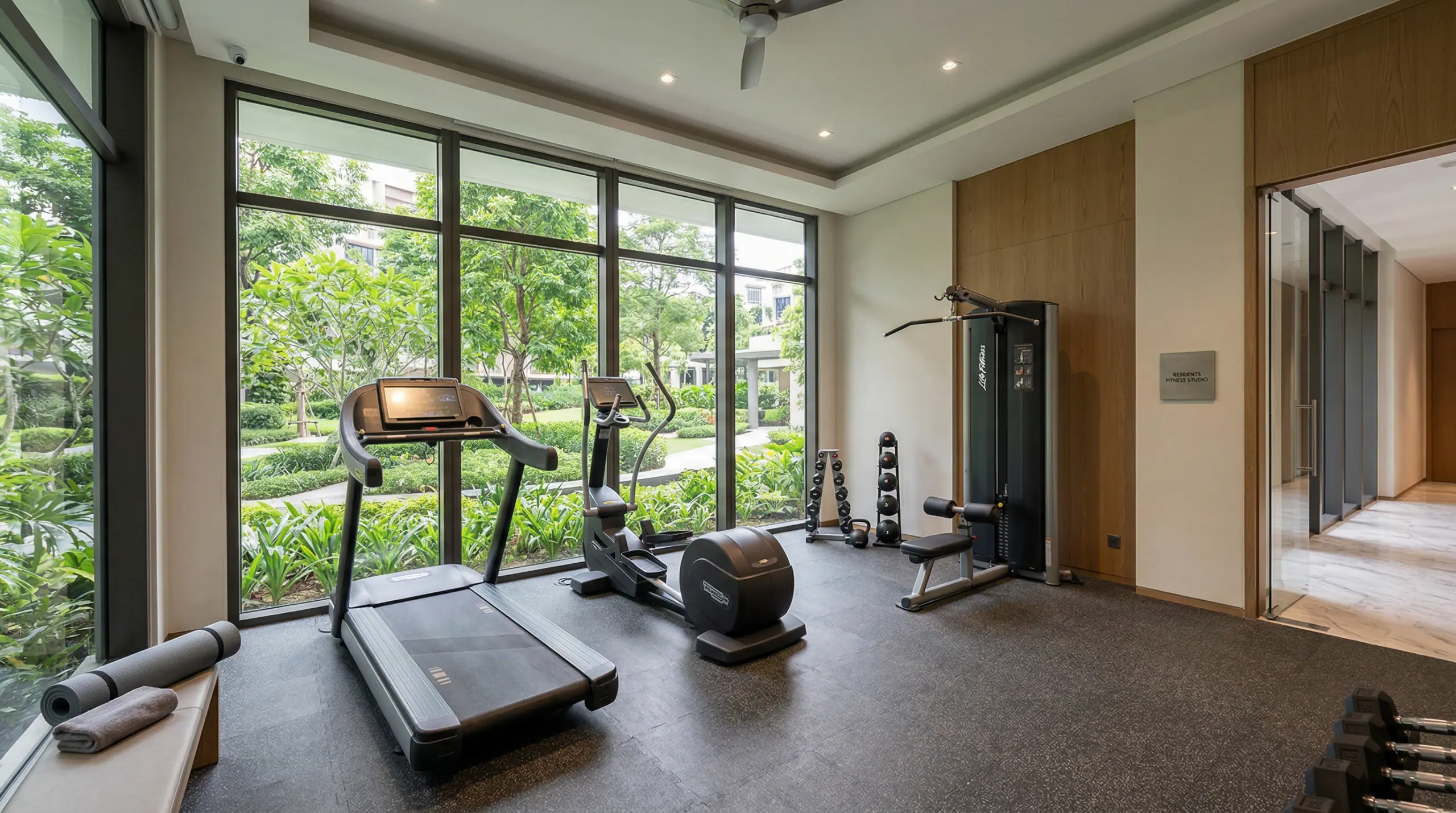
- Compact cardio: low-footprint cross-trainers, upright and recumbent bikes, and a quality commercial treadmill positioned on an acoustic underlay.
- Multifunction strength stations: a dual-pulley functional trainer covers dozens of exercises in under 4 m2 and is the single best value-per-square-metre purchase for a residential gym.
- Adjustable dumbbells and a bench: a modular dumbbell set replaces a full rack in a fraction of the space.
- Virtual coaching corner: a mirror or screen zone with mats, bands and small equipment supports classes without an instructor.
Configurations by floor area
| Floor area | Recommended configuration | Indicative budget |
|---|---|---|
| Under 30 m2 | 2–3 compact cardio machines, dumbbells, bench, mats and small equipment | 15,000–25,000 EUR excluding VAT |
| 30–60 m2 | Cardio line plus a multifunction strength station, free-weights corner, stretching space | 25,000–40,000 EUR excluding VAT |
| Over 60 m2 | Dedicated cardio, strength and stretching zones, premium finishes, optional recovery corner | 40,000–50,000+ EUR excluding VAT |
These estimates cover equipment and flooring for a premium finish; building works, ventilation and access control are additional. Budget should also include preventive maintenance — an annual service contract keeps the amenity safe and presentable and protects the building manager’s liability position.
Governance: making the gym work for the residents’ association
- Set access rules (hours, minimum age, guest policy) in the building regulations from day one.
- Use access control (fob or app) to keep usage traceable.
- Display clear equipment instructions and emergency procedures — essential for unsupervised facilities.
- Ring-fence a maintenance line in the annual service-charge budget rather than funding repairs ad hoc.
Light In Fitness supports developers and building managers across Europe with 3D layout studies, commercial-grade equipment supply, acoustic flooring and installation. Browse our residential gym equipment range or request a free quote for a tailored proposal.
Finishes and atmosphere: what premium means in practice
A premium gym should feel part of the building’s design. Start with matching surfaces: wood-effect rubber flooring, framed mirrors and indirect LED light. Then choose equipment finishes. Coordinated wood or matt-black ranges can also work well in off-plan sales brochures. Finally, consider the senses: fresh air, quiet ventilation, a water point, towels and integrated sound. These details form a small part of the full budget. Together, they can determine whether residents value the room and return to it.
Delivery, installation and commissioning
Residential projects face specific limits. Goods lifts may be small, lobby finishes need protection and working hours may be restricted. Neighbours may remain on site during the works. Check machine dimensions against lifts, corridors and doors early. Some commercial cardio machines can be taken apart for access. Protect delivery routes and use permitted delivery hours. At handover, check levelling, anchoring and the function of each machine. Give the managing agent a file with conformity documents, user manuals and the maintenance schedule. Specify these services in the purchase contract.
Case example: a 45 m2 gym in a 60-apartment development
An example for a premium development of around 60 apartments is a 45 m2 gym. It includes two cross-trainers, a treadmill with acoustic underlay and a recumbent bike. Strength equipment includes a dual-pulley trainer, adjustable dumbbells and two benches. Add mats, small accessories, wood-effect rubber flooring and a mirrored strength wall.
Flooring, delivery and installation place this example near the middle of the 25,000–40,000 EUR excluding VAT band. Around 15–25 regular users per week can use the room comfortably. The managing agent can operate fob access from 6 am to 10 pm, quarterly servicing and an annual full inspection.
Once decoration is complete, this scale of fit-out can take under two weeks on site. Treat this as a project example; confirm scope, timing and price in a quotation.
Common mistakes to avoid
Four errors account for most disappointing residential gyms: buying home-grade machines that fail within two years of shared use; skipping acoustic treatment and discovering the problem through complaints; furnishing the room with equipment nobody asked for instead of surveying residents first; and leaving maintenance unbudgeted so the first breakdown becomes a residents’-meeting dispute. All four are avoidable at specification stage — which is exactly where professional support pays for itself.
FAQ — Residential development gyms
Does a residents’ gym really add property value?
In the premium segment, yes: a quality fitness amenity is consistently cited among the most-used shared facilities and supports both resale pricing and rental demand. The effect depends on execution — a cramped room with home-grade machines can detract rather than add.
Can home-rated equipment be used in a shared residents’ gym?
It should not be. A shared gym is collective, unsupervised use: equipment certified to EN ISO 20957 class S is the appropriate specification, both for durability and for the liability position of the developer or managing agent.
How is noise controlled in a gym above apartments?
Three layers: acoustic underlay beneath the whole floor, thick rubber tiles (or dedicated drop zones) in free-weight areas, and equipment placement away from party walls. Vibration-isolating feet under treadmills help further.
What ongoing budget should a residents’ association plan?
Plan roughly 3–5% of the initial equipment value per year for preventive maintenance and consumables, plus a renewal provision so cardio machines can be replaced after 8–10 years without a special levy.