Senior Living Gym Equipment: Fitness Rooms for Independent-Living Residences
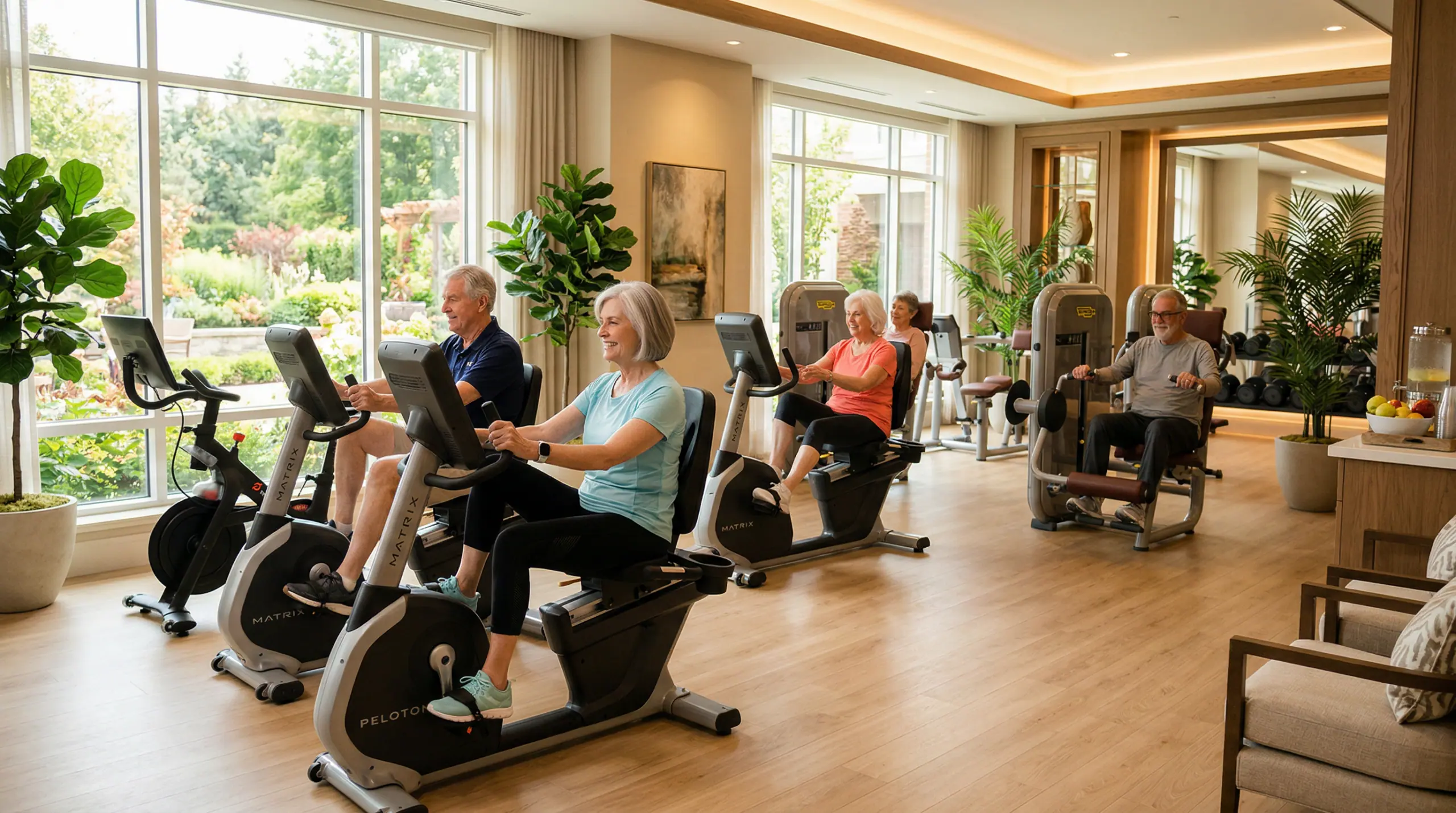
The ACSM (American College of Sports Medicine) ranks fitness programmes for older adults second in its 2026 worldwide trends survey. Demand also comes from independent-living residences, retirement communities and premium developments. These settings differ from medicalised care homes. A well-equipped fitness room can help developers and managers improve the residence’s appeal. It can also support resident retention.
This guide covers everything needed to design and equip a fitness space for active seniors in an independent-living setting: equipment selection, safety criteria, space planning by residence size and realistic budgets.
The active-senior market: why residences are investing
Europe’s population is ageing. More older adults want to stay active and understand the benefits of exercise for health and longevity. An on-site fitness space can be part of their choice of residence. Sector surveys report links between these amenities and occupancy. Treat these as planning indicators, then assess demand among the residents your project will serve.
Independent living versus care homes: two different worlds
| Criterion | Independent-living / serviced residence | Care home / medicalised facility |
|---|---|---|
| Population | Autonomous seniors | Dependent residents requiring care |
| Purpose of the gym | Preventive wellbeing, maintaining independence | Rehabilitation, therapeutic use |
| Medical supervision | Not required | Mandatory |
| Equipment type | Adapted commercial fitness equipment | Medical-therapeutic equipment |
| Equipment budget (estimate) | 20,000–80,000 EUR excluding VAT | 40,000–150,000 EUR excluding VAT |
This guide deals exclusively with non-medicalised independent-living residences. If you are equipping a care setting, see our dedicated guide to care home fitness equipment and our article on adapting strength equipment for care home residents.
Selecting equipment for active seniors
Five selection principles
- Low joint impact: protect knees, hips and spine
- Accessibility: suitable seat heights, easy mounting and dismounting
- Legibility: simple consoles, large displays, tool-free intuitive adjustments
- Passive safety: machines that cannot be used dangerously without supervision
- Comfort: comfortable upholstery, ergonomic grips, minimal vibration
Low-impact cardio: the priority equipment
| Equipment | Benefits for seniors | Watch points |
|---|---|---|
| Recumbent bike | Back support, no knee pressure, ideal after hip replacement | Seat height 40–45 cm preferred |
| Upright bike with wide saddle | Natural position, moderate cardiovascular stimulus | Comfortable saddle, adjustable handlebars |
| Short-stride cross-trainer | Fluid movement, zero impact, works upper and lower body | Stride of 40 cm or less for smaller users |
| Step machine | Strengthens glutes and quadriceps, stair simulation | Support rails essential on both sides |
| Rowing machine | Seated cardio plus full-body strengthening | Requires good shoulder and hip mobility |
To avoid: high-speed treadmills (fall risk), spin bikes (uncomfortable position for unprepared older users) and any cardio machine without support rails. Browse our full commercial cardio equipment range for suitable models.
Guided strength training
Sarcopenia — age-related muscle loss — is the number-one enemy of independence in later life. Adapted resistance training on selectorised machines is clinically proven to slow the process.
| Machine | Muscle groups | Senior-specific parameters |
|---|---|---|
| Inclined leg press | Quadriceps, glutes, hamstrings | Starting load of 5 kg or less, angle of 45 degrees or more, high seat |
| Lat pulldown | Back, biceps, trapezius | Triangle grip for easy holding, neutral guided path |
| Assisted shoulder press | Deltoids, triceps | Limited range if mobility is reduced |
| Leg extension | Quadriceps | Comfortable knee padding, loads starting at 2–3 kg |
| Guided biceps curl | Biceps | Stable elbow support, controlled movement |
Critical technical point: choose machines whose starting load is 5 kg or less with increments of 2.5 kg or less. Standard weight stacks starting at 10 kg are unsuitable for beginners or frailer users.
Balance, coordination and fall prevention
Falls are the leading cause of accidental death among the over-65s, making a dedicated balance and proprioception area essential:
- Wall-mounted rehabilitation bar or parallel bars, at least 2 m long
- Low training staircase (2–3 steps) with double handrails
- Proprioception equipment: stable balance trainers, wobble boards, balance discs
- Slow-walking treadmill (0.5–3 km/h) with side and front rails
- Sensory walking path: 4–6 m2 of varied floor textures
Stretching and mobility zone
Allow 15–20 m2 with thick floor mats (25–30 mm), height-adjustable stretching tables (60–90 cm), support cushions, light resistance bands, soft foam rollers and stable high chairs with armrests for seated exercise.
Non-negotiable safety criteria
Ergonomics and access
- Seat heights: 45–50 cm to ease sit-to-stand transitions
- Clearance: at least 1.5 m around each machine for transfers
- Support rails on all cardio equipment at 90–110 cm height
- Floor marking: clear zone boundaries with contrasting colours for partially sighted residents
Mechanical and electronic safety
- Visible, accessible emergency stop on all motorised cardio machines
- Safety clips on walking treadmills
- Maximum load clearly displayed on every machine
- Mandatory annual inspection of cables, belts and safety systems
Flooring
Floor safety deserves close attention. Specify slip resistance suitable for sports use. Avoid raised joints and sudden changes between zones. Use contrasting colours at edges and level changes. The guide’s example uses 8–12 mm rubber or PVC, but thickness alone does not prove fall protection. Check the flooring’s declared performance for the intended activity. See our rubber gym flooring guide.
Wheelchair access and inclusive design
An independent-living residence may include wheelchair users and people with limited mobility. Plan access from the start. The example allows aisles at least 1.40 m wide, with 1.50 m for turning. Check these dimensions against the site’s local access rules. Choose equipment usable from a wheelchair, such as arm/leg ergometers or side-access strength stations. Add accessible changing rooms and clear signs in large print and braille.
Space planning by residence size
| Residence size | Residents | Recommended area | Typical configuration |
|---|---|---|---|
| Small residence | 20–40 | 30–50 m2 | 3–4 cardio, 3–4 strength, mobility zone |
| Mid-size residence | 40–80 | 50–80 m2 | 5–6 cardio, 5–6 strength, proprioception, mobility |
| Large residence | 80–150+ | 80–120 m2 | 8–10 cardio, 6–8 strength, balance zone, relaxation room |
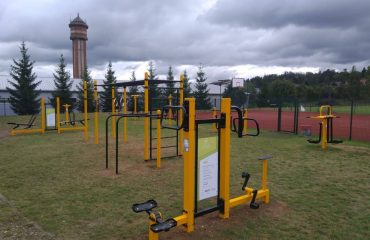
Plan five zones. Allow 5–10 m2 for welcome space and 15–30 m2 for cardio facing windows or screens. Arrange the 15–25 m2 strength zone in a U or L for easy supervision. Use 10–15 m2 for balance work, with suitable soft flooring and wall bars. A stretching area can occupy 10–20 m2. These are planning ranges to adapt to the site. An outdoor extension can add options. See our guide to a senior outdoor fitness area.
Indicative budgets
| Configuration | Contents | Estimated budget |
|---|---|---|
| Essential (30–50 m2) | 3 cardio, 3 strength, mobility zone | 18,000–35,000 EUR excluding VAT |
| Standard (50–80 m2) | 5 cardio, 5 strength, proprioception, mobility | 35,000–60,000 EUR excluding VAT |
| Premium (80–120 m2) | 8–10 cardio, 6–8 strength, balance, relaxation | 60,000–100,000 EUR excluding VAT |
Light In Fitness supports property developers and residence operators across Europe from needs assessment and 3D layout plans through delivery, installation and after-sales service. Request a free quote for your senior living fitness project.
FAQ — Senior living fitness rooms
What is the difference between equipping an independent-living residence and a care home?
Independent-living residences house autonomous seniors who need no medical supervision; equipment targets preventive wellbeing and maintained independence. Care homes house dependent residents, and their equipment is medical-therapeutic, subject to stricter health regulations. Budgets, equipment ranges and suppliers differ substantially between the two.
Which cardio equipment suits residents aged 70–85 best?
Recumbent bikes and short-stride cross-trainers (under 40 cm) are the best fit: effective cardiovascular work with minimal joint impact, comfortable seating and integrated support rails. Slow-walking treadmills (0.5–3 km/h) with side rails are also very popular for stabilised walking practice.
Is a fitness instructor required in a residence gym?
A permanent instructor is not compulsory, but weekly supervised sessions led by an adapted-physical-activity professional are strongly recommended. Clear pictogram-based usage instructions on every machine are essential for safe unsupervised use.
What minimum area is needed for a residence of 50 residents?
Around 50–65 m2, allowing 5–6 cardio machines, 4–5 strength stations, a proprioception zone and a stretching area. Below 30 m2 the offer becomes too limited to genuinely attract and retain residents.
How can the equipment be financed?
Depending on the country and the residence’s status, options include public modernisation grants for the senior-housing sector, health-authority programmes supporting preventive physical activity, and — for private commercial residences — professional equipment leasing over 3–5 years. Contact Light In Fitness for a quote and advice on the financing options available.
Réalisations documentées
- Dalles et sols sportifs : livraisons documentées – plusieurs chantiers
- Sol sportif extérieur, square Georges-Vallerey – Taverny (95)
Sources et références
- Code du sport, articles R322-4 à R322-43 – garanties d’hygiène et de sécurité applicables aux établissements d’activités physiques et sportives (Légifrance)