Ninja Warrior Course: Design, Installation and Budget
Un parcours Ninja Warrior combine force, agilité, équilibre et endurance sur une succession d'obstacles franchis en continu. En établissement recevant du public, la conception doit intégrer hauteur sous plafond, ancrages, zones de réception et surveillance possible depuis un point unique. Le budget se construit sur le nombre de modules et la nature de la structure porteuse.
How do you build a Ninja Warrior course?
The Ninja Warrior phenomenon is not slowing down. Television turned a spectacular discipline combining strength, agility, balance and endurance into a mainstream activity, and obstacle courses are now going up across Europe: specialist gyms, leisure centres, outdoor parks, military bases, schools, campsites and sports complexes are all investing in these structures. For local authorities and leisure operators, a Ninja course is a genuine attraction that pulls in a young, active, family audience. This guide covers how to design, install and budget for one.
1. What a Ninja Warrior course actually is
A Ninja Warrior course is a sequence of obstacles that test the participant physically. Unlike a conventional weights room, the point is not to lift loads but to move, climb, hang and jump through obstacles of increasing difficulty.
The common obstacle types are:
- Monkey bars: suspended horizontal bars crossed by swinging arm over arm.
- Swinging rings: hanging rings that move under load, demanding grip strength and coordination.
- Warped wall: a curved wall that has to be run up.
- Rope bridge and balance beam: crossings that test balance.
- Climbing net: vertical or horizontal net climbing.
- Swinging beams: a hanging crossing over moving beams.
- Liana jump: jumping to and catching suspended holds.
- Salmon ladder: driving a bar up between rungs, the signature move of the format.
- Quintuple steps: angled platforms that have to be run across without stopping.
- Slackline or unstable beam: a crossing on a deliberately unstable surface.
The strength of the concept is its modularity: every course can be matched to the space available, to the audience it serves (children, teenagers, adults, competitive athletes) and to the budget.
2. The main types of Ninja course
As a manufacturer of Ninja structures, Light In Fitness builds for each of these contexts.
Indoor Ninja course. Installed in a sports hall, a warehouse or a dedicated venue. Required clear height: 4 to 6 metres as a minimum. Rubber tiles or thick tatami mats underneath to make falls safe. The natural choice for specialist gyms, indoor leisure centres and sports complexes. See our indoor Ninja Warrior rigs.
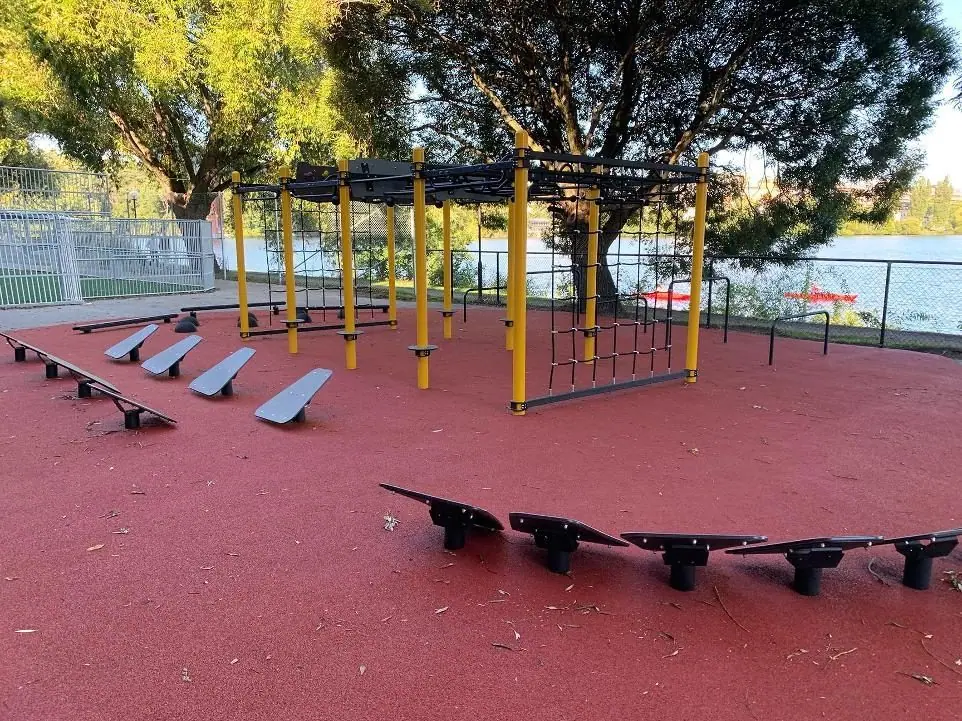
Outdoor Ninja course. Installed in a park, a campsite, an activity centre or a municipal open space. Outdoor Ninja modules are built in galvanised, powder-coated steel to survive weather exposure, with impact-attenuating surfacing to EN 1177. Browse our outdoor Ninja structures.
Combined course. Ninja modules mixed with street workout, parkour and CrossFit elements for a versatile space that appeals to every user group.
Children Ninja course. Obstacles scaled in size and difficulty for the 4 to 12 age group: limited fall height, easier holds, obstacles spaced more closely. Ideal for schools, holiday clubs and playgrounds. Children playground equipment is covered by EN 1176-1, and its surfacing by EN 1177.
Full multi-discipline parks. Complete parks bring CrossFit, street workout, parkour and Ninja together in one unified structure for maximum versatility.
3. Design and customisation
Every Ninja course is one of a kind. The design depends on several factors.
Available space. A minimum course needs roughly 50 to 100 sq m. A large competition course occupies 200 to 500 sq m and can run to 1,000 sq m or more. Outdoors, the possibilities are far more open.
Target audience. Obstacle difficulty varies enormously depending on whether you are serving children, families, recreational athletes or seasoned competitors. A good course offers several difficulty levels.
Budget. Courses are modular, so you can start with a handful of obstacles and add more over time.
Regulation. Courses open to the public have to meet the safety standards in force: EN 1176-1 for playground equipment, EN 16630 for outdoor fitness equipment for adults, and EN 1177 for impact-attenuating surfacing. Requirements for supervision, signage and inspection follow the national rules applying where the equipment is installed.
Our design process runs in six steps: site audit from a visit or from your drawings; a bespoke 3D layout matched to your constraints and objectives; a detailed costing covering obstacles, foundations, surfacing and installation; manufacture of the structures; delivery and assembly by our specialist teams; and handover, with the conformity check and certificates.
4. Surfacing: safety first
The floor is the single most critical safety element of a Ninja course. Falls are frequent and are part of the discipline, so the surface has to absorb enough energy to prevent injury.
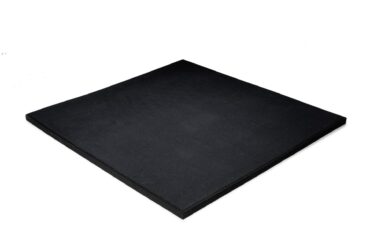
Indoors, use rubber tiles of 40 to 50 mm for moderate fall zones, tatami mats of 40 to 60 mm where falls are more severe, and foam pits under the high obstacles such as the warped wall and the salmon ladder.
Outdoors, use outdoor rubber tiles compliant with EN 1177, wood chips at a minimum depth of 300 mm in natural settings, or impact-attenuating sand in fall zones. Our range of impact-attenuating surfacing is specified on that basis.
The critical fall height has to be calculated obstacle by obstacle, and the surfacing selected to match it. That calculation is the step where projects most often go wrong, and we work through it with you.
5. Who invests in Ninja courses?
Leisure centres and attraction parks. A Ninja course draws families and groups. It is a high-value paid activity with a strong return on investment.
Local authorities. An open-access outdoor Ninja course is an investment in the attractiveness of a neighbourhood, and it complements existing outdoor fitness areas and playgrounds.
Campsites and holiday resorts. A differentiating facility that attracts sporty family clientele.
Gyms and CrossFit boxes. A Ninja area brings in a young, dynamic membership and sits naturally alongside existing CrossFit rigs.
Sports clubs and federations. Physical preparation, team building and functional training. A growing number of federations are starting to structure the discipline formally.
Schools and education centres. Motor skills, coordination and self-confidence for children and teenagers, and a natural complement to a children fitness trail.
Military bases and training centres. Physical preparation on a modernised assault course.
6. Budget and return
Investment scales in three broad tiers. A small course of 5 to 8 obstacles on 50 to 100 sq m suits an operator starting out or adding to an existing offer. A mid-size course of 10 to 15 obstacles on 100 to 200 sq m gives a complete offer for a leisure centre or a municipal site. A large course of 15 to 25 obstacles or more on 200 to 500 sq m and beyond becomes a competition venue or a headline attraction. The Ninja Warrior rig 3288 is a typical mid-size building block.
Every project is different, so pricing is issued per project rather than from a list.
On the revenue side, a Ninja course in a paid leisure venue earns from individual entries, family passes, birthday bookings, corporate team building and competitions. For a well-run, well-located site the payback period generally falls between 12 and 24 months.
7. Why work with Light In Fitness
We manufacture Ninja structures and cover the whole project: bespoke design for your space and your audience; galvanised, powder-coated steel with stainless fixings, built to the applicable European standards; a full range spanning Ninja modules, parkour structures, street workout cages, playground equipment and impact surfacing; a turnkey service from audit and 3D layout through to delivery and installation; and support for public procurement, including tender documentation. More than 2,500 customers have been equipped since 2013, and warranties run up to 20 years on our steel structures and for life on stainless steel.
Conclusion
A Ninja Warrior course is a high-potential concept with a broad and enthusiastic audience. Whether you are a local authority, a leisure centre, a gym, a campsite or a sports club, a well-designed and well-installed course strengthens your appeal and generates real engagement.
Frequently asked questions
How much floor area does a Ninja course need? A minimum of 50 sq m for a small course of 5 to 8 obstacles, and 200 to 500 sq m or more for a full competition course. Outdoors the constraints are looser.
Is a Ninja course dangerous? With suitable impact-attenuating surfacing, obstacles built to standard and clear signage, the risk of serious injury is very low. Falls are part of the practice and are absorbed by the floor.
Can Ninja and street workout be combined? Yes. Combined CrossFit, street workout, parkour and Ninja parks give maximum versatility and reach a wider audience.
How long does an outdoor Ninja course last? Our galvanised, powder-coated steel structures have a service life of 15 to 25 years with minimal maintenance.
Can you respond to a public tender? Yes. We regularly support public bodies through procurement procedures.
Start your project
Send us your site plan, your audience and your budget and we will come back with a 3D layout and a costed proposal: request a quote.
Réalisations documentées
- Cage street workout ultime, Carcassonne – armée française
- Cage street workout ultime, Tahiti – armée française, Polynésie
- Cage SP Max, centre EPIDE de Combrée – établissement public d’insertion
- Cage SP Max, lycée Saint-Bénigne de Dijon – établissement scolaire
Sources et références
- Décret n° 96-1136 du 18 décembre 1996 – prescriptions de sécurité relatives aux aires collectives de jeux (Légifrance)
- NF EN 1176-1 – Équipements et sols d’aires de jeux, partie 1 : exigences de sécurité et méthodes d’essai générales (AFNOR)
- NF EN 1177 – revêtements de surface amortissants : détermination de la hauteur de chute critique (AFNOR)
- NF EN 16630 – modules fixes d’entraînement physique de plein air : exigences de sécurité et méthodes d’essai (AFNOR)