How to Build a Custom Pump Track in Glass-Reinforced Polyester
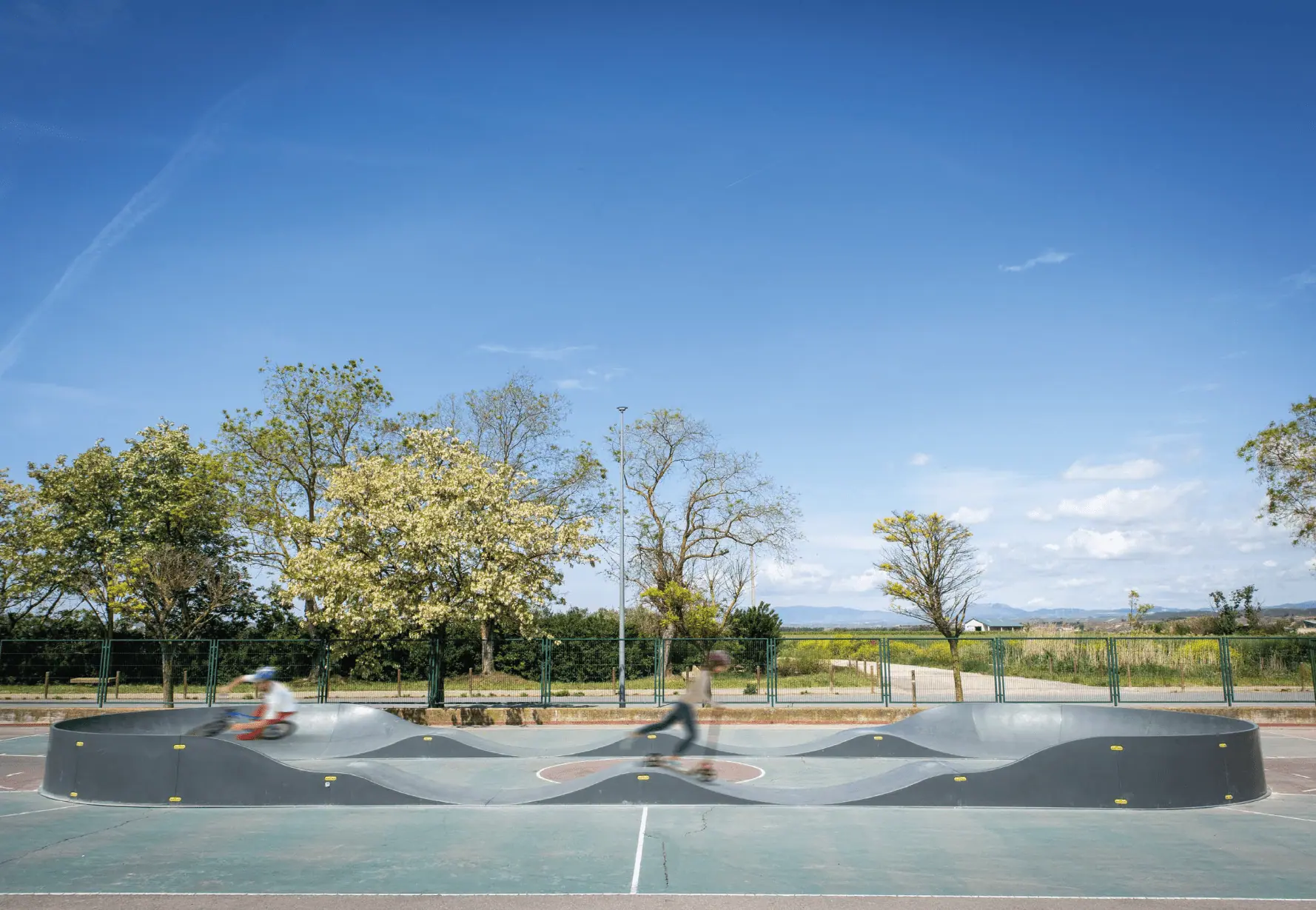
A pump track is a closed loop of rollers, banked turns and flat sections designed so that riders keep their speed by pumping the terrain rather than pedalling. It is one of the few pieces of outdoor sports infrastructure that works for a five-year-old on a balance bike and for an experienced rider on the same afternoon, which is exactly why local authorities, campsites, holiday parks, schools and residential developers keep asking for one.
This article explains how a custom pump track is built using modular elements in glass-reinforced polyester, and what a site owner needs to think about at each stage.
What a pump track is
The track combines rollers, banked corners and flat transitions into a continuous circuit. Riders generate speed by pushing down into the compressions and unweighting over the crests, so momentum is maintained without pedalling. The result is a smooth, flowing ride that rewards technique rather than power, which is what makes the format accessible across ages and ability levels.
Pump tracks have become popular precisely because of that accessibility. Unlike a technical trail, a pump track has no minimum skill threshold: a beginner rolls it slowly, an experienced rider carries speed through the whole loop, and both use the same circuit.
Why glass-reinforced polyester
Modular tracks in glass-reinforced polyester have several advantages over earth-built tracks for a site that has to stay open and stay safe.
- Durability. The material resists the abrasion of tyres and the effects of weather, and it holds its profile over years of use without the reshaping that a compacted-earth track needs after every wet season.
- Design flexibility. Because the circuit is assembled from elements, the layout can be shaped to the plot rather than the plot to the layout. Banked turns, rollers and flat sections are combined to suit the space and the intended user profile.
- Weather resistance. The surface performs in rain and under strong sun, so the facility is not seasonal.
- Simple maintenance. Routine care is cleaning the surface of dirt and debris and carrying out minor repairs when needed, rather than rebuilding the profile.
- Reversibility. A modular installation can be extended, reconfigured or removed, which matters on leased land and on sites with a defined project horizon.
Building a custom pump track step by step
Step 1: Planning and design
Start from the plot and the users. Decide the size of the circuit and the mix of banked turns, rollers and flat sections, and match the difficulty to who will actually ride it: a school and a bike park have very different requirements. Computer-aided design is used to visualise the circuit before anything is ordered, which is also what allows a realistic view of the space needed around the track for spectators, circulation and safety run-off.
Step 2: Preparing the ground
The ground must be levelled and cleared of obstacles. Depending on the site this can mean removing rocks, tree roots and debris with mechanical plant, and it always means confirming drainage: standing water under or beside a circuit shortens the life of everything on it. This is also the stage at which access, fencing and any surrounding surfacing are decided.
Step 3: Installing the elements
The glass-reinforced polyester elements, the banked turns, rollers and flat sections, are then installed following the manufacturer instructions. They must be securely fixed to the ground so that nothing shifts under load or in use. Fixing detail depends on the substrate, which is why the ground preparation and the installation method are decided together rather than in sequence.
Step 4: Testing and adjustment
Once assembled, the circuit is ridden and checked. The point is to confirm that the flow works, that speed is carried where it should be and that no transition is harsher than intended. Adjustments to element position at this stage cost very little; the same adjustment after the site opens costs a great deal more.
Step 5: Regular maintenance
Clean the surface of dirt, leaves and debris, inspect the elements and their fixings on a regular cycle and carry out minor repairs promptly. For a publicly accessible facility this inspection should be logged, in the same way as any other outdoor sports installation on the site.
Regulatory and safety considerations
A pump track open to the public is a sports facility, not a garden feature. Before installation, confirm the requirements that apply in your country and locality for outdoor sports facilities, public access, signage and supervision, and check what your insurer expects. Riders should wear a helmet, and knee pads, elbow pads and gloves are recommended, on a bike in good condition and suited to the discipline.
Where a pump track sits alongside a play area, remember that children play equipment and its impact-absorbing surfacing fall under their own separate standards, which are not the same as those covering the cycle circuit. Our outdoor sports parks for children and outdoor sports flooring ranges are specified accordingly.
Frequently asked questions
What is the difference between a pump track and a skatepark?
A pump track is designed for bikes and produces a flowing ride without pedalling. A skatepark is designed for skateboards, inline skates and scooters, and combines ramps, rails and obstacles specific to those disciplines. The two can coexist on a site but they are not interchangeable.
How long does it take to build a custom pump track?
It depends on the size of the circuit and the complexity of the design. The installation of modular elements is fast compared with earth construction, but the overall programme also includes design, groundworks and any permissions, so plan the project rather than the assembly.
Who is a pump track suitable for?
Riders of all levels, from children on balance bikes to experienced BMX and mountain bike riders. The design decides how demanding the circuit is, which is why the user profile belongs in the brief from the beginning.
Can a pump track be installed on a private site?
Yes, where there is sufficient space. Check the local planning and noise requirements that apply to your site, and make sure the safety and supervision arrangements match who will have access.
Design your pump track with Light In Fitness
Light In Fitness has supplied outdoor sports installations to local authorities, campsites, holiday parks, schools and developers since 2013. Our modular pump tracks are configured to the plot rather than sold as a fixed catalogue item. Send us your site plan, your available area and the profile of your users, and we will propose a circuit and a costed layout. Request a quote to get started.