Gym equipment names in English and French: the international buyer glossary
Chaque machine de salle porte un nom français consacré et un équivalent anglais utilisé par les fabricants : tirage vertical pour lat pulldown, développé couché pour chest press, cage guidée pour smith machine. Connaître les deux nomenclatures évite les erreurs de commande et de devis. Cette page établit la correspondance famille par famille.
A lat pulldown is a tirage vertical, a chest press is a developpe couche a la machine, and a Smith machine is a cage guidee. If you are running a tender, comparing quotations or ordering spare parts across borders, those three equivalences are worth more than they look: the same machine appears under different names in two bids, and a parts request under the wrong term goes to the wrong department. This glossary gives the English to French correspondence for strength, free-weight and cardio equipment, plus the UK and US variants that cause almost as much confusion as the translation does.
Why terminology becomes a procurement problem
Equipment nomenclature bites at four moments in a project, and each one costs money:
- Writing the specification. Every station must be identifiable without ambiguity by every supplier invited to bid, whatever their base language.
- Comparing quotations. Two bids can list the same machine under two different names, or two different machines under the same name. A converging chest press and a plate-loaded chest press are not interchangeable, and both are sometimes simply called a chest press.
- Ordering spare parts. Manufacturer part catalogues are indexed to the manufacturer’s own product naming, which is almost always English, even for continental European brands.
- Training staff. Members ask for machines by whatever name they learned. Instructors need both.
The safe practice in an international tender is to list the English name, then the local name, then the primary muscle group or function. That way each supplier identifies the station unambiguously and the returned quotations are directly comparable line by line. Our sports equipment tender specification guide sets out the wider document structure.
Selectorised and plate-loaded strength machines
| English (manufacturer term) | French | Primary muscle group |
|---|---|---|
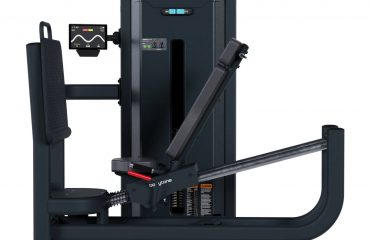
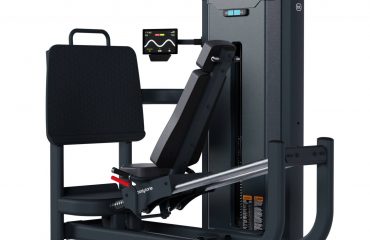
| Chest press | Developpe couche a la machine | Chest |
| Converging chest press | Developpe assis convergent | Chest |
| Pec deck / butterfly | Ecarte couche a la machine | Chest |
| Reverse fly / rear delt | Ecarte inverse | Posterior deltoids |
| Lat pulldown | Tirage vertical | Back |
| Seated row / low row | Tirage horizontal assis | Back |
| Shoulder press | Developpe militaire assis | Shoulders |
| Leg press | Presse a jambes | Quadriceps, glutes |
| Leg extension | Extension des jambes | Quadriceps |
| Leg curl | Flexion des jambes | Hamstrings |
| Hack squat | Hack squat | Quadriceps, glutes |
| Hip thrust machine | Machine a hip thrust | Glutes |
| Hip abductor / adductor | Machine abducteurs / adducteurs | Hips, thighs |
| Calf raise | Machine a mollets | Calves |
| Preacher curl | Curl biceps au pupitre | Biceps |
| Smith machine | Cage guidee | Multi-purpose |
| Cable crossover | Poulie vis-a-vis | Multi-purpose |
| Roman chair / captain’s chair | Chaise romaine | Abdominals, lower back |
A note on two terms that regularly derail a specification. A Roman chair means a vertical knee-raise and dip tower in most commercial catalogues, but in some ranges it means a 45-degree back extension bench. State the function, not just the name. And hack squat covers both the plate-loaded angled sled and a machine-guided version; specify the loading system explicitly.
Free weights, racks and functional equipment
| English | French | Use |
|---|---|---|
| Power rack / power cage | Cage a squat | Squats, pressing, pull-ups |
| Squat rack / half rack | Rack a squat ouvert / demi-rack | Squats, pressing |
| Flat bench | Banc plat | Bench press, rows |
| Adjustable bench | Banc reglable | Incline and decline pressing |
| Olympic barbell | Barre olympique | Compound lifts |
| Dumbbells | Halteres | Unilateral work |
| Bumper plates | Disques bumper | Weightlifting, cross training |
| Kettlebell | Kettlebell | Functional training |
| Sled / prowler | Traineau de force / chariot de poussee | Conditioning |
| Rig | Rig de cross training | Multi-station structure |
| Wall bars / stall bars | Espalier | Mobility, rehabilitation, schools |
| Plyometric box / plyo box | Caisson pliometrique | Jump training |
| Battle rope | Corde ondulatoire | Conditioning |
Cardio equipment
| English | French | Common variants |
|---|---|---|
| Treadmill | Tapis de course | Running machine (UK, informal) |
| Upright bike | Velo droit | Exercise bike, upright cycle |
| Recumbent bike | Velo semi-allonge | Semi-recumbent, seated bike |
| Cross trainer | Velo elliptique | Elliptical (US), elliptical trainer |
| Rowing machine | Rameur | Rower, indoor rower, ergometer |
| Indoor cycle | Velo de cycling indoor | Spin bike, studio bike, group cycling bike |
| Stair climber | Monte-escaliers | Stepmill, stepper, climbmill |
| Air bike | Velo a air | Assault bike, fan bike |
| Ski ergometer | Ergometre a ski | SkiErg |
UK and US English are not the same specification language
Cross-border buyers lose as much to English-to-English differences as to translation. The recurring ones:
| UK English | US English | Note |
|---|---|---|
| Cross trainer | Elliptical | Same machine; catalogues split roughly by market |
| Rowing machine | Rower / erg | Erg also refers to ski and bike ergometers |
| Selectorised machine | Selectorized / pin-loaded | Pin-loaded is the clearest term in a specification |
| Gym flooring | Gym flooring / rubber matting | Matting can mean rolls, tiles or mats; always give thickness and format |
| Multi-gym | Multi-station / functional trainer | Multi-gym implies domestic in some markets |
| Free weights area | Free weight floor | – |
Terms to avoid in a specification
Three words cause more disputes than any other, and none of them should appear in a tender document.
- Semi-professional. This category does not exist. EN ISO 20957-1:2024 defines use classes: S for professional and commercial use, H for domestic use and I for inclusive professional equipment intended for supervised use by people with disabilities, alongside accuracy classes A, B and C for load indication. A supplier offering semi-professional equipment is offering class H at a class S price. Write the class into the specification.
- Commercial grade. Meaningless without a reference. Replace it with the class designation and the standard.
- Heavy duty. Replace with the rated user weight, the rated load and the frame section in millimetres.
How to write the equipment schedule
For each line of the schedule, state: English name, local-language name, loading system (pin-loaded, plate-loaded, cable, bodyweight), primary function, rated load and user weight, standard and use class, footprint in millimetres, and required colour or upholstery reference. That level of detail is what makes returned quotations comparable without a second round of clarification, and it is the difference between a two-week and a two-month procurement. Our notes on structuring a multi-product equipment quotation cover the commercial side of the same document.
Frequently asked questions
What is a lat pulldown called in French?
Tirage vertical. The horizontal variant, where the handle is pulled towards the torso from a seated position, is the tirage horizontal assis, known in English as a seated row or low row.
Is a Smith machine the same as a cage guidee?
Yes, they are the same machine. Cage guidee is the established French term and Smith machine is the international name used in manufacturer catalogues. In a specification, write both, and add the counterbalance and bar path angle, because those differ significantly between models.
Why do manufacturer catalogues use English names?
Almost all professional equipment manufacturers design for an international market, so product references, spare part schedules and technical documentation are indexed to English naming. Even where the sales literature is localised, the parts catalogue behind it usually is not, which is why a service request should always quote the English designation and the model reference.
How should machines be named in an equipment specification?
English name, local name, loading system, primary function, rated load, standard and use class, and footprint. Naming alone is not enough: two machines called a chest press can differ by loading system, converging or parallel path, seat adjustment range and footprint, and those differences change both the price and the floor plan.
What does the S class in EN ISO 20957-1 mean?
Class S designates equipment designed for professional and commercial use, which is the class any paid-access or supervised facility should specify. Class H is domestic and class I covers inclusive professional equipment for supervised use by people with disabilities. There is no intermediate or semi-professional class, whatever a datasheet may claim.
Sourcing equipment across borders? Light In Fitness has supplied gyms, hotels, clubs, defence facilities and public authorities across Europe and export markets since 2013, and we quote against English, French or bilingual specifications. Send us your equipment schedule, in whatever language it is written, and we will return a line-by-line costed response. Request a quote or see our guide to the types of gym machine.