Buying Professional Strength Training Equipment: The B2B Guide
Buying strength training equipment for a facility is not the same exercise as buying it for a spare room. The machines have to survive continuous use, fit users of every size, satisfy the standards that apply to premises open to the public, and still leave room in the budget for flooring, delivery and installation. Light In Fitness has equipped gyms, hotels, campsites, schools, clubs, local authorities and rehabilitation centres since 2013, and this guide sets out how we approach the specification with a professional buyer.
Why specification matters more than brand
Two machines can look identical in a catalogue photograph and behave completely differently after eighteen months on a busy gym floor. What separates them is the specification: the section and the welding of the steel frame, the quality of the bearings and pulleys, the density of the upholstery foam, the travel of the adjustments, and whether spare parts are still available in five years.
The reference point for indoor stationary training equipment is EN ISO 20957-1, and the level to specify for a facility is class S, the class intended for professional and commercial use with unsupervised access. That single line in a tender document rules out the semi-professional products that dominate consumer marketplaces, and it protects you if a user is injured on equipment that was never designed for the traffic it received.
Beyond the standard, ask three questions of any supplier. What is the warranty, and on which parts? Who installs it, and is installation included? And what is the lead time for a replacement cable, pad or pin two years from now? Those answers usually reveal more than a specification sheet.
Guided machines, plate loaded or free weights
The right mix depends on who trains in your facility, not on what is fashionable.
Selectorised machines are the fastest way to get a mixed membership training safely. The movement is guided, the load changes with a pin, and a new member can be inducted in minutes. They are the natural backbone of a hotel gym, a corporate facility, a school or a rehabilitation room, and of the general training area of any club. The full range sits in our strength training machines section.
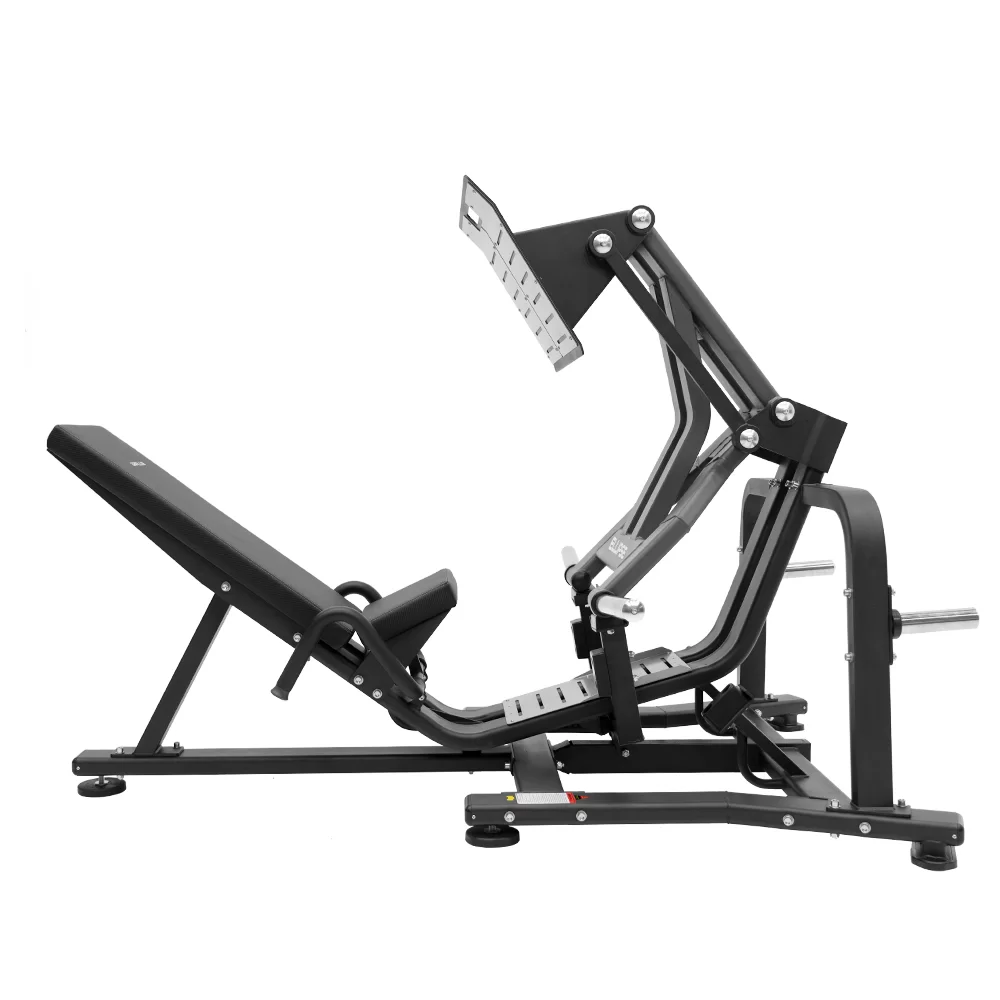
Plate loaded machines load Olympic discs rather than a stack. They give a different resistance feel, are mechanically simpler and, with fewer moving parts, are often easier to maintain in heavy-use environments. They suit strength-focused clubs and cross-training boxes. See the plate loaded machines range.
Free weights — racks, benches, barbells and dumbbells — cover the compound patterns that no guided station reproduces, and they carry the coordination and stabilisation work that experienced users come for. A free-weight zone needs more floor area per user and more supervision, but it is what distinguishes a serious strength offer. Benches are grouped under weight benches.
In practice a balanced facility uses all three. Guided machines handle volume and beginners, plate loaded stations handle the intermediate and strength segment, and a free-weight area anchors the offer.
Covering every muscle group without over-buying
The temptation when equipping a room is to buy one machine per muscle. It is rarely the right answer. A better method is to list the movement patterns you need to cover and then choose the smallest number of stations that covers them: horizontal push, vertical push, horizontal pull, vertical pull, knee-dominant, hip-dominant, and trunk. Seven patterns, and a well-chosen line-up covers all of them.
From there, the number of stations is driven by peak-hour attendance rather than by total membership. Count how many people are on the floor at your busiest hour, allow for the fact that guided stations turn over faster than free-weight stations, and size the room to that figure. Duplicating the two or three most popular stations usually does more for member satisfaction than adding an eighth different machine.
Accessories complete the picture: benches, barbells, dumbbells, kettlebells, storage racks and the flooring that protects both the slab and the equipment. Budgeting for them from the start avoids the familiar situation where the machines arrive and there is nothing to put them on.
Sector by sector
Commercial gyms and clubs need depth on the popular stations, a credible free-weight area and equipment that tolerates continuous use with limited supervision.
Hotels and campsites usually work with a small room, unsupervised access and guests of every level. Compact multi-station units and a short line of guided machines deliver more usable training per square metre than a scattering of specialised stations, and class S is non-negotiable because nobody is watching the room.
Schools, universities and clubs need equipment that a large group can rotate through quickly under a single instructor, with adjustments that suit a wide range of body sizes.
Rehabilitation and medical facilities prioritise fine load increments, a controlled range of motion and adjustments that make it easy to reproduce a prescribed setting from one session to the next.
Local authorities and social housing operators generally buy through a tender. The specification, the standards referenced, the warranty and the maintenance commitment carry as much weight as the price, and a supplier who can supply drawings and technical files makes that process considerably easier.
Customisation, finishes and lifespan
Frame colours, upholstery colours and branding can be matched to the identity of the facility, which matters more than it sounds: a room whose equipment looks coherent photographs better and ages better in the eyes of members. More importantly, a durable powder-coated finish and commercial-grade upholstery are what allow the equipment to be cleaned several times a day for years without the surfaces breaking down.
Longevity is also an environmental argument and a financial one. A machine specified for the traffic it actually receives, maintained on a simple schedule and re-upholstered once in its life will cost far less per year of service than a cheaper unit replaced twice over the same period.
Frequently asked questions
How do I know a machine is genuinely professional? Ask for the class under EN ISO 20957-1. Class S is the professional and commercial class. If a supplier cannot answer, treat the product as consumer equipment.
Should I start with guided machines or free weights? If the facility is unsupervised or serves mainly beginners, start with guided machines. Add a free-weight zone once you have the floor area and the staffing to supervise it.
Can I equip a room in phases? Yes, and it is often the sensible approach. Plan the final layout first, then install in phases so that the cabling, flooring and circulation still work when the room is complete.
Do you supply flooring and accessories as well as machines? Yes. Rubber flooring, storage, benches, barbells, dumbbells and kettlebells are all part of the same quotation, which avoids incompatible deliveries and duplicated transport.
Getting a specification for your own project
Every project starts the same way: a floor plan, a user profile, an opening date and a budget. From those four elements our team produces a proposed line-up, a layout drawing and a costed proposal, and adjusts it with you until the room works. Request a quote and we will take your project from plan to installed facility.