Weight Benches for Commercial Gyms: How to Specify Them
A weight bench looks like a simple piece of equipment, yet it is one of the hardest-working stations in any commercial facility. It carries barbell pressing, dumbbell work, core and back exercises, and it is used all day by members whose body weight, technique and loading vary enormously. For a gym operator, a cross-training box, a hotel wellness suite, a club or a rehabilitation centre, the bench is a structural decision rather than an accessory purchase.
Free-weight training on a bench recruits the stabilising musculature alongside the target muscle group, which is why coaches keep returning to it. A selectorised machine isolates a movement pattern; a bench loaded with dumbbells or a barbell asks the body to control the weight in space. That makes the bench equally relevant to first-time members, to users with reduced mobility, to performance athletes and to post-injury reconditioning programmes. The paragraphs below set out what to examine before you commit to a bench range across a whole floor.
Benches with integrated barbell supports
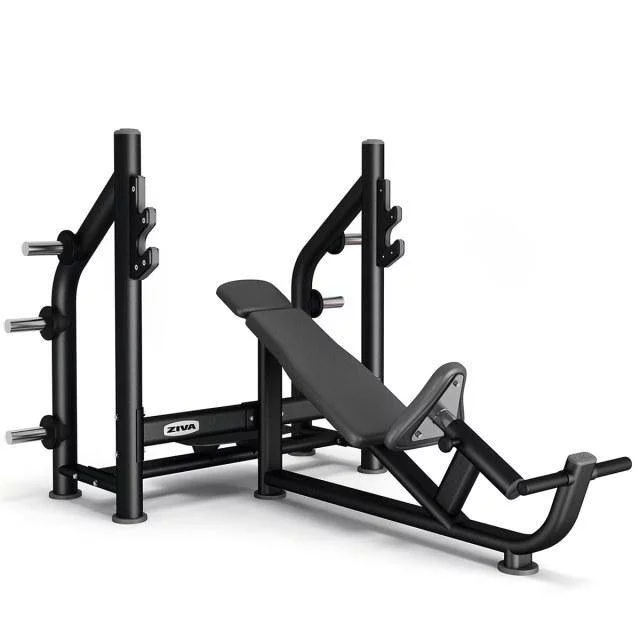
Start with the exercises the bench has to support. If barbell bench pressing is part of your programming, specify a bench with its own uprights, or plan the bench to sit inside a rack or a power cage. Flat benches without uprights are simpler machines with few or no adjustments, and they are excellent for dumbbell pressing, rows and accessory work, but they cannot safely receive a loaded barbell on their own.
In practice most commercial floors need both: a run of fixed flat benches for dumbbell stations, and a smaller number of benches paired with uprights or racks for barbell work. Deciding this at the layout stage avoids the classic problem of a busy free-weight area where every adjustable bench is permanently parked inside a rack.
Multi-adjustable benches for varied programming
An adjustable bench earns its floor space by covering far more than the flat position. A backrest that moves through positive incline and decline positions turns one footprint into a full pressing, shoulder, row and core station. Combined with a seat pad that also adjusts, it keeps users in a correct position instead of sliding down the pad under load.
Pay attention to the adjustment mechanism itself. A ratchet-style system is quicker and more stable in day-to-day use than a pin-and-hole system, and it matters more than it sounds: an adjustment that takes two hands and a lifted backrest will simply not be used between sets, and members end up training in whatever position the bench was left in. Optional attachments such as a preacher curl pad or a leg curl and leg extension unit extend the exercise range further without adding a second machine.
Build quality decides the lifespan
Build quality is where commercial and light-duty benches part company. Look at the steel frame first: section size, wall thickness and clean, continuous welds. In a showroom, inspect the weld beads directly; on a tender, ask for the frame specification and the warranty terms in writing.
The upholstery is the second wear point. Synthetic leather that resists sweat, cleaning products and abrasion, over dense foam of adequate thickness, is what keeps a bench presentable after three years of continuous use. The fixing between the pad and the frame deserves equal attention, because the loads a bench receives are rarely vertical and centred. Most of the punishing forces arrive at the corners of the pad, from the side, when a user sits down heavily or racks a dumbbell one-handed. A pad that is bolted through a full-width plate will outlast one held by a few screws into thin sheet.
For indoor professional installations, specify equipment built to EN ISO 20957-1 class S. That is the reference for equipment intended for supervised, unrestricted-access professional use, and it is what an insurer, a local authority or an audit will expect to see in your documentation. Class I is a professional class covering inclusive-access equipment; it is a different scope, not a higher intensity grade above class S.
User weight and load ratings
Manufacturers publish two different figures, and they are frequently confused. The maximum load is the total the bench is rated to carry: user body weight plus the weights being lifted. The maximum user weight covers the user alone. Read which one is quoted before comparing two benches.
Specify with headroom. Advanced lifters need it obviously, but so does a beginner-oriented facility: members get stronger, and a bench chosen exactly at today’s numbers becomes the limiting factor within a season. Where a bench will sit in a heavy free-weight zone or serve a strength club, the highest available rating in the range is the sensible default.
Useful bench attachments
Beyond the curl pad and the leg extension attachment, a dumbbell rack placed next to the bench is the single most useful addition on a commercial floor. It shortens the walk between rack and bench, keeps loaded dumbbells off the floor, and improves safety when users move heavy pairs into a pressing position. A pair of dedicated barbell uprights behind the bench serves the same purpose for barbell work.
These accessories also protect the equipment itself. Most bench damage on a busy floor comes from dumbbells being dropped or rested on the frame and the pad rather than from training loads.
Bench and weight packages
Where a facility is being fitted out from scratch, or a functional zone is being added to an existing floor, a package that combines benches with dumbbells, weight plates, a dumbbell rack and uprights is usually the most efficient route. It keeps the finishes consistent, simplifies the delivery and installation, and avoids the situation where the bench arrives before the equipment it was meant to work with.
Explore the full range in our weight benches category, alongside the wider strength training machines and the professional dumbbells that most bench stations are built around.
Frequently asked questions
Is a flat bench enough for a commercial gym?
Only as part of a mix. Flat benches are robust, inexpensive per station and ideal for dumbbell pressing and rows, but they cannot cover incline, decline or seated work. Most floors combine several flat benches with a smaller number of fully adjustable ones.
What standard should an indoor bench meet?
EN ISO 20957-1 class S, the professional class for supervised facilities with unrestricted access. Equipment described as semi-professional or intended for unsupervised private use does not belong on a commercial floor.
How do I compare load ratings between two models?
Check whether the figure quoted is the maximum total load or the maximum user weight, then compare like with like. Choose a rating with margin above your heaviest expected use.
Which attachments are worth ordering with the bench?
A dumbbell rack next to the bench is the priority. A preacher curl pad and a leg curl and extension unit add exercise variety where floor space is limited.
Specifying your bench range
A bench is a long-life asset: chosen properly, it will outlast several generations of cardio equipment on the same floor. Define the exercises first, then the adjustment system, then the frame and upholstery quality, and finally the load ratings with headroom for progression. Our team can review your layout, your member profile and your budget, and put together a bench configuration that fits the way your facility actually trains. Request a quote and we will come back to you with a costed proposal.