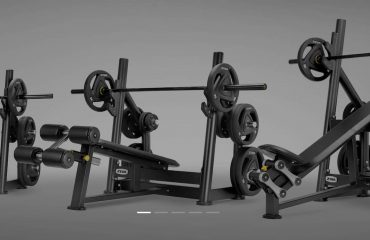
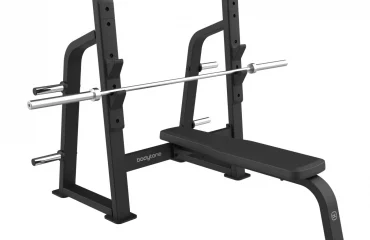
Decline Bench Press: Technique and Bench Setup
Le développé décliné sollicite préférentiellement le faisceau abdominal du grand pectoral, avec une contribution du triceps et du deltoide antérieur. L'inclinaison négative réduit la course et l'implication de l'épaule. Il complète le développé couché et le développé incliné dans un plan de travail complet.
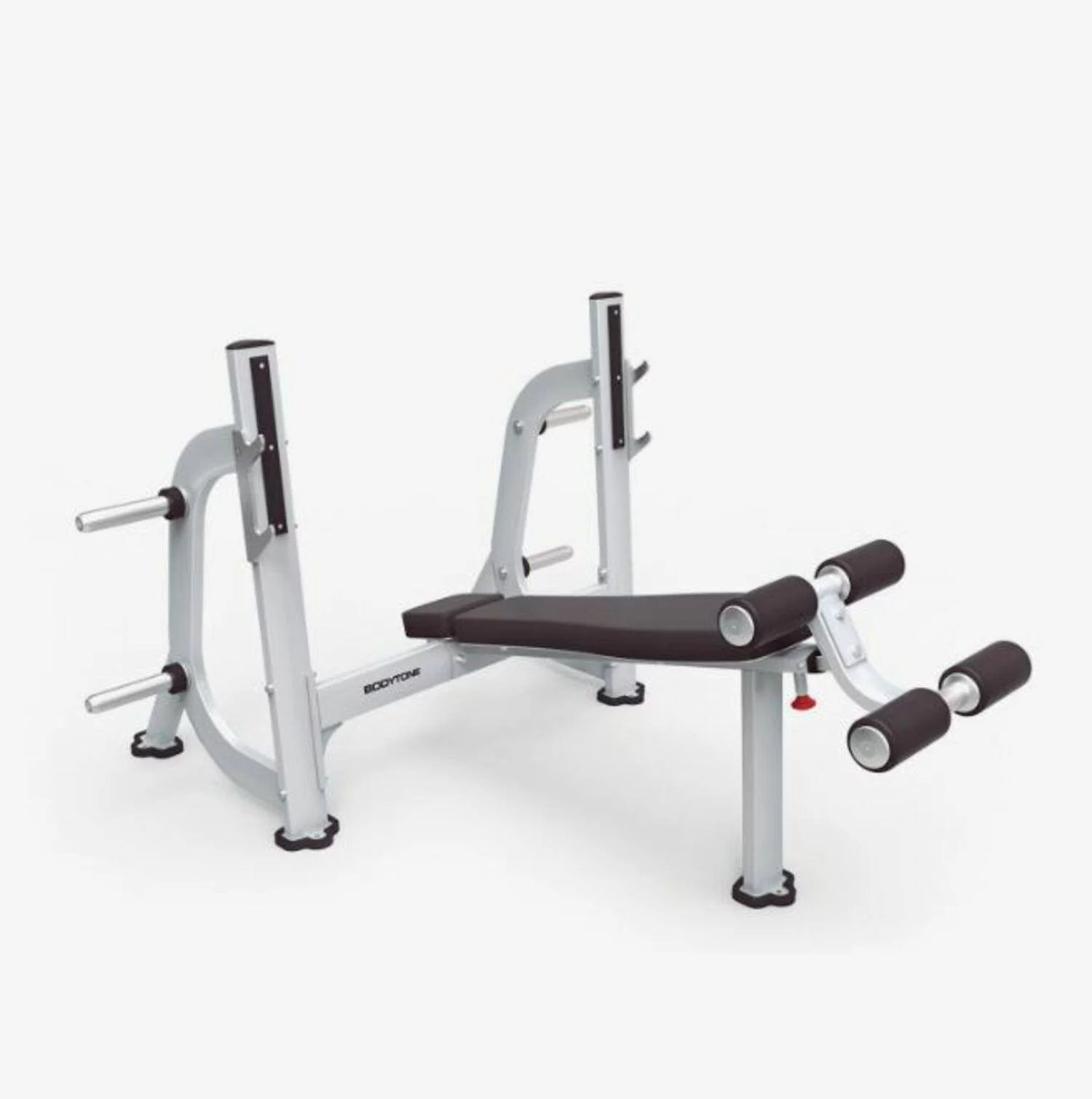
The decline bench press loads the lower fibres of the pectoralis major first, with the triceps and the anterior deltoid assisting. The negative angle shortens the pressing path and takes load off the shoulder, which is why it belongs alongside the flat and the incline press in a complete chest programme.
Muscles involved in the movement
- Pectoralis major
- Triceps
- Anterior deltoid
Start position
- Lie down on a bench set to a negative incline.
- Grip the bar slightly wider than shoulder width.
- Lift the bar off the supports, keeping the shoulder blades pressed tightly together.
Performing the movement
- Holding that start position, breathe in and lower the bar slowly towards the lower chest.
- Hold the bar for a fraction of a second, then begin to press, breathing out through the final phase.
- As the arms extend, avoid hyperextending the elbows, squeeze the chest, then start the next descent.
- Complete the planned number of repetitions.
Coaching points worth posting on the floor
- Lower the bar about twice as slowly as you press it.
- Keep constant tension on the muscle for the whole set.
- Do not let the wrists bend back too far.
- Protect the elbow joint and never lock out hard under a heavy bar.
- Breathe deliberately and stay focused on the bar path.
- On heavy sets, always work with a spotter.
Choosing a decline bench for a commercial floor
Decline pressing is the movement members most often set up badly, so the bench matters as much as the cue. On a supervised commercial floor, a fixed decline frame with integrated uprights is usually a better answer than an adjustable bench pushed to its lowest setting: the rack height stays repeatable and the lift-off is safer for a member training without a partner. Indoor equipment for professional use falls under EN ISO 20957-1 class S, and that is the class to specify for a club, a hotel gym, a corporate facility or a municipal centre.
Two practical criteria decide the rest. First the leg rollers, which carry the whole body once the torso is inclined downwards: padding quality and adjustment range are what members actually feel. Second the free space behind the uprights, which determines whether a spotter can stand there at all. The Bodytone EB06 Olympic decline bench press and the Etenon PTT02 Olympic decline bench are both built around that layout, and the wider selection sits in our professional weight benches range.
Frequently asked questions
Does the decline press replace the flat bench press?
No. It complements it. The flat press covers the whole pectoral, the incline press emphasises the upper fibres, and the decline press emphasises the lower ones while reducing shoulder involvement. A complete plan uses all three angles.
Is it suitable for members with shoulder discomfort?
The shorter range of motion and the reduced anterior deltoid contribution often make it more comfortable than flat or incline pressing, but that is a decision for the coach or the practitioner following the member, not a general rule.
Should a club buy a dedicated decline bench or a multi-position bench?
It depends on traffic. A dedicated Olympic decline station makes sense where the free-weight area is busy and the movement is programmed regularly. A multi-position bench used with dumbbells is the more space-efficient answer for a smaller floor.
Specifying benches for your gym
The right decline bench depends on your floor plan, your programming and the profile of your members. Send us your layout and we will come back with a bench configuration and a written quotation: request a quote.