Professional Weight Bench and Bench Press: Choosing the Right Support
La qualité d'un développé couché dépend autant du banc que de la barre : sellerie qui ne s'écrase pas, verrouillage stable sous charge et châssis sans vibration. Un banc standard convient au travail d'entretien ; un banc de compétition, plus large et plus rigide, s'impose dès que les charges augmentent. Les supports de barre et les barres de sécurité complètent le poste.
The bench press is the reference movement for building upper body strength, and the quality of the lift depends as much on the bench as on the bar. Upholstery that does not compress, a locking mechanism that stays stable under load and a frame that does not vibrate are what turn a bench into a safe, repeatable training station. Whether you are equipping a club, a hotel gym or a new studio, the choice between a general purpose bench and a professional one changes what your members can actually do.
Why the support decides the lift
The difference between a professional bench and a general purpose one is support and stability. To press heavy, the body has to be anchored. A bench that flexes, or that is too narrow, prevents effective scapular retraction, which caps the force the lifter can produce and increases shoulder injury risk. That is a mechanical problem, not a matter of preference: the bench either transmits the drive from the floor through the torso to the bar, or it absorbs it.
Indoor equipment in a commercial facility falls under EN ISO 20957-1 class S, the class written for supervised professional use. State it in your specification and ask for the declaration on the exact model. Class I is a professional class covering inclusive access, not a tier above class S.
Choosing the bench format
- Flat bench: the reference for heavy pressing, thanks to unmatched stability and the simplest possible load path.
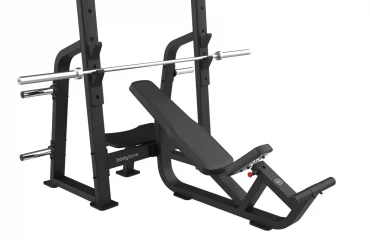
- Incline and decline bench: essential for varying the angle and working every portion of the chest and shoulders. Judge it on how positively the back pad locks, because that joint is where cheap benches fail.
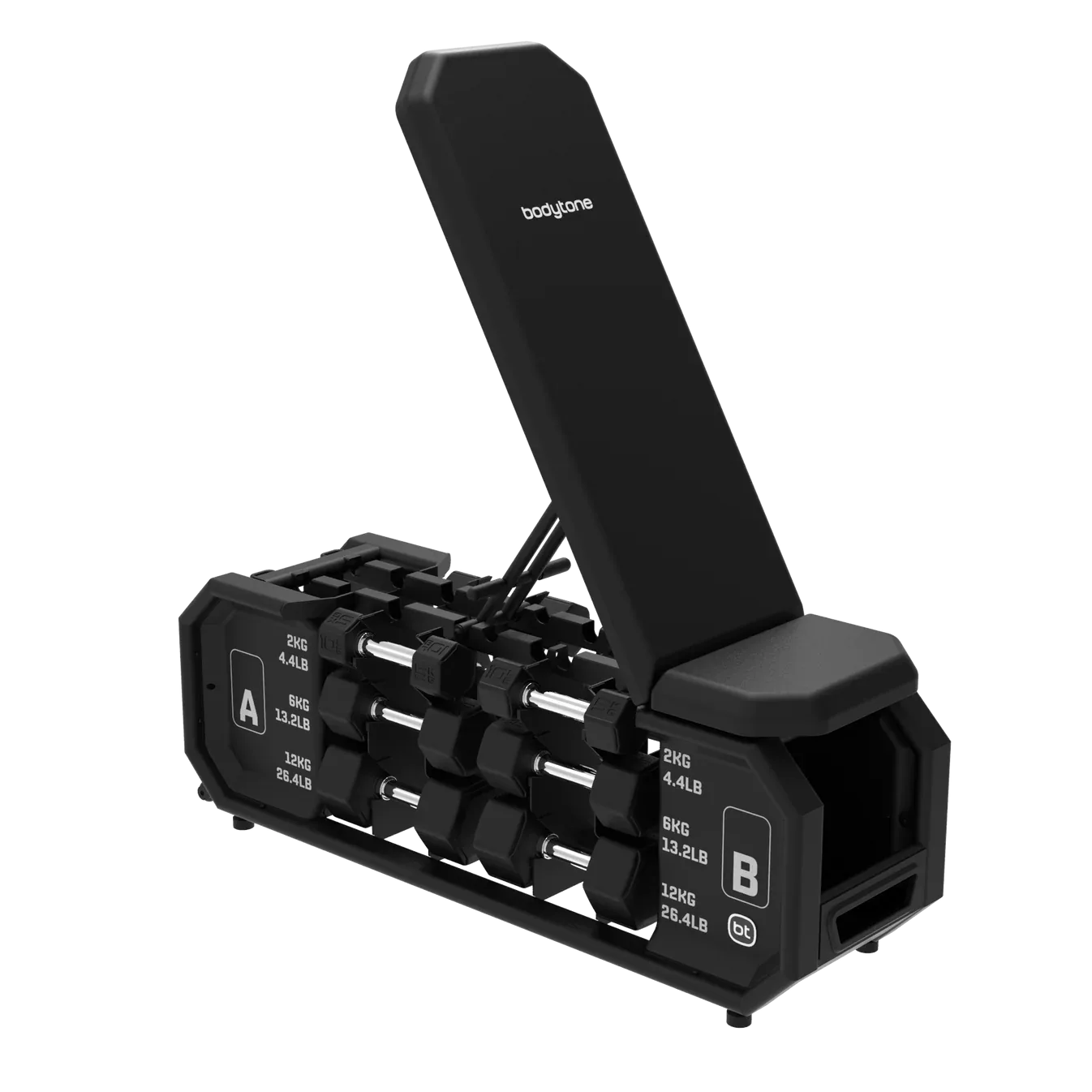
- Folding bench: a workable answer where floor area is tight, provided the folding mechanism does not cost you rigidity or safety.
A standard bench is well suited to maintenance work and general training. As soon as loads climb, a competition style bench, wider and stiffer, becomes the right specification. Compare formats across the range of professional weight benches.
What professional construction actually means
Three things carry the load. The steel: reinforced sections and a wide footprint stop the bench from rocking or tipping when a lifter drives through the feet. The upholstery: high density foam that does not sink under heavy loads, because a pad that compresses turns a stable base into a soft one halfway through the set. The covering: a genuinely non-slip surface keeps the back gripped to the pad during the hardest reps rather than letting the lifter slide out of position.
| Criterion | General purpose bench | Professional bench |
|---|---|---|
| Load capacity | Often limited | Rated for professional use |
| Foam quality | Compresses quickly | High density foam that keeps its shape |
| Safety | Risk of tipping | Wide footprint and heavy gauge steel |
| Ergonomics | Basic | Designed around the bench press position |
Completing the station
A bench on its own is only part of a pressing station. Bar supports and safety bars are what make heavy work possible without a spotter permanently attached to the equipment, and they belong in the specification from the start. Add a robust rack or power cage to secure the bar, and professional dumbbells for the isolation work that surrounds the main lift. Resistance bands are a low cost way to alter the strength curve on the press.
Frequently asked questions
Flat bench or adjustable bench?
A flat bench is the more stable platform and the better choice for heavy pressing. An adjustable bench covers more exercises. Most commercial floors need both, in a ratio that follows how the room is actually programmed rather than a fixed rule.
How do I judge upholstery quality before buying?
Press hard into the pad with the heel of your hand and watch whether it bottoms out. High density foam resists and recovers. If the pad sinks under hand pressure, it will sink further under a loaded lifter, and it will keep sinking as it ages.
Which standard applies to a bench in a commercial gym?
EN ISO 20957-1 class S covers indoor equipment intended for supervised professional use. Ask for documentation on the specific model rather than on the product family.
Are safety bars really necessary?
On any bench where members press near their maximum without a spotter, yes. Safety bars set at the right height are the difference between a failed rep and an incident, and they cost far less than the consequences of not having them.
Specifying your pressing area
Tell us how many pressing stations you need, the load range you expect and the footprint available, and we will propose a bench and rack combination that fits. Browse the wider range of professional strength training machines or request a quote and we will cost the station as a whole.