Smith Machine for Commercial Gyms: The Complete Buyer Guide
La Smith machine guide la barre sur des rails verticaux ou légèrement inclinés, avec des crans de sécurité sur toute la course. Elle permet un travail en charge sans pareur, ce qui la rend adaptée aux salles en accès libre. Elle décharge en contrepartie les stabilisateurs, que la barre libre sollicite.
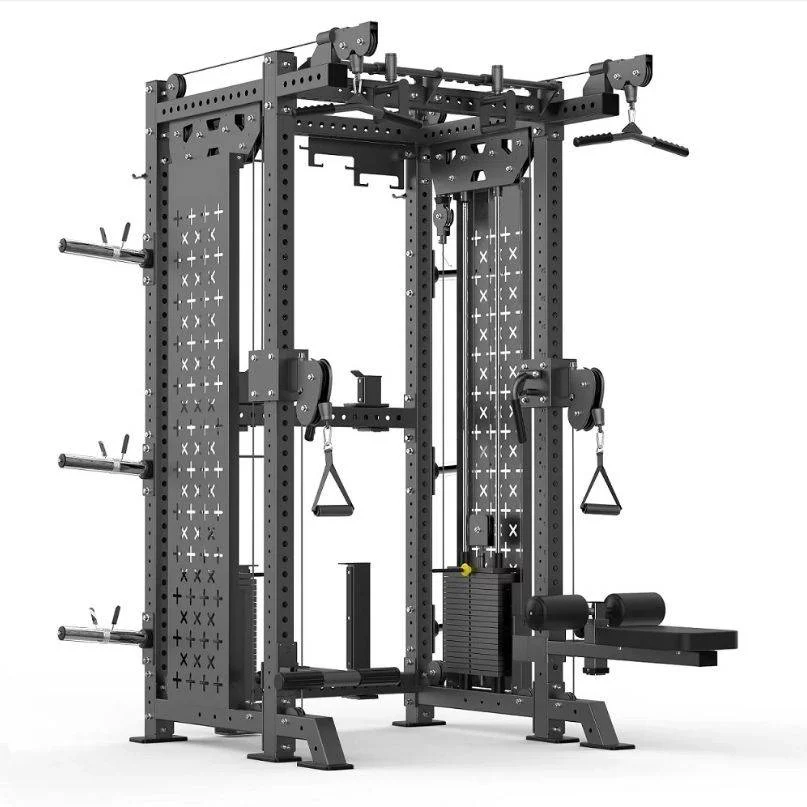
The Smith machine, also called a guided or gantry barbell rack, is one of the few pieces of strength equipment that earns its floor space in almost every kind of commercial facility. It guides an Olympic bar along fixed vertical or slightly inclined rails and offers catch positions along the whole travel, so a member can load heavy without a spotter. For a gym operator running staffed and unstaffed hours, that single characteristic changes the risk profile of the free weight area.
What a Smith machine actually does
The bar is captive. It cannot drift forward, backward or sideways, and it can be locked at any height with a short rotation of the wrists. That makes the movement highly repeatable and lets a user work close to failure alone. The trade-off is real and worth explaining to your members: because the machine controls the bar path, the stabiliser muscles that a free barbell recruits are largely taken out of the equation. A Smith machine complements a rack, it does not replace one.
In a professional setting this matters for programming. Guided work suits hypertrophy blocks, high-repetition sets, tempo work and any protocol where a member trains without supervision. Free barbell work stays in the rack area for technique and transfer.
Which muscle groups it covers
The frame supports work standing, seated and lying, which is why a single unit can cover most of a member’s session. On a guided bar your members can perform:
- squats, front squats and split squats
- bench and incline press, paired with a bench
- overhead and shoulder press
- rack pulls, shrugs and calf raises
- bent-over rows and inverted rows under the bar
Lower body work is the most common use. The guided path lets a member load the legs without the joint stress of correcting a wobbling bar, which is why physiotherapy units and rehabilitation centres specify guided racks so often. Upper body pressing and pulling then extend the same footprint to the back, chest and arms.
Specifying a Smith machine for a commercial site
Three questions decide the model.
Who uses it, and supervised or not? A club with free access at 6am needs deep, positive catch hooks and clear travel markings far more than it needs an exotic pulley option. A supervised studio can prioritise versatility instead.
How much floor and ceiling do you have? Guided racks are tall. Ceiling height is the constraint that eliminates models fastest, especially in converted retail units, hotel basements and school sports halls. Measure before you shortlist.
Do you want the frame to do more than one job? Combined units add a dual pulley station, a half cage or a 3D bar that moves horizontally as well as vertically. A single combined frame can replace two or three separate stations in a compact hotel or residential gym.
Whatever the configuration, specify equipment built and tested for continuous unsupervised use. Indoor strength equipment for public and commercial facilities falls under EN ISO 20957-1 class S. Ask for the declaration before you sign the order, not after installation.
Installation, flooring and clearance
A guided rack transmits load into a small footprint and takes repeated impact from racked bars. Put it on a floor that can absorb that: bonded rubber tiling under the frame at minimum, thicker in the loading zone. Leave circulation space on both sides for plate loading, and keep the mirrored wall far enough back that a bar can be racked safely at the top position.
Fixing to the floor or to a wall depends on the frame and on the building. Free-standing units in leased premises are usually preferred; bolted-down frames are the norm in high-traffic municipal facilities. Confirm the manufacturer’s requirement rather than improvising on site, because an unbolted frame that was designed to be anchored is a genuine hazard.
Frequently asked questions
Is a Smith machine safe to use alone?
That is precisely what it is designed for. The catch hooks along the rails let a user abandon a repetition at any point in the range. It is the standard answer for facilities that operate unstaffed hours.
Does it replace a squat rack?
No. It sits alongside one. The guided bar removes the stabilising demand that makes free barbell work valuable, so a serious strength area needs both.
Is it suitable after an injury?
Guided loading is widely used in rehabilitation because the movement path is controlled and the load can be released instantly. Movements should be slow and deliberate, with no jerking, whatever the muscle group being trained.
How much space does one need?
Footprint varies by model and by whether a pulley station or half cage is integrated. Ceiling height is usually the binding constraint, so send us your ceiling clearance with your enquiry.
Choosing the right frame for your facility
Our full range of professional Smith machines covers compact single frames through to combined 3D units, and sits alongside our squat racks and power racks for facilities building a complete free weight area. Combined models such as the Bodytone SR10P 3D Smith machine squat rack are a common answer where floor space is limited.
Tell us the room dimensions, the ceiling height, the expected traffic and the type of facility, and we will come back with a configuration and a costed proposal. Request a quote and our team will size the equipment around your site rather than around a catalogue page.